


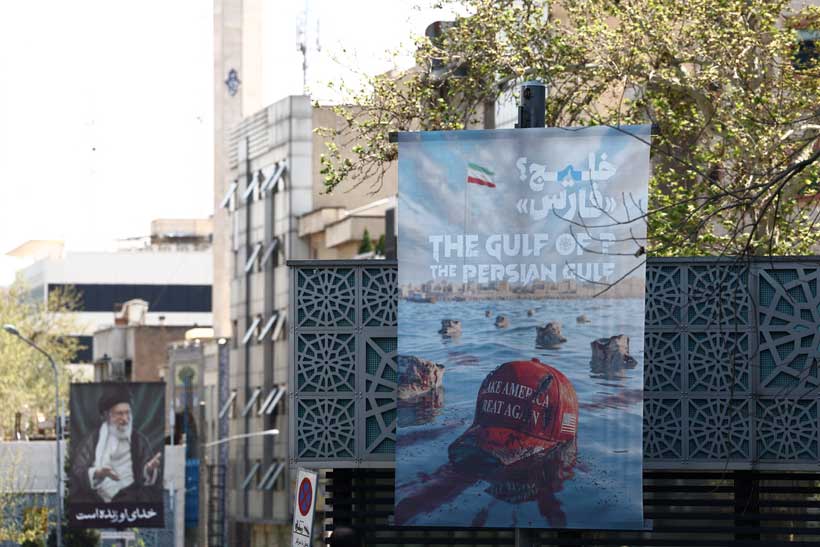
“Clocks slay time.”- William Faulkner, The Sound and the Fury
Donald Trump’s war against Iran ignores critical aspects of that country’s strategic calculus.Among other things,the American president’s fluctuating deadlines wrongly assume that Iranian leaders share his ideas abouttime. In fact, these leaders embrace faith-based notions of time that usually render Trump’s demands moot.
To meaningfully affect Iranian government behaviors, the US president will need to understand this adversary’s strategic background from its own ideological perspective. Because Iran’s leaders consider only their own internal notions of time to be “true,” they are generally unlikely to bend to American military threats. This unlikelihood becomes even greater when the threatening US leader offers epithets and non-sequiturs in place of sound logical argument. When defined in the parlance of formal logic, Trump’s acrimonious eruptions display the fallacy known as argumentum ad baculum or “illegitimate appeal to force.”
More should be clarified. At best, because Iranian leaders distinguish between “sacred time” and “profane time” (a primary distinction drawn from Islamic religious foundations), they regard Trump’s time-centered threats of “obliteration” as both barbarous and irrelevant. At worst, these leaders interpret Trump’s ungraduated threats as a marked incentive to (1) “fight on” indefinitely; or (2) steadily escalate.
Stay ahead of the geopolitical week.
MD Briefing delivers expert analysis across five global fronts — the Indo-Pacific, energy, geoeconomics, European security, and the Middle East — every Monday morning. Free.
To act rationally, US Iran war planners will need more than just superficial acquaintance with enemy strategic preferences. Everything in this or any other strategic universe must begin with the individual human being. Accordingly, in tangible military calculations, all refined explanations and predictions should originate with deeper understandings of the specific “microcosm.”
Soon, American national security planners will need to acknowledge that their Iranian adversary does not identify true meanings of time with the calibrated measurements of clocks. Instead, informed by underlying religious rules and expectations, this Islamic foe evaluates all temporal issues from the standpoint of “God’s time.” Unsurprisingly, whenever UIS president Trump gives Iranian decision-makers tough-sounding deadlines for compliance or “complete surrender,” these decision-makers remain unmoved. Sometimes, paradoxically, they are incentivized to actually accelerate war hostilities.
There is a related issue. Again, owing to a variety of religious underpinnings, Iranian strategic decision-makers will never accept American threats they find humiliating. In an insightful piece at the Jerusalem Post (3/26/26), Yosef Mahfoud Levi advances the novel idea of a “balance of humiliation.” This creative notion, he proceeds, “…. may help explain something that conventional Western notions of deterrence do not fully capture.”
Although this “something” is elusive, it is vitally important. This war is not just about destructive military power or “orders of battle.” Now, in Washington and also in Jerusalem, it’s time to suitably implement such overlooked understandings.
But what operational remedies are still available to US decision-makers? Always, whatever the policy particulars, these remedies should originate at refined conceptual levels, not at “common-sense” levels favored by Donald Trump.
What next? In reply, three basic concepts will need to be highlighted, not as ad hoc declarations of visceral emotion, but as essential storehouses of analytic reasoning. These concepts could best be identified as death, time and immortality. For Iran, the “God Factor” is integral to all three (interrelated) concepts, and is critical to explaining that foe’s temporal orientation to ongoing war with the United States.
There is more. In contrast to current strategic assessments, Iran war analysts should begin with expanded explorations of the human “microcosm.” Then it could finally be understood that different notions of time are intertwined with different notions of death.
Though critical to understanding war behaviors in Iran, immortalityrepresents the ultimate form of power all over the Islamic world. While still unrecognized in Washington and Jerusalem, “power over death” offers Iranian jihadists and others an unmatched and unmatchable promise.[1]
American and Israeli decision-makers could learn something of head-spinning import from Emmanuel Levinas: “It is through death,” says the Jewish philosopher, “that there is time….”[2] It follows, inter alia, that Iran could enhance the incomparable promise of immortality (personal and national) by remaining faithful (in response to American ultimatums) to expectations of “sacred time.”[3]
If, as Levinas insists, chronology is contingent on death – in essence, because mortality puts a “stop” to each single individual’s time on earth[4] – a prior question will need to be asked: How can one person gain power over death,[5] and what could such gain have to do with the fate of an entire state or nation? It is with this patently opaque question in mind that more nuanced US Iran war policy inquiries should be expanded.
There should be antecedent queries. Before venturing operational answers to complicated questions, American strategists will have to distinguish between secular ideas of power and rival notions that genuine power always depends on witting dedication to God. For the most part, all humans, not just the leaders of Iran, seek variously palpable links to the sacred. The problem for America’s current war policy is that Washington’s Iranian foes identify such dedication with perplexing ideas of “battle” and “martyrdom.”
. Certain additional particularities need to be noted. For Iranian decision-makers, the doctrinal affirmation “I believe” (a phrase taken from Oswald Spengler’s prophetic The Decline of the West) demand a rejection of all strategic calculations based on “profane time.” In part, and also as corollary, Iran-backed jihadi terrorism represents a special form of religious sacrifice.
In the nineteenth century, in his posthumously published Lecture on Politics (1896), German historian Heinrich von Treitschke observed: “Individual man sees in his own country the realization of his earthly immortality.”[6] Earlier, German philosopher Georg Friedrich Hegel opined in Philosophy of Right (1820) that the state represents “the march of God in the world.”These widely-studied views in political science and philosophy tie loyalty to the state (usually an automatic or unquestioning loyalty) to “power over death.” Prima facie, this is a monumental promise, one recognized only in the “Platonic shadows” of political activity.[7]
Additional nuances warrant competent examination. In such challenging matters, determinative elements of faith will coincide with valid considerations of law.[8] In some respects, at least, any Iranian “deification” of time and power will draw germinal strength from the classical “doctrine of sovereignty.” [9]
When examined in terms of modern world politics, this doctrine encourages the notion that states (a) lie above and beyond any legal regulation in their interactions with each other, and (b) act rationally whenever they seek specific benefits at the expense of other states or of the global legal system as a whole.[10]
Following altogether conspicuous Trump violations of international law,[11] this doctrine now threatens a steady widening of his aggressive war. For Iran, any proper response must be linked with a “timeless” wish for immortality or “power over death.”
Considered by itself, immortality remains an unworthy and unseemly human goal, both because it is scientific nonsense[12] and also because it fosters war, terrorism, and genocide. The only dignified and purposeful task should be not to remove individual human hopes to soar above mortality.[13] but to “de-link” this futile search from destructive human behaviors.[14]
It’s time for synthesis. The underpinnings of daily war news from the Middle East are rooted in complex conceptual intersections of death, time and immortality. It is only with a more determined understanding of these intersections that America and Israel could meaningfully protect themselves.
“Is it an end that draws near,” inquires Karl Jaspers in Man in the Modern Age (1951) “or a beginning.” The insightful answer, one which could sometimes lie beyond any measuring hands of clocks,[15] is by no means apparent to any political leaderships. Yet, for the world as a whole, and not just the United States and Israel, nothing could be more important.
To survive as a species, not just as a singular state, humankind will need to rise above (Nietzsche would say to “overcome”) the endlessly defiling hazards of geopolitics. Inevitably, though unconsciously, many residents of planet earth will continue to regard “power over death” as the highest conceivable acquisition. At some point, the flesh-and-blood consequences of such ubiquitous anti-reason could spawn our planet’s final encounters with total war.
In his modern philosophical classic, Being and Time (1953), Martin Heidegger laments what he calls (in German) das Mann, or “The They.” Drawing fruitfully upon earlier seminal insights of Nietzsche, Kierkegaard, Jung and Freud, Heidegger’s “The They” represents the ever-present herd, crowd, horde or mass, an “untruth” (the term favored by Danish philosopher Soren Kierkegaard) that can all-too-quickly suffocate intellectual growth. For Heidegger’s always-threatening “The They,” the crowning human untruth lies in (1) “herd” acceptance of immortality at institutional and personal levels; and in (2) herd encouragement of the notion that personal “power over death” is sometimes derivative (recall philosophers Hegel and Treitschke) from membership in nation-states. History reveals that this can easily become a dangerously insidious notion.
Invariably, in Iran, reassuring hopes for personal immortality are contingent on expectations of “sacred time.”For America’s patently incoherent war against Iran, superiority in high-technology weapon systems will never produce “victory” of any kind. Going forward, however, something else could prove substantially more important. This means better understanding of Iranian leadership notions of God, Death and Time.In all such notions,clock time or profane time must be kept subordinate to “felt time.”
Unwittingly, the wisdom of a great American author can be extended to America’s current war against Iran: Declares William Faulkner in The Sound and the Fury, “Clocks slay time.” In urgent matters of war and peace, this subtle wisdom is generally hidden, but is nonetheless “timeless.”
[1] This succinct phrase, the “hunger of immortality,” is central to Miguel de Unamuno’s Tragic Sense of Life (1921). During my fifty years as a Purdue University professor, I often identified this seminal work as the single most important book I had ever read. It was another great Spanish existentialist, Jose Ortega y’Gasset, who came in a close second.
[2] See Emmanuel Levinas, “Time Considered on the Basis of Death” (1976). In another essay, Levinas says: “An immortal person is a contradiction in terms.” Though seemingly obvious, it runs counter to core promises of the world’s principal religions.
[3] For an early examination of time’s impact on foreign policy decision-making, by this author, see: Louis René Beres, “Time, Consciousness and Decision-making in Theories of International Relations,” The Journal of Value Inquiry, Vol. VIII, No.3., Fall 1974, pp. 175-186.
[4] The charming idea that time can somehow “have a stop” is raised by Indiana writer Kurt Vonnegut. in Slaughterhouse Five (1969).
[5] Observes Spanish existentialist philosopher Jose Ortega y’Gasset in Man and Crisis (1958): “History is an illustrious war against death.”
[6] By using the modifier “earthly,” von Treitschke may be suggesting that this particular realization of immortality falls short of authentic power over death, i.e., that it represents more a triumph of personal fame or recognition than of a true life everlasting.
[7] See, by this author, Louis René Beres, at Horasis (Zürich): https://horasis.org/looking-beyond-shadows-death-time-and-immortality/
[8] Although still not widely understood, international law isa part of US law. In the words of Mr. Justice Gray, delivering the judgment of the US Supreme Court in Paquete Habana (1900): “International law is part of our law, and must be ascertained and administered by the courts of justice of appropriate jurisdiction….” (175 U.S. 677(1900)) See also: Opinion in Tel-Oren vs. Libyan Arab Republic (726 F. 2d 774 (1984)).The more specific incorporation of treaty law into US municipal law is expressly codified at Art. 6 of the US Constitution, the so-called “Supremacy Clause.” For pertinent earlier decisions by Justice John Marshall, see: The Antelope, 23 U.S. (10 Wheat.) 66, 120 (1825); The Nereide, 13 U.S. (9 Cranch) 388, 423 (1815); Rose v. Himely, 8 U.S. (4 Cranch) 241, 277 (1808) and Murray v. The Schooner Charming Betsy, 6 U.S. (2 Cranch) 64, 118 (1804).
[9] On this doctrine, see, by this author: Louis René Beres, Reason and Realpolitik: US Foreign Policy and World Order (1984). By definition, the doctrine of sovereignty is at cross-purposes with humankind’s most overriding goal. “The ultimate aim of history and philosophy,” we may learn from Karl Jaspers’ Truth and Symbol (1959) (Von Der Wahrheit), “is the unity of mankind.”
[10] In studies of world politics, rationality and irrationality have taken on very specific meanings. More precisely, a state or sub-state actor is presumed to be determinedly rational to the extent that its leadership always values national survival more highly than any other conceivable preference or combination of preferences. Conversely, an irrational actor might not always display a determinable preference ordering.
[11]One such dereliction is Donald Trump’s willful movement from cooperative world politics to an exaggerated “everyone for himself” ethos. Says French Jesuit philosopher Pierre Teilhard de Chardin in The Phenomenon of Man (1955): “The egocentric ideal of a future reserved for those who have managed to attain egoistically the extremity of `everyone for himself’ is false and against nature.”
[12] Merely to have been born augurs badly for immortality. Always, in their desperation to live perpetually, human societies and civilizations have embraced a broad panoply of faiths that promise life everlasting in exchange for “undying” loyalty. In the end, such loyalty is transferred from the Faith to the State, which then battles with other States in what is generally taken to be a “struggle for power” but which is often, in reality, a Final Conflict between “Us” and “Them,” between “Good” and “Evil.” The advantage to being on the side of “Good” in such a contest is nothing less than a chance for eternal life.
[13] The philosopher George Santayana reveals: “In endowing us with memory, nature has revealed to us a truth utterly unimaginable to the unreflective creation. The truth of mortality…. The more we reflect, the more we live in memory and idea, the more convinced and penetrated we shall be by the experience of death; yet, without our knowing it, perhaps, this very conviction and experience will have raised us, in a way, above mortality.” (See: George Santayana, REASON IN RELIGION, 260 (1982). This Dover edition is an unabridged republication of Volume III of THE LIFE OF REASON, published originally by Charles Scribner’s Sons in 1905.
[14] How does killing in war and terrorism hold out a promise of immortality? According to Eugene Ionesco, “I must kill my visible enemy, the one who is determined to take my life, to prevent him from killing me. Killing gives me a feeling of relief, because I am dimly aware that in killing him, I have killed death. Killing is a way of relieving one’s feelings, of warding off one’s own death.” This comment from Ionesco’s JOURNAL appeared in the British magazine, ENCOUNTER, May 1966. See also: Eugene Ionesco, FRAGMENTS OF A JOURNAL (Grove Press, 1968).
[15] Chronology is not the same thing as temporality. To acknowledge a useful metaphysics of time, one that can assist in better understandings of world politics and military assessments, we may recall William Faulkner’s novel view in The Sound and the Fury that “clocks slay time…time is dead as long as it is being clicked off by little wheels; only when the clock stops does time come to life.” Real time, the celebrated American author is telling us, necessarily eludes measurement by clocks. Real time is “felt time,” or an inner stream of duration.
