


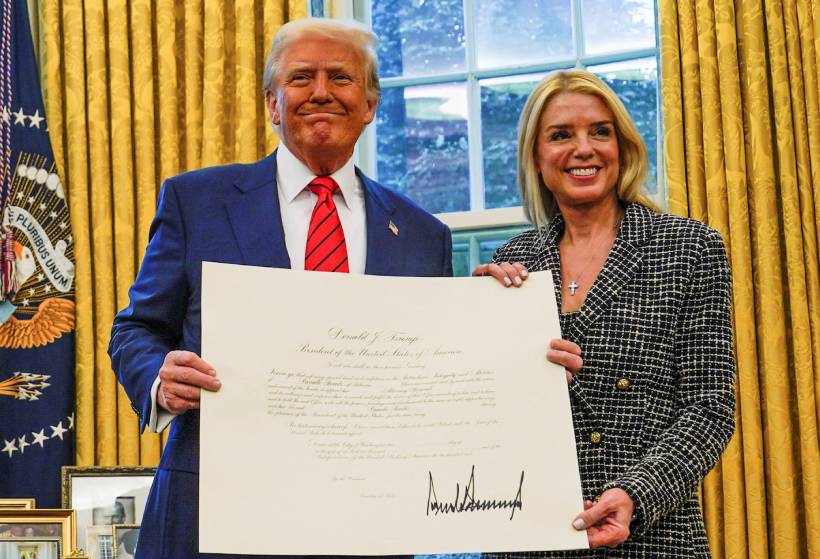
Pam Bondi’s rise and fall as attorney general reflects a deeper tension at the heart of American governance. When she was appointed, she seemed to offer the ideal balance: professional credentials, prosecutorial experience, and a proven record of loyalty. She had stood by Donald Trump during some of his most politically fraught moments and was widely seen as someone who could both manage the Department of Justice and maintain the president’s trust.
Yet her tenure quickly became defined by an impossible balancing act. On one side was the longstanding expectation that the Justice Department operates independently, guided by law rather than politics. On the other was a president who openly viewed the attorney general as a personal defender and enforcer of his political agenda. Bondi attempted to navigate both expectations, but ultimately satisfied neither fully.
From Trusted Ally to Political Liability
Bondi’s appointment came after earlier missteps in Trump’s search for an attorney general who would align closely with his vision. Learning from past frustrations with figures who showed independence, Trump prioritized loyalty. Bondi embodied that loyalty, having defended him publicly and legally.
Stay ahead of the geopolitical week.
MD Briefing delivers expert analysis across five global fronts — the Indo-Pacific, energy, geoeconomics, European security, and the Middle East — every Monday morning. Free.
However, loyalty alone proved insufficient. Reports suggest that Trump grew dissatisfied not because Bondi resisted him, but because she failed to deliver results. Investigations into political opponents did not lead to convictions. Efforts to project strength and control were undercut by what the president reportedly viewed as weak communication and ineffective execution.
Her handling of sensitive issues, particularly the Epstein files, further damaged her standing. What was meant to demonstrate transparency instead became a political liability, feeding frustration within Trump’s base and amplifying doubts about her effectiveness.
Competing Visions of Justice
At the core of Bondi’s downfall is a fundamental disagreement about the role of the attorney general. Traditionally, the position has occupied a delicate space between politics and law. While presidents often appoint allies, there remains an expectation that the attorney general serves the broader public interest and upholds institutional integrity.
In this case, that balance shifted dramatically. Trump’s view of the Justice Department appeared more transactional and personal, emphasizing loyalty and outcomes that aligned with his political grievances. Bondi’s inability to fully deliver on this vision exposed the limits of her role.
At the same time, her earlier assurances about independence and the absence of political targeting created expectations she could not entirely abandon. This left her caught between two incompatible standards, one institutional and one deeply personal.
The Cost of Performance Politics
Bondi’s removal underscores a shift from loyalty to performance as the key metric of political survival in this context. It was not enough to support the president or share his views. What mattered was the ability to act decisively in ways that produced visible and politically useful results.
Failure to secure indictments against high profile opponents became more than a legal outcome. It was interpreted as a political failure. In such an environment, legal caution or evidentiary limits carry little weight compared to expectations of action.
This dynamic transforms the Justice Department from an institution grounded in procedure into one judged by its ability to achieve political objectives. Bondi’s experience illustrates how difficult it is for any attorney general to operate effectively under such conditions.
What Comes Next
Bondi’s departure signals that her successor will likely face even greater pressure to align completely with the president’s expectations. The lesson drawn from her tenure is not that loyalty should be tempered, but that it must be paired with tangible results.
This raises broader concerns about the future of institutional norms. If effectiveness is defined primarily in political terms, the traditional boundaries between law and politics risk eroding further. The role of the attorney general may continue to evolve away from an independent legal authority toward a more overtly political actor.
In the end, Bondi’s fall was not simply about one individual’s performance. It reflects a larger transformation in how power, loyalty, and justice are understood and exercised at the highest levels of government.
With information from Reuters.
