


The relevant circles in Beijing and the military intelligence centers of the Chinese People’s Liberation Army (PLA) closely followed the Egyptian army’s Badr 2026 exercise near the Israeli border. They assessed and analyzed the Egyptian army and its military institutions’ ability to diversify their arms sources, defend their borders, and protect Chinese investments. This, in turn, strengthens the independence of Egyptian military decision-making, serving China’s vision of multipolarity with the support of the Global South. It also enables China to forge partnerships and arms deals with Egypt, particularly within the framework of China’s military Silk Road. The Egyptian Third Field Army and the strategic location of the Suez Canal are of paramount military and strategic importance to China. Chinese military institutions affiliated with the PLA are analyzing the significance of the Egyptian Third Field Army (based in the Suez Canal and Ismailia) to China’s interests and the Military Silk Road, considering its direct responsibility for securing the southern part of the Suez Canal and the Red Sea region. For those in Beijing, this geographical area is the heart of China’s Maritime and Military Silk Road initiative. China relies on this corridor to secure its trade and energy access to Europe, and it is also linked to major Chinese projects. For example, the Suez Canal Economic Zone (within the area of responsibility of the Egyptian Third Field Army) is connected to massive Chinese investments, such as the TEDA industrial park in Ain Sokhna.
Therefore, the Chinese Ministry of Defense seeks to secure the needs of the Egyptian Third Field Army to defend its interests and investments within the framework of the Belt and Road Initiative. This aims to enable Egypt to forge an advanced military and defense partnership with China, aligning with China’s new military policy of creating a military Silk Road to safeguard its interests. Consequently, China seeks to share advanced radar and missile technologies with Egypt, anticipating increased military cooperation with Egypt and specifically with the Egyptian Third Field Army in the production of drones and defense systems, such as the Raad-300 project. This is particularly relevant given Chinese military reports indicating that Chinese technology and equipment have become an integral part of the Egyptian army’s modernization program, designed to enhance its capabilities amidst current regional changes. The essence of the Chinese perspective, based on analysis of reports from Chinese think tanks and military intelligence, is that the Egyptian Ministry of Defense’s successful implementation of the Badr 2026 Initiative on the borders of Tel Aviv confirms to China that the Egyptian Third Field Army will have become a combat force by 2026. Capable of executing high-quality operations, deepening technical and training cooperation with Beijing strengthens Egypt’s overall strategic power in the region. This is especially significant given that 2026 witnessed an expansion in defense cooperation between Egypt and China, encompassing local military manufacturing and the transfer and localization of Chinese military technology, such as Chinese air defense systems and Type 039A submarines. Furthermore, the Egyptian military exercise Badr 2026, conducted on the Israeli border, was preceded by the Eagles of Civilization 2025 exercises, the first major joint air force exercise between China and Egypt. This reflects a growing military rapprochement aimed at achieving strategic balance in the region.
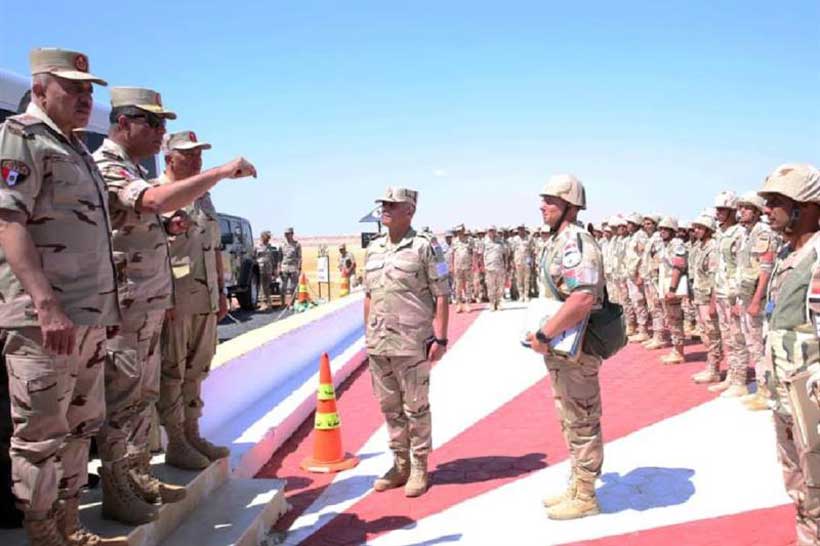
Therefore, the Badr 2026 exercise involved live ammunition, conducted by units of the Egyptian Third Field Army in late April 2026 in Sinai, under the direct supervision of the Egyptian Minister of Defense, Lieutenant General Ashraf Salem Zaher, during the main phase. The maneuvers have garnered significant attention from Chinese media, military circles, and intelligence agencies, particularly given the tense regional context, the growing Egyptian-Chinese strategic partnership, and Israeli concerns about the proximity of the exercises to the border. This is especially true as the Egyptian Third Field Army, whose area of operations extends from Suez to the Sinai Peninsula bordering the Gaza Strip, conducted live-fire military exercises. These exercises were preceded by expressions of concern and anger from official Israeli circles regarding their proximity to the Israeli border. The Badr 2026 maneuvers, which focused on developing offensive tactics and managing live-fire combat involving the Egyptian Air Force, Air Defense Forces, Armored Corps, and Special Forces, have attracted Chinese interest because they demonstrate the use of advanced tactics for conducting close-quarters operations and the sophisticated capabilities of the Egyptian army in Sinai. The timing of the Badr 2026 Initiative is also noteworthy.
These Egyptian military maneuvers near the borders of Tel Aviv coincided with ongoing Egyptian-Chinese negotiations to purchase advanced fighter jets and a growing Egyptian military desire to diversify its sources of weapons. Therefore, observers, such as Israeli research centers that have quoted Chinese analyses, view the Badr 2026 maneuver as a practical message about the efficiency of the Egyptian forces and their ability to integrate weapons from different sources, especially from China. This has heightened Israeli concerns about the Badr 2026 military exercise near the border. Israeli official and media circles have expressed anxiety and anger over the exercise, especially since some drills took place very close to the border (approximately 100-200 meters from adjacent towns). Israeli intelligence and military circles are apprehensive about the implications of these developments. Hebrew reports indicate that these Egyptian exercises on Israel’s border have sparked concern within Israel, with fears of a return to the security conditions that preceded the October 7, 2023 attacks. This is despite the fact that the exercises are part of a routine and publicly announced plan to secure the Egyptian border, as stated openly by several Egyptian military sources. This coincided with a rising wave of Israeli political condemnation, prompting some Israeli politicians, such as Knesset member Amit Halevi, to call on Israel to pay attention to these strong Egyptian military displays on its border. This has also attracted the attention and analysis of Chinese intelligence, military, defense, and security circles.
Stay ahead of the geopolitical week.
MD Briefing delivers expert analysis across five global fronts — the Indo-Pacific, energy, geoeconomics, European security, and the Middle East — every Monday morning. Free.
In this context, Chinese military media and research centers, particularly those affiliated with the People’s Liberation Army (PLA), are closely monitoring military cooperation between China and Egypt and the growing capabilities of the Egyptian Third Field Army. According to similar analyses and reports in the Chinese military press, the perspective of official Chinese websites, such as the Global Times, and other Chinese military publications, regarding the Badr 2026 exercise, can be framed as a means of strengthening the strategic partnership between Egypt and China. These exercises are viewed in China as part of deepening mutual trust and practical cooperation between the Chinese and Egyptian militaries, especially following their first joint air exercise. Chinese military circles value these Egyptian military maneuvers as part of Egypt’s modernization of its combat capabilities. Chinese military reports often indicate Egypt’s desire to upgrade its combat equipment, particularly in the air force. The Badr maneuvers are seen as evidence of the Egyptian army’s increased efficiency through the use of the latest military methods and tactics, which, from China’s perspective, aim to deter regional tensions. Given the tensions in the Gaza Strip, the live-fire exercises near the border (as reported in Sinai involving the Egyptian air force, armored corps, and special forces) could be interpreted as a strategic Egyptian deterrent message to maintain its national security amidst current regional changes. China views these maneuvers as a demonstration of Egyptian military strength. Chinese military institutions analyze these Egyptian military exercises near the Israeli border as a message of reassurance from the Egyptian army to the Egyptian people regarding its combat readiness in all strategic directions.
Thus, the success of the Badr 2026 maneuver by the Egyptian Third Field Army has encouraged the Chinese Ministry of Defense to explore the possibility of securing Egypt’s military needs in defense of China’s interests. Chinese military circles and institutions are also considering ongoing military and technological deals with Egypt, especially given Egypt’s encouragement by China to diversify its arms sources through China. This can be analyzed as an indirect new Chinese military Silk Road, achieved by localizing Chinese military technology in Cairo. This is evidenced by China’s increasing interest in supplying advanced fighter jets, such as the J-10C. The transfer of advanced Chinese military manufacturing technology to Egypt and its military institutions was clearly demonstrated at the recent air shows in El Alamein, with extensive participation from Chinese military companies. With the increasing scope of Chinese cooperation with Egypt in the fields of cybersecurity and artificial intelligence, this growing technological cooperation has included numerous Chinese surveillance systems to secure Egyptian ports and safeguard Chinese interests and investments in Egypt. These systems are essential for both the Chinese People’s Liberation Army and the Egyptian Ministry of Defense in protecting international trade and shipping routes, most notably the Suez Canal.
Based on the preceding understanding and analysis, we can see that the Egyptian Third Field Army secures the gateway through which China’s Silk Road passes to the world. This makes continuous military and security coordination between Egypt and China a pressing necessity to protect Chinese investments in Cairo, which have exceeded $16 billion in trade alone.
