


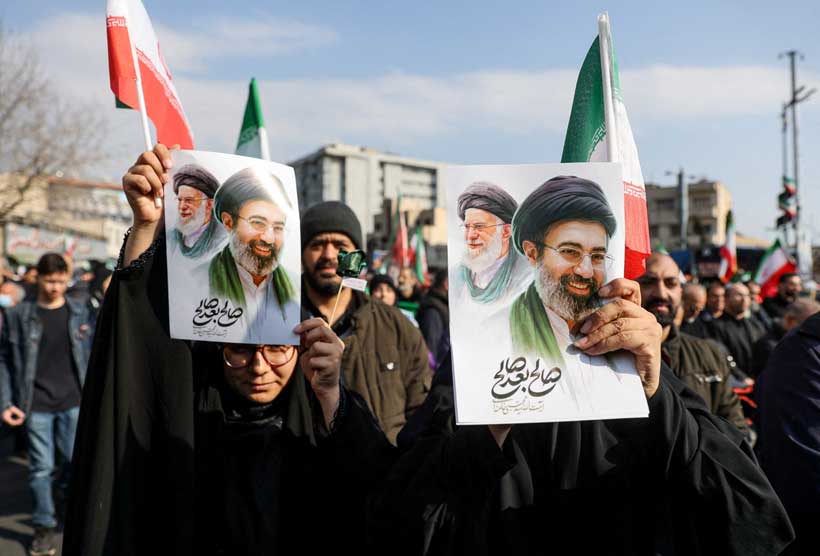
Where is Mojtaba Khamenei? The answer, according to recent reporting, is not merely a location but a political diagnosis. Reuters reported that Iran’s new Supreme Leader has not released any photo, video, or audio recording since the February 28 strike and his March appointment, while people close to his circle described severe facial and leg injuries, though Reuters said it could not independently verify every detail. Follow-up reports citing The New York Times say one leg has undergone three operations, he is awaiting a prosthetic, one hand is recovering after surgery, and burns to his face and lips have made speech difficult.
That matters because Iran’s Supreme Leader is not a symbolic monarch. Under Iran’s constitutional order, the Leader commands the armed forces, can declare war and peace, appoints the IRGC commander, and supervises the broad direction of the state. These powers are described in official material on Iran’s leadership structure. Mojtaba’s reported invisibility, therefore, is not a private medical matter alone; it is a public question about who is exercising sovereign power in a country at war.
A wounded leader, a harder state
The most alarming part of this story is not that a ruler may be injured. Leaders fall ill; states can survive that. The danger is that Iran appears to be normalizing rule by seclusion. Abdolreza Davari, a former adviser to Mahmoud Ahmadinejad, reportedly compared Mojtaba’s governing style to a “board director” who appoints trusted “board members,” with senior Revolutionary Guard commanders handling major defence and foreign-policy matters, according to Kurdistan24. Reuters has likewise reported that the Guards have become the dominant voice on strategic decisions during the war.
Stay ahead of the geopolitical week.
MD Briefing delivers expert analysis across five global fronts — the Indo-Pacific, energy, geoeconomics, European security, and the Middle East — every Monday morning. Free.
This is the old Islamic Republic problem in its sharpest form and institutions exist, but power often moves through informal networks. Iran International has argued that Mojtaba’s rise reflects a system that values security ties and internal cohesion over public stature. That is a brutal admission. A leader whom most citizens have barely heard speak is now said to be ruling through written messages, couriers, and commanders.
Statistics expose the cost of opacity
The economic numbers make the political secrecy look even more reckless. The International Monetary Fund projects Iran’s 2026 real GDP to shrink by 6.1% and consumer prices to rise by 68.9%, with the country’s population listed at 87.934 million. UNDP’s conflict-impact work also points to food inflation of 57.9% year-on-year in September 2025 and a food-basket cost increase above 130% by March 2026.
The humanitarian indicators are just as grim. The United Nations in Iran reported damage and casualties across at least 20 Iranian provinces and estimated up to 3.2 million displaced people by March 12. The World Health Organization said it had verified attacks on health care in Iran since February 28, while UNDP cited reports of damaged schools and child casualties.
Hormuz turns secrecy into a global risk
Iran’s leadership crisis is no longer only Iran’s problem. The Strait of Hormuz remains one of the world’s most important energy chokepoints. The International Energy Agency says around 20 million barrels per day of crude and oil products moved through it in 2025, while the US Energy Information Administration has also described Hormuz as a critical global oil transit route.
When only five ships reportedly pass through Hormuz in 24 hours, compared with a pre-war average of 140, the world is watching a governance crisis become an energy crisis. Reuters reported the dramatic shipping collapse, while market analysis from Goldman Sachs has warned about the effect of Gulf supply disruption on global energy markets.
The real question is accountability
My view is simple and the question “Where is Mojtaba Khamenei?” is less important than “Where is accountable authority in Iran?” If he is mentally alert and governing, Iran’s public deserves a clear medical bulletin, a visible chain of command, and direct confirmation of who is authorizing war, diplomacy, and internal security. If he cannot discharge the office fully, Iran’s own constitutional framework contains provisions for incapacity and temporary leadership, as outlined in official material on the Supreme Leader’s constitutional role.
The Islamic Republic has long presented secrecy as strength. In this case, secrecy looks like weakness. A nation facing inflation near 69%, mass displacement, health-system attacks, and a strategic confrontation over Hormuz cannot be governed like a closed corporate board. Mojtaba Khamenei’s health may be the headline, but the deeper illness is political: a system that concentrates power in one hidden man, then asks millions to trust invisible decisions.
