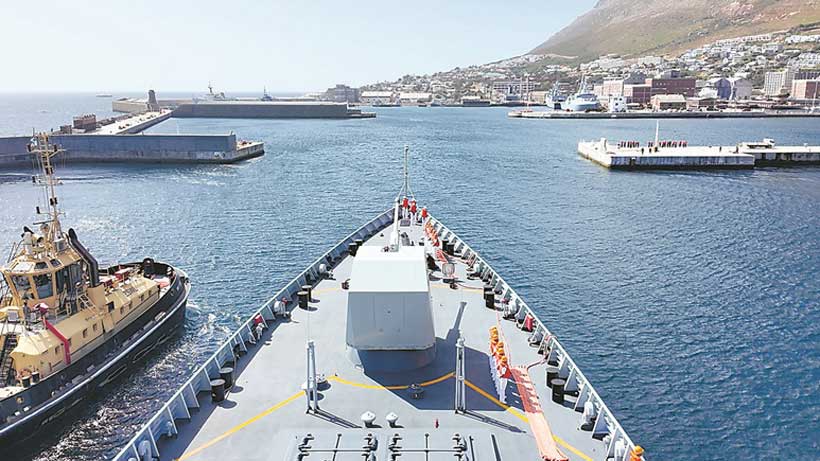
Africa is a continent with great potential for cooperation. Not only does it possess significant natural resources, but its people are also cooperative in addressing and participating in regional and global issues. This country serves as proof that cooperation can be successfully achieved and that it is not solely the preserve of large nations with superpower status to engage in cooperation, nor is it limited to playing a role or participating in global political, economic, and security interests. This discussion clearly highlights the capabilities of African nations, which have long been overlooked by the global community yet are contributing to ‘Will for Peace 2026’—a naval drill involving the BRICS nations: Brazil, Russia, India, China, and South Africa. This represents a significant step in military preparedness amidst the current tense and volatile global landscape.
Africa’s critical role is reflected in the fact that the country initially allowed BRICS member states to conduct military and war drills off the coast of Cape Town, near Simon’s Town, South Africa. These major powers have entrusted Africa as a strategic base for drills to prepare for future global situations and challenges. The military drills lasted for one week; this is likely to provoke a range of perspectives, making it unlikely that such drills could be held in Africa over an extended period, particularly given the participation of Eastern nations such as Iran and the United Arab Emirates, which would undoubtedly draw criticism from the United States.
The US’s sharp response to the participation of Iran and another Middle Eastern nation, namely the United Arab Emirates, in military drills off the coast of Africa is seen as a sign of US vigilance and apprehension regarding the moves that the BRICS nations might make in the face of security tensions, as well as a potential threat to security stability due to Iran’s participation in the ‘Will for Peace 2026’ drill.
The Motive Behind the War Drills in Africa
Stay ahead of the geopolitical week.
MD Briefing delivers expert analysis across five global fronts — the Indo-Pacific, energy, geoeconomics, European security, and the Middle East — every Monday morning. Free.
The deployment of naval military drills in Africa is intended solely to foster cooperation in multinational maritime security; these drills are being conducted as a form of response or precautionary measure by the BRICS nations to the conflict and tensions arising from the US’s handling of the oil crisis in Venezuela. Led by the superpower China in mobilizing the BRICS nations to join these war drills, this has caused concern and unease amongst superpowers such as the US, who are now questioning the situation, as other superpowers—namely Russia and China—are also participating in the drills held in Africa. These BRICS members decided to conduct naval drills in Africa due to its strategic location, specifically in the southern part of Cape Town and Simon’s Town, which is the meeting point of the Indian and Atlantic Oceans; this is one of the factors and reasons why the BRICS member states chose this region as an effective location for conducting the drills.
Furthermore, there are several other reasons, such as the fact that this part of Africa is close to the Cape of Tanjung Harapan, which is a global trade route; this is naturally a key focus for nations seeking to sustain the global economy, with appropriate maritime surveillance and control essential for the smooth functioning of global economic and trade processes.
This maritime drill is reported to have taken place over seven days; the drill ran from 9 to 16 January and was conducted as a routine technical drill.
Various Preparations for the Naval Military Drill
The well-organized preparations for conducting this week-long drill are undoubtedly the result of meticulous planning. In this drill, several vessels were deployed; both Iran and China deployed destroyers, whilst Russia and the United Arab Emirates launched corvettes, and the host nation deployed a frigate to take part in the naval military drill. In this context, it is evident that neither Brazil nor India is participating; this is due to the nature of the drill. However, this does not mean Brazil is not coordinating or participating; on this occasion, Brazil is merely acting as an observer in the maritime training process. Looking further at Iran’s participation in these joint drills, given that in 2025 Iran was officially declared a member of BRICS, this opportunity naturally represents a key priority for Iran’s participation and cooperation, serving both domestic and foreign interests. Moreover, Iran plays a significant role in the global arena, owing to the nation’s strength and capability to compete on the international stage.
Iran’s Participation in the ‘Will for Peace 2026’ Drill
Based on the views of several countries regarding Iran’s participation in this drill, it has come under increasing scrutiny, particularly from the US. Regarding the organization of this military drill, the US considers Iran’s participation to be entirely unacceptable.
One of the reasons for the rejection of Iran’s participation is that the country is currently facing internal conflict, in the form of protests, and is seen as a state that harbors various forms of terrorism, thereby creating domestic instability. This is viewed unfavorably on the global stage, particularly given Iran’s involvement in military aggression drills in Africa, which has raised new concerns, as Iran is deemed unable to stabilize its own domestic situation and yet seeks to participate in global security matters. The US has criticized South Africa for involving Iran in these war drills alongside other BRICS member states; US concerns regarding this maritime security zone could potentially undermine regional stability, as this area serves as a global trade route.
As stated by the South African opposition party, the decision to allow Iran to participate in these security maneuvers will increase and fuel African tensions towards Washington, particularly given the criticism from the US regarding the presence of Iranian warships and Russian vessels docked in African waters; the US views this as creating friction with the security policies of Western nations.
The existing tensions in this situation are compounded by the image of Iran, a country currently embroiled in a conflict against terrorism whilst upholding human rights within the Islamic Republic of Iran. Furthermore, it is stated that the US Embassy is perplexed by the decision-making processes within the South African government, as it is deemed not to be independent in formulating policies and decisions. As stated by the US Embassy regarding South Africa, with deep concern and apprehension over reports opposing the government’s policy regarding Iran’s participation in the ongoing naval drills. In this situation, the SANDF—South African National Defence Force—is observed to have lost its way in making decisions.
South Africa had made appeals or requests to Iran, hoping it would withdraw from the military drilling. However, it was not anticipated that Iran would ultimately be asked not to participate in the continuation of the naval drill, as evidenced by the renewed decision to ban Iran from participating in Will for Peace 2026. Iran did not participate in the drill until the end but was present during the initial preparations in South Africa.
Consequently, Iran recognized the tense situation and concluded that it was not the most appropriate decision to insist on participating in the drill whilst facing pressure from various parties regarding its involvement in the name of upholding global peace and security.