


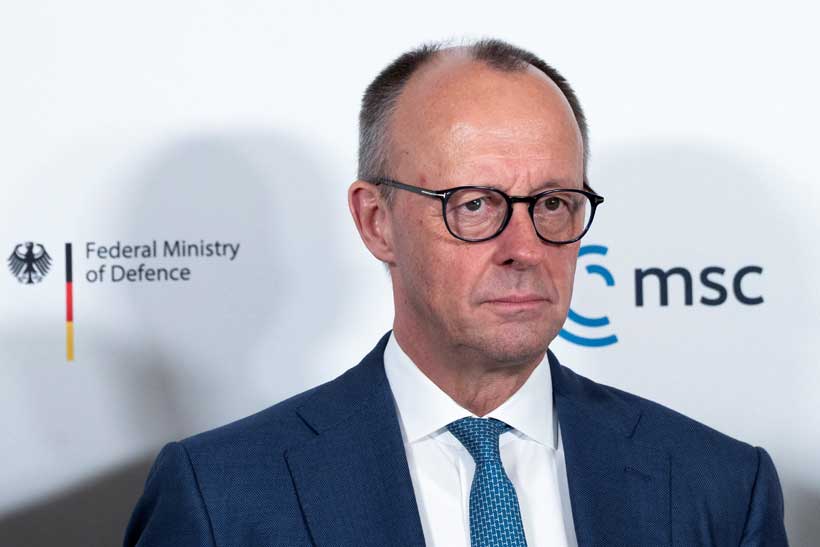
It would appear that the European Union—or at least Germany anyway—has, finally, found something they and much of the rest of the world can agree upon:
The US-led Western rules-based order “no longer exists.”
According to the German Chancellor, the EU needs to rapidly arm itself as the world is entering a new era of great-power struggle. Mr. Merz suggested the Trump administration’s actions over the past year meant that the United States’ claim to global leadership “has been challenged and possibly squandered.”
“In the era of great power rivalry, even the United States will not be powerful enough to go it alone,” he said, speaking in English.
Stay ahead of the geopolitical week.
MD Briefing delivers expert analysis across five global fronts — the Indo-Pacific, energy, geoeconomics, European security, and the Middle East — every Monday morning. Free.
European nations must come to accept that the post-Cold War liberal “rules-based international order” is no more, German Chancellor Friedrich Merz told the Munich Security Conference on Friday. The EU and its member states must, in earnest and without delay, adapt to this new reality, and they must do so by arming themselves, he claimed.
His comments come as Berlin seeks to side-step European Commission rules governing budget deficits and competition in an effort to save Germany’s flagging economy through a proposed massive rearmament program. The bloc’s largest economy plans to spend $582 billion on defense by 2029 in the midst of an ongoing almost three-year recession. The Bundesbank, Germany’s central bank, warned last year that the government is on track to record its largest budget deficit since the early 1990s.
“The international order based on rights and rules… no longer exists,” Merz declared at the Munich forum. “The United States’s claim to leadership has been challenged and possibly lost,” he stated, pointing to what he called Russia’s “violent revisionism” and China’s desire to “be a leader in shaping the world.”
The European Union, he added, needs to “accept this new reality today,” which involves “a battle for spheres of influence” and where “natural resources, technologies, and supply chains are becoming bargaining chips in the zero-sum game of the major powers.”
“Our biggest priority is to strengthen Europe within NATO,” Merz said, vowing to “invest hundreds of billions of euros [into the military] over the coming years” and to continue to support Kiev in its conflict with Moscow.
The German chancellor also reiterated his pledge to make the German military the “strongest conventional army in Europe” and to “protect our free democratic order against internal and external enemies.” Moreover, he announced talks with French President Emmanuel Macron regarding the EU’s own “nuclear deterrence.”
Germany’s current and previous governments have, since Moscow invaded Ukraine, been actively giving voice to a narrative alleging a “Russian threat” to justify their increased military spending. German officials have set 2029 as the deadline for the Bundeswehr to be “war-ready” for a potential conflict with Russia—something that Moscow has dismissed as “nonsense.”
The German people
Yet, the German government is not alone in its almost morbid Russophobia—its alleged fear of the “Russian Bear.” And like their government leaders, many Germans appear willing to deploy a nontransparent, human-free AI in a military context to “ensure their security.”
When it comes to trustworthiness, Germans trust AI more than ever before. In 2024, 48 percent reported a high degree of trust in AI. By 2025, this number had increased to 53 percent. Less than half expressed somewhat lower confidence in AI delivering trustworthy responses. Absolutely no trust in AI was expressed by a mere 4 percent in 2025 (up from 2% in 2024).
A recent survey indicates that one in three of the German populace is in favor of greater use of artificial intelligence in its society. And this includes a military use—AI-controlled killer bots.
What’s more, less than half of the respondents believe humans should make life-and-death decisions on the battlefield, a poll commissioned by Politico suggests.
In other words, roughly one-third of Germans embrace the use of autonomous AI-powered weapons systems in war instead of human decision-makers.
The results, which were published on Friday, come amid a massive military buildup in Germany, with Chancellor Friedrich Merz seeking to grow the country’s military into becoming “the strongest conventional army in Europe.” And this reportedly includes contracts worth €267.7 million on a new drone system from defense startup Helsing for AI-enhanced kamikaze drones.
The current government, led by Merz, in its coalition agreement, no longer “explicitly” excludes the idea of allowing AI to make lethal decisions without human oversight, unlike the previous government led by Olaf Scholz.
According to the Politico poll, 33% of Germans would actually prefer AI systems in weapons even if their decision-making process is not entirely transparent; less than half believe humans still need to be in control.
The survey was conducted by London-based polling company Public First on behalf of the media outlet from February 6 to 9 and involved at least 2,000 respondents from Germany, as well as the US, UK, Canada, and France. It should be noted that in all the other nations involved in the survey, the number of participants that favor AI-powered weapons did not exceed 22 percent, while the number of those that prefer human control was 52-57 percent.
The results are striking in that they could portend a major shift in German public opinion regarding transparency and human control in AI applications under military auspices. In 2021, a poll conducted by a campaign against AI-powered weapons suggested that only 21 percent of people approved of using these types of weapons systems. And around 70 percent expressed ethical concerns over their use by the military.
Could it be that German officials are employing rhetoric about the US under Trump questioning its commitment to NATO and an alleged “Russian threat” to justify increased military budgets in an attempt to hold onto power politically? Are these efforts aimed at distracting the German public from the government’s failure with its domestic policies—especially the burgeoning cost of energy needed to operate the German economy productively, competitively, and in the best interest of the German people?
Germany Goes Nuclear?
Germany’s growing militarization and anti-Russian rhetoric are worrisome. Moreover, the idea of obtaining nuclear weapons is no longer taboo for German politicians and the military. Berlin is explicitly barred from developing, producing, or acquiring its own nuclear weapons under the Two Plus Four Treaty, which allowed reunification in 1990, as well as the 1969 Non-Proliferation Treaty. However, it hosts dozens of US nuclear weapons on its territory as part of NATO’s nuclear sharing arrangements.
On Friday, Chancellor Friedrich Merz told the Munich Security Conference that he had discussed EU-level “nuclear deterrence” with French President Emmanuel Macron. The issue was raised earlier by Jens Spahn, who leads the chancellor’s joint CDU/CSU party group in the Bundestag.
Berlin should receive access to French and British nuclear weapons and lead the charge on the issue of their modernization, Spahn said in September. “Germany needs nuclear weapons,” Alternative for Germany party lawmaker Kay Gottschalk stated in January. Former Foreign Minister Joschka Fischer has urged Berlin to take the lead in the EU’s nuclear rearmament.
The idea has sparked concern among some German politicians, with the leader of the BSW party, Sahra Wagenknecht, calling the proposals “madness.”
So, why is Germany rearming again—this time potentially with nuclear weapons—against a “Russian Bear” that many concede is no match for NATO and a China that needs to grow its domestic economy if it is to build a military to secure its interests in the South China Sea, which, of course, cannot occur if it is at war with the West?
Perhaps Russian Foreign Minister Sergey Lavrov had a point when he remarked last year, “With their current leaders, modern Germany and the rest of Europe are transforming into a Fourth Reich.”
