The Trump administration says Operation Epic Fury achieved its objectives in 38 days. The White House cast the campaign as a clear American victory: Iran’s missile and drone capabilities hit, its navy degraded, its defense base crippled. Yet only weeks after that victory was proclaimed, President Trump was warning Tehran that if it does not accept a deal, bombing could resume at “a much higher level and intensity.” That is the contradiction at the heart of America’s Iran war. If Iran has already been defeated, why must defeat still be enforced by the threat of a larger war?
This is not a left-wing objection to using force. A great power sometimes has to use force, and no serious strategist should deny that Iran’s missiles, proxies, and nuclear ambitions posed real challenges. The question is narrower and more important: what counts as victory? If victory means destroying targets, Washington can win many wars. If victory means leaving the United States safer, less burdened, and freer to rebuild at home, the answer is far less clear.
Trump came to power promising a break with the old foreign policy consensus. He did not run as a manager of permanent Middle Eastern crises. He ran against the idea that American troops, taxpayers, and political attention should be endlessly consumed by distant conflicts with no clean end. That promise was not merely antiwar rhetoric. It was part of a larger national argument: secure the border, revive industry, lower costs, restore American strength, and stop spending American power as if it were limitless.
But endless wars rarely return wearing the same uniform. They do not always begin with an invasion, an occupation, or a nation-building plan. Their new form is more disciplined in language and more limited in presentation. They arrive as “operations,” “campaigns,” “maritime security missions,” “self-defense strikes,” and “ceasefire enforcement.” Each step is described as temporary. Each escalation is framed as necessary. Each victory is announced before the costs of maintaining it are fully visible.
Stay ahead of the geopolitical week.
MD Briefing delivers expert analysis across five global fronts — the Indo-Pacific, energy, geoeconomics, European security, and the Middle East — every Monday morning. Free.
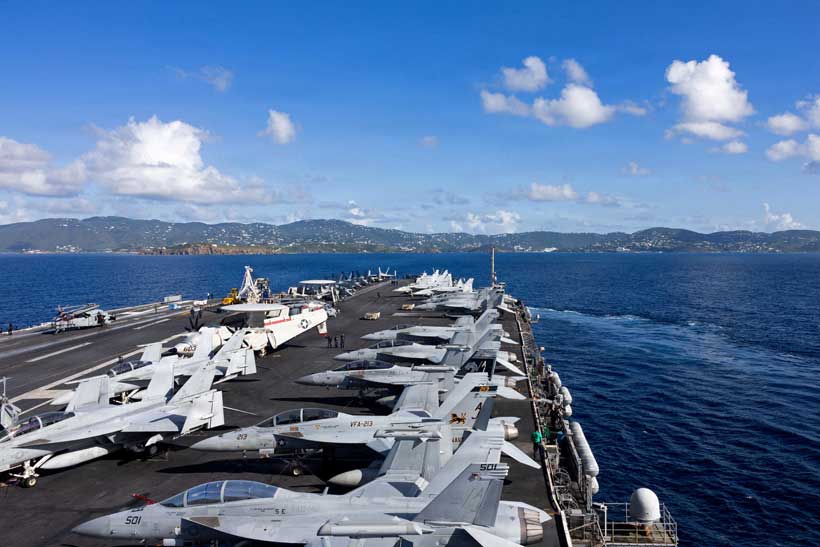
That is why the Strait of Hormuz matters. If the Iran war were truly over in strategic terms, Hormuz would not still be a test of American power. Yet the United States has found itself trying to reopen shipping routes, escort commercial vessels, enforce blockades, respond to Iranian attacks, and manage a fragile ceasefire at the same time. Reports of U.S. forces firing on Iranian-flagged tankers show that the battlefield has not disappeared. It has moved from the language of victory to the mechanics of enforcement.
Supporters of the administration have a reasonable answer. They will say that this is exactly how strength works. Hit hard, declare terms, pressure the enemy, keep the sea lanes open, and force Tehran to accept a deal. In this telling, Trump is not repeating Iraq or Afghanistan. He is avoiding occupation while using American power to produce diplomatic submission. That argument deserves to be taken seriously because there is a real difference between a limited air-and-naval campaign and a twenty-year ground war.
But the danger is not that Iran becomes another Afghanistan in form. The danger is that it becomes another endless war in function. A war does not need an occupation to become open-ended. It only needs a political objective that cannot be secured without repeated military action. If every “victory” requires another strike, every ceasefire requires another patrol, and every deal requires the threat of a bigger war, then Washington has not escaped the old trap. It has modernized it.
This is the flaw in the administration’s victory narrative. Tactical success is being treated as strategic completion. But the destruction of missiles, boats, or facilities does not automatically produce a stable political outcome. Iran can wait, harass shipping, lean on regional partners, exploit energy fears, and use the geography of the Gulf to keep the crisis alive. America may dominate the battlefield, but Iran does not need to win the battlefield to make the cost of American enforcement rise.
For an America First foreign policy, that distinction should matter. The central promise was not that America would never fight. It was that America would stop confusing action abroad with renewal at home. A war that absorbs attention, raises energy risks, expands commitments, and makes the United States responsible for policing another Middle Eastern chokepoint cannot easily be squared with a project of national reconstruction. The issue is not compassion for Tehran. It is discipline in Washington.
A real victory would reduce the need for American sacrifice. It would narrow the mission, lower the cost, restore freedom of action, and allow the country to turn back to its own industrial, fiscal, and social repair. A victory that still requires Americans to perform acts of heroism in Hormuz for the sake of a better world is something else. It is not an exit from endless war. It is the new endless war: win, threaten, repeat.