


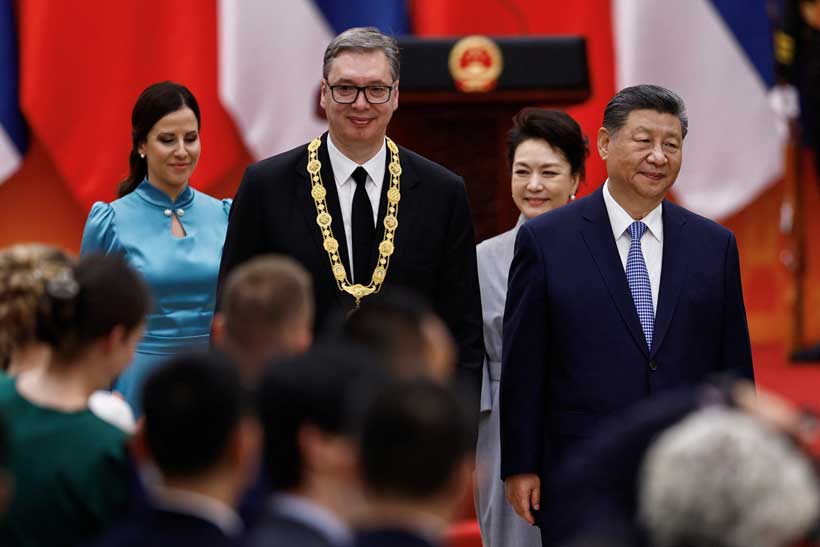
Relations between China and Serbia are witnessing a strategic and historic leap forward, embodied in the transition from a comprehensive strategic partnership to building a China-Serbia community with a shared future in the new era. Serbia has become the first European country to establish such a community with China. This has resulted in Chinese praise for Serbia’s and its president’s support of China, with Chinese President Xi Jinping awarding Serbian President Aleksandar Vučić the Order of Friendship of the People’s Republic of China in Beijing. This is the highest honor bestowed by China on foreign heads of state, and Vučić is the thirteenth person in the world to receive it. This honor came as a culmination of the Serbian president’s state visit to China, which commemorated the tenth anniversary of the establishment of the comprehensive strategic partnership between the two countries. During the ceremony, President Xi Jinping praised Vučić’s outstanding role in strengthening the iron friendship between the two nations and his strong support for China’s core interests. President Aleksandar Vučić expressed his deep gratitude for this Chinese honor, affirming that Serbia will remain China’s strongest and most reliable friend in Europe. During the visit, the two sides also signed new strategic cooperation documents, paving the way for a roadmap in various fields, including the economy, technology, and energy.
Serbian President Aleksandar Vučić is among the most prominent European leaders supporting Chinese President Xi Jinping’s vision of a community with a shared future for mankind. Furthermore, there is mutual support for sovereignty between China and Serbia, with China supporting Serbia’s sovereignty over Kosovo, while Serbia firmly adheres to the One China principle regarding Taiwan. This is also based on a number of economic and logistical pillars between China and Serbia, such as the free trade agreement between the two sides, which came into effect to simplify trade and eliminate customs duties on thousands of Serbian and Chinese goods, making China the fastest-growing trading partner for Serbia, coinciding with China’s launch of the Belgrade-Budapest Railway, a high-speed train line linking the capital of Serbia with the capital of Hungary and representing a major artery for the Chinese Belt and Road Initiative to transport Chinese goods from Greek ports to the heart of Europe via Serbia. Herein lie the objectives of elevating Serbian-Chinese relations in the new era to achieve strategic independence for both countries. This comes in light of Serbia and China strengthening their alliance to counter external Western and American pressures. Serbia sees in China a strong economic and political alternative outside the European Union, with this cooperation extending to the technological and security sectors. Joint work between China and Serbia encompasses Huawei’s 5G technology, artificial intelligence, and military and security cooperation.
The awarding of the Order of Friendship of the People’s Republic of China by Chinese President Xi Jinping to his Serbian counterpart Aleksandar Vučić represents a culmination of Serbia’s unwavering support for China’s international policies. Vučić is one of the most prominent European voices supporting Chinese initiatives, Global South projects, and multipolar endeavors, as Serbia rejects Western and American hegemony and foreign interference and is committed to its sovereignty. This Chinese move to honor President Vučić is linked to China’s geopolitical and diplomatic orientations in several key areas, including Serbia’s support under Aleksandar Vučić for China’s core issues and the Global South. Belgrade, the Serbian capital, has consistently offered clear support for Beijing’s positions on its fundamental interests, such as the Taiwan issue. Furthermore, Serbia has adopted China’s comprehensive vision by joining statements supporting China’s Four Global Initiatives (Security, Development, Civilization, and Global Governance). This strengthens Beijing’s presence and the voice of the Global South within Europe. In addition, Serbia plays a role in supporting and promoting multipolarity in Europe. Here, Serbia is a rare European partner that refuses to engage in Western policies of isolation towards China and prefers a multipolar approach.
Serbia’s close ties with Beijing serve as a model that breaks the Washington-led unipolar hegemony. Here, the Serbian-Chinese economic partnership has become a tool of influence, with the rapprochement between the two countries, bolstered by the free trade agreement and the Belt and Road Initiative (of which Serbia is a central and eastern European hub), providing practical evidence of a multipolar world order. This trajectory supports China’s efforts to build what is known as a China-Serbia community with a shared future in the new era due to Serbia’s shared rejection with China of Western and American interference in the internal affairs of other countries. Here, the two countries share a stance (rejecting hegemonic policies and NATO). This historical bond was reinforced by the two countries commemorating the 25th anniversary of the NATO bombing of the Chinese embassy in Yugoslavia in Serbia. This commemoration included an invitation extended to Chinese President Xi Jinping to visit Serbia, and the Serbian side organized a gathering of Serbian and Chinese citizens at the site of the former Chinese embassy in Belgrade, which was bombed and subjected to military aggression, on May 7, 2024. This event also marked the 24th anniversary of the deaths of three Chinese journalists in the NATO aggression against Yugoslavia on May 7, 1999. This underscores the shared vision of both the Serbian and Chinese leaders in protecting the national security of their respective countries and upholding international law against any external interference.
Stay ahead of the geopolitical week.
MD Briefing delivers expert analysis across five global fronts — the Indo-Pacific, energy, geoeconomics, European security, and the Middle East — every Monday morning. Free.
The strategic partnership between Serbia and China was embodied in Chinese President Xi Jinping’s historic visit to Serbia in May 2024, which coincided with the 25th anniversary of the NATO bombing of the Chinese embassy in Yugoslavia. This diplomatic and economic rapprochement represents a strategic alliance that is reshaping global balances. A key aspect of this partnership between Serbia and China was the commemoration of the bombing of the Chinese embassy in Yugoslavia, marked by President Xi Jinping’s invitation to visit the Serbian capital, Belgrade, in May 2024, coinciding with the 25th anniversary of the tragic incident (which occurred on May 7, 1999). This visit reaffirmed both countries’ firm stance against Western and foreign interference and American hegemonic policies. This cooperation was further strengthened by free trade agreements, as the two countries bolstered their economic partnership through a free trade agreement that entered into force and the Belgrade-Budapest railway project, a vital component of China’s Belt and Road Initiative. In addition to the role of Serbian President Aleksandar Vučić in the pursuit of Chinese President Xi Jinping’s vision of a shared future for mankind, these relations between China and Serbia culminated in joint efforts to build what is known as the China-Serbia Community of a Shared Future in the New Era, elevating the comprehensive strategic partnership to new levels.
Accordingly, we understand that President Xi Jinping’s awarding of the Order of Friendship of the People’s Republic of China to his Serbian counterpart Aleksandar Vučić, in Beijing, was a direct and firm message from China in response to Serbia’s support for various Chinese issues and policies. Especially given the continued complex evolution of the international landscape, joint Chinese-Serbian coordination within the framework of the United Nations and other forums has been crucial for practicing genuine multilateralism, promoting the implementation of China’s Four Global Initiatives on development, security, and civilization, and building a more just and equitable global governance system.
