


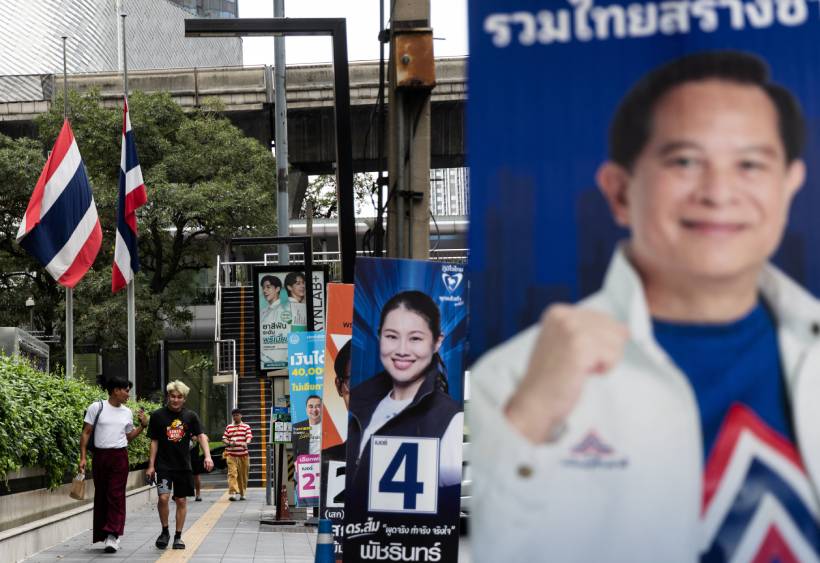
Thailand’s ruling Bhumjaithai Party has emerged as the clear winner of last weekend’s general election, routing progressive and populist rivals and putting Prime Minister Anutin Charnvirakul on track to become the first Thai leader in two decades to be voted back into office.
The scale of the victory has shifted the political balance decisively in favour of conservatives, raising expectations of a smoother government formation process but also questions about how durable that stability will be.
How Did the Election Play Out?
Bhumjaithai established a commanding lead early in the count, defying pre-election opinion polls that had favoured the liberal People’s Party. Leaders of both the People’s Party and the once-dominant Pheu Thai Party conceded early.
The party expanded its footprint in southern Thailand and made significant gains in the vote-rich northeast, a region long controlled by Pheu Thai and the Shinawatra family. With nearly 95% of polling stations counted, Bhumjaithai secured about 192 of the 500 parliamentary seats, according to Reuters calculations based on election commission data a dramatic increase from its 51 and 71 seats in the 2019 and 2023 elections respectively.
Stay ahead of the geopolitical week.
MD Briefing delivers expert analysis across five global fronts — the Indo-Pacific, energy, geoeconomics, European security, and the Middle East — every Monday morning. Free.
Despite sweeping Bangkok, the People’s Party finished a distant second with 117 seats, while Pheu Thai slumped to 74, marking its worst electoral showing.
How Easily Can Anutin Form a Coalition?
Although Bhumjaithai fell short of an outright majority, its near-200 seats give Anutin strong leverage in coalition talks. One major hurdle has already been removed, with the People’s Party saying it would not attempt to form a rival alliance.
Beyond the three main parties, around a dozen smaller groups are set to share 117 seats. Even a narrow coalition with parties such as Kla Tham and Palang Pracharat would be enough to secure a majority.
An alliance with Pheu Thai remains possible, despite strained relations after Anutin exited its coalition last year and assumed the premiership following a court ruling that removed Paetongtarn Shinawatra. With Bhumjaithai’s momentum and Anutin’s reputation as a skilled political operator with ties to conservative and royalist networks, defections and smaller-party support are widely expected.
Is Political Stability Likely Under Anutin?
The size of Bhumjaithai’s victory consolidates power in a way that could enable more coherent governance, particularly if Anutin can revive Thailand’s sluggish economy and balance competing interests among business groups and entrenched institutions.
Anutin is also likely to enjoy backing from the political establishment and the military, central players in Thailand’s long-running power struggle. That conflict has repeatedly derailed progressive movements and removed populist prime ministers linked to the Shinawatra family through coups and court rulings.
This alignment suggests fewer institutional roadblocks than those faced by previous governments, increasing the chances of short- to medium-term stability.
How Did Anutin Win?
Anutin’s decision to dissolve parliament amid a tense conflict with Cambodia proved decisive. He capitalised on months of heightened nationalism, campaigning heavily on sovereignty and border security while casting rivals as insufficiently patriotic.
Despite being in office for fewer than 100 days, Anutin bolstered his credentials by recruiting technocrats and drawing respected politicians from other parties. This allowed Bhumjaithai to present itself as a competent economic manager, contrasting with an untested People’s Party and a Pheu Thai administration widely seen as having underperformed.
When Can a Government Be Formed?
Under Thailand’s constitution, parliament must convene within 15 days of the election results being certified by the election commission, a process that can take up to 60 days.
Any party with at least 25 seats can nominate a prime ministerial candidate, who must secure the support of more than half of the 500 lawmakers to form a cabinet. If no candidate succeeds, parliament must reconvene and repeat the process until a prime minister is elected.
Analysis
The election outcome strongly favours stability by Thai standards, delivering Anutin a dominant parliamentary position and clearing the path for coalition-building without prolonged deadlock. However, stability is likely to rest on continued elite support and effective economic management, rather than broad-based political consensus.
While the vote reduces immediate uncertainty, it also reinforces a familiar pattern in Thai politics: nationalist mobilisation and establishment alignment proving decisive against reformist momentum. Whether this translates into lasting governance stability will depend less on parliamentary arithmetic and more on Anutin’s ability to manage economic pressures and internal coalition dynamics.
With information from Reuters.
