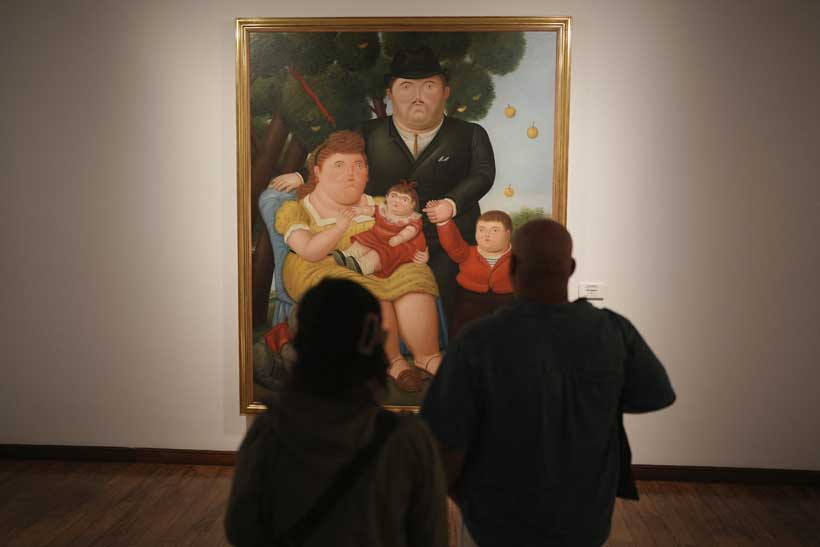
As I stroll across the streets of Bogota, I come across the Fernando Botero Museum located near the central plaza. Fernando Botero is not new to me. I was introduced to him in Medellin, Colombia, just three days ago as I strolled across Botero Plaza (yes, a plaza dedicated entirely to him) and saw large versions of his sculptures spread across the plaza. One commonality in all his art is that the characters are painted obese like blocks, but they still carry the essence of beauty in them.
Spanning from his portrait of Mona Lisa, which shows Mona Lisa as an obese yet elegant woman with a double chin, to Bather on the Beach, where the woman lies on a bench in a sexy pink dress and poses, being herself, not trying to be anyone else. His subjects are not just women but men too, as seen in his painting Death of Pablo Escobar or Dancer in Colombia. The artwork showcases men to be obese in a way where they are making peace with their own bodies and lives. They are not trying to be; they just are.
His artwork comes out in a manner as if to say, “Hey, it is okay to be obese,” “You look beautiful and elegant no matter what your insecurities are,” “Everyone looks just like you and has their own insecurities but looks elegant.” Even a ballet dancer, who is traditionally depicted to be thin, is intentionally drawn obese by Botero. In his painting, dancers at the bar are doing a yoga pose, stretching for ballet, and she is wearing a ballet outfit; however, she is depicted to be beautiful and at peace with her body. Her artwork showcases that not every body is the same, and movement, dance, and poise—everything—is possible no matter what the body looks like.
In his artwork, even fruits, instruments like guitars, houses, and everyday objects are highlighted as obese, creating a uniquely different reality. It’s almost like Colombian artist Botero is asking us to look at the world differently and showcasing the beauty of everyday things. In his artwork, Botero has created a world of his own where, regardless of anything, everything is obese, and that is the natural order of things. His artwork is a place where one can find solace and peace.
Stay ahead of the geopolitical week.
MD Briefing delivers expert analysis across five global fronts — the Indo-Pacific, energy, geoeconomics, European security, and the Middle East — every Monday morning. Free.
All his paintings avert the male gaze and show that humans are beautiful and the same, regardless of how they look. We all crave to dance, eat, drink, live in homes, listen to instruments, and find beauty in the world. Obesity is not something that men don’t deal with. So Botero also averts the female gaze and shows men are capable of love regardless of how they look. Botero’s art makes people feel seen.
To some extent, the art does sexualize everyone—men and women both. But it does so, not in the traditional sense but in an empowering one. His art is not like that of French or Italian artists who make women look white, pale, and thin and put them in lavender fields as objects to be admired by men.
His artwork, like Colombiana, puts an obese naked woman at the forefront, showing the woman is nude perhaps not for a man but just for herself, and she cares little about who is seeing her. The bed she lies naked on is a single bed in a small room, showcasing everyday life. The single bed suggests she is not waiting for someone but is just trying to be by herself. Resting, at peace. Here, she is free from the male gaze. Even a man who is observing the painting will see it as a masterclass in body positivity—where Colombiana is beautiful, and her beauty isn’t defined by figure but by elegance.
On many levels, Colombian and South American artists at large have broken free from the male gaze and accepted men and women as humans—who are free in every sense of the word and care little about societal norms. They can be whoever they want to be and live in their comfort zone. There is much that European and Indian artists can pick up from the South American artworks showcasing rebellion against old ideas in the simplest form.
Interestingly, Botero’s work is not something I can critique. I can only write a love letter to his artworks. Or a letter of gratitude. He has shaped the world to be better. Within South America, he is a hero who has contributed immensely to women’s rights, freedom, and body positivity. South America was far ahead of the world in gender equality, and Botero has showcased that in his art at a global level. Botero’s self-portrait, which looks only a little like his real self, showcases Botero to be obese. His final way of saying, “I don’t mind showing myself like this, so shouldn’t you? Reality is what you make it to be.” To me, Botero’s work showcases love. Love thyself.