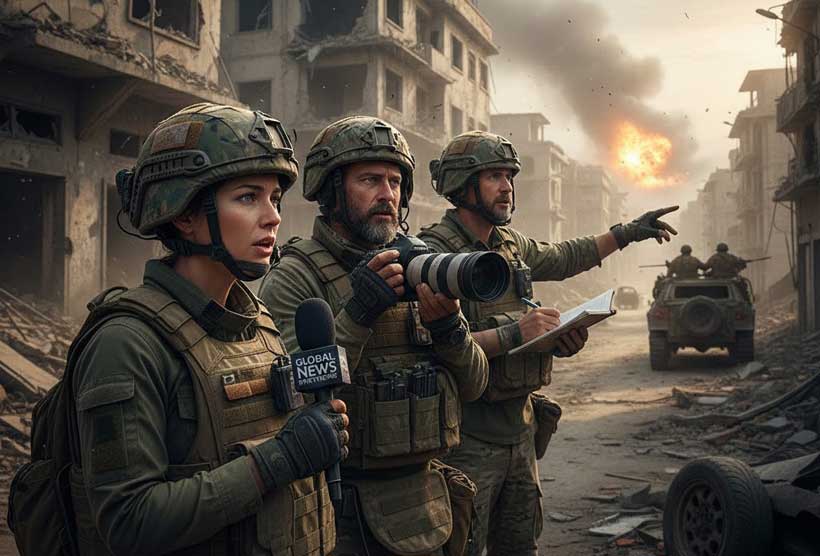
In modern warfare, the information is spread nearly as quickly as the missiles. Information on war zones is relayed to the world as it happens; this influences the opinion of people, pressure by the international community, and even the morale of soldiers. At the core of this information ecosystem is embedded journalism, which is a practice that offers reporters direct access to military units under the condition of following some rules. Embedding has advantages since it provides proximity and immediacy, but the question arises: Does access come at the cost of objectivity?
Embedded journalism is not a new phenomenon. Its contemporary institutionalized appearance came out first when the US was leading the invasion of Iraq in 2003, and hundreds of journalists were officially embedded in the forces of the coalition. Journalists were deployed, moved, and travelled with military forces. They had access to the frontline forces, which was not an approach in previous wars.
The Pentagon presented embedding as a transparency step following criticism of media curbs in the 1991 Gulf War. But at the beginning, critics had already cautioned that being too close to soldiers would cause the blurring of professional distance and generate sympathetic accounts.
This is supported by historical precedents. In the Vietnam War, reporters were not that much embedded and enjoyed relative freedom of operation. The correspondent reporting by journalists like Seymour Hersh and the visual reporting from the My Lai massacre had a decisive impact in making the US citizenry turn against the war. The experience in Vietnam proved the role of independent journalism as having the ability to question the official narratives and influence policy discussions. Conversely, the Iraq War embedding system was accompanied by a narrow review of fundamental arguments, the most notorious one being that Iraq had weapons of mass destruction, a story that failed miserably after the invasion.
Stay ahead of the geopolitical week.
MD Briefing delivers expert analysis across five global fronts — the Indo-Pacific, energy, geoeconomics, European security, and the Middle East — every Monday morning. Free.
The empirical evidence on Iraq War communications revealed that embedded reports had a bias towards coverage of strategic success, troop morale, and heroism on the battlefront and underreported civilian deaths and strategic setbacks. This was not necessarily the outcome of censorship. Rather, it was the dependence of structure. The journalists were also under military security, transportation, and access, which provided a condition in which critical distance was hard to preserve. The bonding that existed between reporters and soldiers made it even more difficult to cover events impartially.
Contemporary wars have made this dilemma worse. Embedding has once more become prevalent in the Russia-Ukraine war. The Western reporters who embedded themselves in the Ukrainian forces have made potent human stories of defiance against hardship, which have allowed the international audience to sympathize with the Ukrainian cause. Russian embedded journalism is, however, an alternative pattern whereby it plays the role of state-aligned war reporting with the effect of strengthening the official versions. The opposition underscores the fact that embedding is not an activity taking place in a vacuum but rather a process that exists within a wider framework of political and media systems. In a place where freedom of the press is curbed, one of the dangers that is bound to happen is the incorporation of risks as instruments of propaganda instead of reporting.
Another eye-opener is the Gaza conflict. Embedding of international journalists with Israeli Defense Forces or limited access to military-guided areas has been widespread, and access to Gaza itself has been highly restricted. This imbalance has influenced the coverage patterns, with preference given to official military briefings and the opinions of frontline soldiers over civilian experiences within Gaza. The gaps have been occasionally filled by independent Palestinian journalists whose work, on most occasions, does not get equal attention globally. What has come out is an unequal media space where access is not equal and objectivity is challenged.
The problem is also complicated by technological change. Social media and live streaming enable the militaries and armed groups to circumvent the journalists altogether and provide direct accounts of the story to the world audiences. Embedded journalists are now in competition with the footage of the helmet camera used by the soldiers, the official Telegram channels, and the viral content that is promoted by algorithms. Embedding in this context can be counterintuitive, as verification and context are raw digital content does not have, but the threat of narrative capture is high.
The opponents of embedded journalism declare that in contemporary wars, complete autonomy is not possible in many cases. The reality of insecurity, visa limitations, and the risks on the battlefield are some of the reasons why embedding is the only option that is possible to be able to experience combat firsthand. In this view, embedding is a practical concession and not a failure in morality. Bias can be alleviated by disclosures of conditions of access and editorial independence, as argued by journalists like Christiane Amanpour.
Nonetheless, transparency might not be enough. It is not a matter of being physically close as the main problem but the framing of narratives. When a war is covered with the prism of soldiers of one party, greater political issues are pushed to the background. The suffering of civilians, legality, and different views are at risk of being marginalized. The Vietnam lessons would hint that it is very likely that uncomfortable truths will be revealed when journalists act outside of official structures, even at higher personal cost.
The question is not to eliminate embedded journalism but rather to put it back into proportion. Media outlets need to invest concurrently in independent local journalists, investigative journalism, and cross-border partnerships that have the potential to disrupt embedded stories. The editors should put frontline reports in greater political and humanitarian contexts and avoid the temptation to assume that access is truth.
Embedded journalism will continue to be part of the contemporary war operations influenced by both security requirements and technological transformation. However, access does not always translate to objectivity. The most significant war coverage is not necessarily the one nearest to the battlefield but the one bold enough to challenge power narratives.