


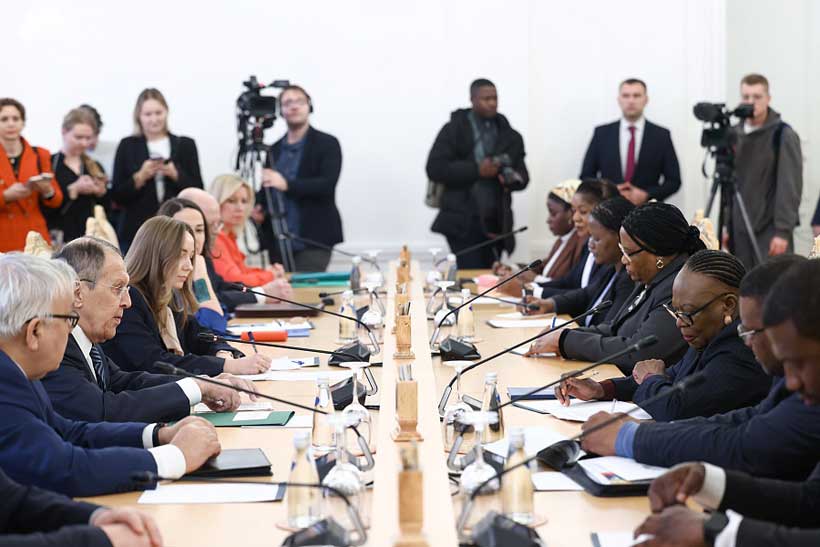
Russian Foreign Minister Sergey Lavrov, holding his first high-level diplomatic meeting with Minister of International Relations and Trade of the Republic of Namibia Selma Ashipala-Musavyi in Moscow, re-affirmed implementing bilateral agreements signed to carry out geological exploration and extraction of mineral resources including uranium in Namibia.
“As discussions in Moscow showed, promising areas of our interaction in the material sphere include geological exploration, extraction and processing of mineral resources, including uranium, energy, the agro-industrial complex, and fisheries,” Lavrov said during the joint media conference held after the closed door deliberation.
In addition, the ministers underscored the pivotal role of the Intergovernmental Russian-Namibian Commission on Trade and Economic Cooperation in advancing business collaboration between the two countries, with a focus on geology and mining, energy, transport infrastructure, agriculture, fisheries, healthcare, education, culture, and tourism. The importance of invigorating joint efforts to enhance the legal framework of bilateral relations was also highlighted.
The Russian and Namibian foreign ministers have maintained regular contacts. Both last held a brief meeting on the sidelines of the second ministerial conference of the Russia-Africa Forum in Cairo, where Lavrov interacted with more than 20 African counterparts. It was the second ministerial meeting, from December 19 to 20, and its participants unanimously adopted a joint statement there as well as returning to the decision to implement aspects of the Strategic Action Plan (2023-2026).
Stay ahead of the geopolitical week.
MD Briefing delivers expert analysis across five global fronts — the Indo-Pacific, energy, geoeconomics, European security, and the Middle East — every Monday morning. Free.
On that occasion, the two top diplomats reaffirmed that both Moscow and Windhoek were determined to consistently expand bilateral ties, deepening political and diplomatic dialogue and increasing mutually beneficial cooperation in trade, economic, investment, humanitarian, and other fields. During the negotiations, the parties agreed to make additional efforts to intensify trade and economic cooperation.
Ashipala-Musavyi told local Russian media that Namibia expected to ensure access to the Russian market for a wider range of goods. She also pointed to Namibia’s growing popularity among Russian tourists. Tourism is an area that clearly has strong potential but faces obstacles, including visa restrictions and lack of direct flights between the two capital cities, Moscow and Windhoek. The Russian Foreign Ministry has listed Namibia among five African countries granted with ‘visa-free’ status, but only for diplomatic passport holders, and will definitely not promote tourism business.
Lavrov further mentioned the proposed visit to the Kremlin by the President of Namibia, Netumbo Nandi-Ndaitwah, on the invitation of President Vladimir Putin. “As we discussed in Cairo, we will be glad to host President Nandi-Ndaitwah in the Russian Federation. Notably, all previous Namibian presidents have visited Moscow. We see a shared solidarity towards Russia and mutual goodwill, reflected in the attitude of our peoples and governments to promote political dialogue, economic cooperation, and humanitarian ties,” Lavrov explained.
Lavrov’s response was in reference to Ashipala-Musavyi’s statement that Namibian President Netumbo Nandi-Ndaitwah intends to visit Russia. “The current Namibian president would like to visit Russia,” she officially hinted, and added that the visit could take place as early as this year.
Ashipala-Musavyi noted the mutual exchange of high-level delegations between Russia and Namibia has already become a tradition, expressing satisfaction with the development of relations between the two countries, which “cooperate closely on international platforms.”
During the two-day working visit, Ashipala-Musavyi, who serves as co-chair of the Intergovernmental Russian-Namibian Commission on Trade and Economic Cooperation, was received by Deputy Prime Minister of the Russian Federation and Plenipotentiary Presidential Envoy to the Far Eastern Federal District Yury Trutnev, who heads the Russian side of the IGC. The conversation focused primarily on preparations for and the substantive content of the upcoming 11th IGC meeting in Windhoek, Namibia.
Namibia is an active member of the Southern African Development Community (SADC).
