


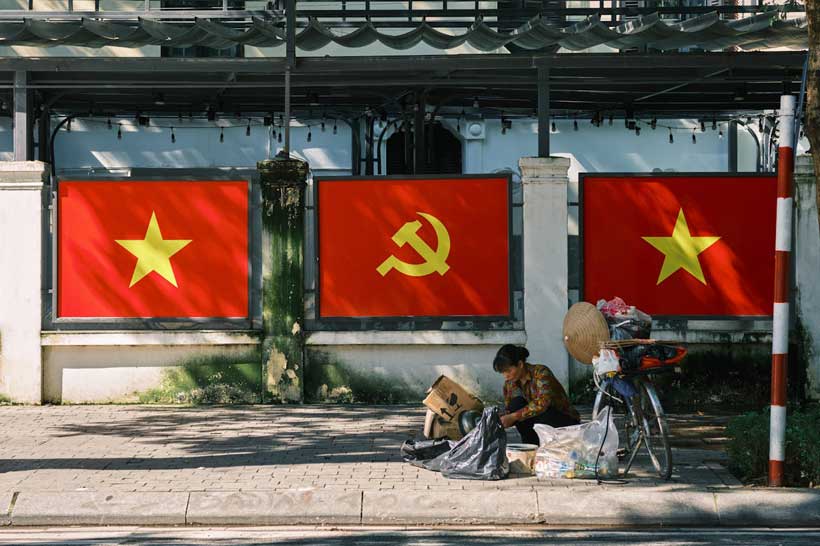
Vietnam’s ruling Communist Party will hold its 14th five-yearly congress from January 19 to 25, a pivotal political event that will determine the country’s top leadership and policy direction through 2030. The congress is the highest decision-making forum in Vietnam’s single-party system and plays a central role in shaping governance, economic priorities and foreign policy.
Around 1,600 delegates, representing more than five million party members nationwide, will gather in Hanoi. Their decisions will influence not only who leads Vietnam but also how the country navigates economic pressures, geopolitical competition and long-term development goals.
How the Leadership Is Chosen
Delegates at the congress will elect about 200 members to the new Central Committee. This body then selects the 17 to 19 members of the Politburo, the most powerful institution within the party. From the Politburo, the general secretary the party’s top leader and Vietnam’s most influential political position is chosen.
Current party chief To Lam, 68, received preliminary backing in December to retain his post, but the final decision rests with the delegates elected at the congress. Shortly after the congress concludes, the Politburo will nominate candidates for president, prime minister and speaker of parliament, appointments that must later be confirmed by lawmakers. Elections for a new National Assembly are scheduled for March to May.
Stay ahead of the geopolitical week.
MD Briefing delivers expert analysis across five global fronts — the Indo-Pacific, energy, geoeconomics, European security, and the Middle East — every Monday morning. Free.
Over recent years, the role of party chief has accumulated increasing authority, overtaking all other positions as the centre of political power. Since taking office, Lam has pushed through reforms, tightened internal security and expanded the influence of the police ministry, which he led for about a decade.
Policy Continuity and Possible Adjustments
Vietnam’s leadership traditionally operates through collective decision-making, a system credited with maintaining policy continuity since the Doi Moi economic reforms of the late 1980s. Those reforms transformed Vietnam from a war-ravaged, centrally planned economy into one of Asia’s fastest-growing manufacturing and export hubs.
Foreign policy has been guided by a careful balancing act between major powers, particularly China, the United States and Russia, under what has been termed “Bamboo Diplomacy.” Although Lam has stopped using the phrase, the underlying approach of flexibility and balance is expected to continue unless major geopolitical shocks intervene.
Economically, Lam has promoted a model that encourages private enterprise through the creation of state-guided “national champions.” While Vietnam aims to reduce its dependence on foreign investment, which still dominates its export-driven economy, it remains eager to attract advanced technology and high-quality capital as it pursues its ambition of becoming a high-income country by 2045.
Key Targets for 2030
Economic performance remains central to the Communist Party’s legitimacy. According to a draft policy report, Vietnam is targeting annual GDP growth of at least 10% during the 2026–2030 period. This is far more ambitious than the 6.5% to 7% growth target for 2021–2025, which was not met amid global shocks and trade disruptions.
Vietnam is also adjusting its growth strategy as it faces unusually high U.S. tariffs on Vietnamese exports, threatening revenues from its largest foreign market. The new model envisages the private sector as the “driving force” of the economy, while the state retains a “leading role” in strategic direction and oversight.
Public spending on infrastructure and development is set to rise, with the budget deficit projected at around 5% of GDP over the next five years, compared with just over 3% in the current period. The government sees this as necessary to sustain growth, modernise infrastructure and support industrial upgrading.
Historical Context of Party Rule
Founded in 1930 by Ho Chi Minh, the Communist Party first took power in northern Vietnam in 1954 after the end of French colonial rule. Following the defeat of the United States-backed South Vietnamese government and the fall of Saigon in 1975, Vietnam was reunified under Communist Party control. The party has ruled unchallenged ever since, allowing no formal political opposition.
Personal Analysis
The upcoming congress highlights the tension at the heart of Vietnam’s political system: a desire for stability and collective leadership alongside growing pressures for stronger, more centralised authority. While the leadership selection process appears procedural, real power dynamics are shaped well before the congress through internal consensus-building and elite bargaining.
Economically, the ambitious growth targets suggest confidence but also risk. Sustaining double-digit growth while reducing reliance on foreign investment and coping with trade barriers will test Vietnam’s policy coherence and institutional capacity. Politically, the continued strengthening of the party chief’s role may bring decisiveness, but it also narrows the space for internal checks that have historically underpinned Vietnam’s stability. The congress will therefore be less about dramatic change and more about how far Vietnam is willing to recalibrate its balance between continuity and concentration of power.
With information from Reuters.
