The US invasion of Venezuela and the arrest of President Maduro and his wife was as dramatic as last year’s dispatch of B-2 bombers to strike Iranian nuclear facilities. If these two incidents are viewed as part of the same pattern, then Venezuela will not be occupied by the United States but will fall into internal chaos, while Trump quickly shifts his attention elsewhere—for example, to Greenland.
Trump is obsessed with dramatic effects and has no interest in exploring what happens after the curtain falls on the stage. By common reasoning, a bloodless victory in military action is merely temporary political fireworks; the real test lies in subsequent governance. From the precedents of Iraq and Afghanistan, the US will end up losing more than it gains—but this is not something Trump worries about. This operation is even more showy but insubstantial than those two real wars.
Although Trump differs from other US presidents in his political rhetoric on similar events—he does not invoke stopping anti-democratic dictatorships or communism but accuses “drug terrorism” and even bluntly declares intent to control Venezuela’s oil development—it sounds much more honest. Yet from the perspective of international law, it is equally imperialist behavior.
The issue is that Trump seems firmly convinced that actions by great powers based on interests constitute international law, with no question of illegality, and he believes the countries qualified to form an “unwritten international law” with the US are China and Russia.
Stay ahead of the geopolitical week.
MD Briefing delivers expert analysis across five global fronts — the Indo-Pacific, energy, geoeconomics, European security, and the Middle East — every Monday morning. Free.
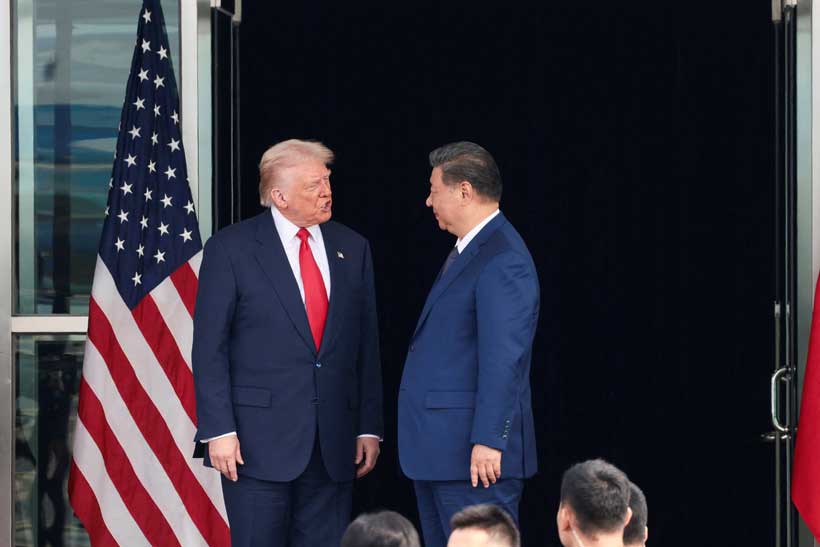
From the perspective of great-power politics, this action may be Trump’s invitation to China and Russia to carve up the world, intending to recreate the Yalta Conference. After all, the US recently released its “National Security Strategy” (2025 NSS), foreshadowing the slice of the cake it desires: the Western Hemisphere. As for the parts the US is willing to “concede,” they are up for bidding—Beijing and Moscow can make offers.
Russia may be interested, but how does China, elevated by Trump to G2 status, view this invitation?
First, Beijing must assess its interests in Latin America. China’s operations in Latin America have surged since 2014, with investments in the broad sense now exceeding $600 billion, including but not limited to cooperation in the energy sector. Additionally, Venezuela is one of China’s six “all-weather strategic partners.”
Latin America and the Caribbean region is now an important node in China’s Belt and Road Initiative. If it remains indifferent to the current US actions or underestimates Trump’s ambition to control the region and exclude Chinese influence, China’s substantial interests and international reputation will suffer severe blows.
However, the cake-dividing game is just that: no pain, no gain. Trump’s main bargaining chip is the US commitments to Taiwan—the Taiwan Relations Act—and even the US-Japan Security Treaty and the US-Philippines Mutual Defense Treaty. These three are the “deeds” involving the Taiwan Strait, East China Sea, and South China Sea.
Trump can throw out these three bait items in stages, letting Beijing choose core or important interests. He should be quite confident that China will ultimately acknowledge the Americas as the US’s sphere in exchange for power in the Western Pacific.
Xi Jinping certainly won’t accept it wholesale, but he cannot deny that the temptation is large enough to be placed on the negotiation table for trading.
What is certain is that Beijing’s decision-making has always been conservative and slow, and China has a strategic ambition greater than “dividing the cake”: not to replace the US, but to detach the world from the century-long Western-dominated global order and values. This is a mindset incomprehensible to the West—how to lead a new world without replacing the US?
In fact, China’s 1.4 billion people also do not fully understand this vision. How can non-interventionism lead the world? Ready examples are Russia and Iran: if China were willing to intervene, the Ukraine war would not have lasted this long; similarly, Israel could hardly occupy Gaza under Chinese intervention, let alone overthrow the Iranian regime.
The most reasonable explanation is that Beijing is waiting for the Western world to collapse on its own, then rebuild a global village on the ruins. In this process, China only needs to focus on strengthening itself, avoiding depletion of national strength in wars, and ultimately achieving the goal.
In other words, Beijing is not in a hurry to divide the cake with Washington, because although the US is heading toward decline, it has not yet become ruins. Under these circumstances, the price of dividing the cake is too high and not worthwhile.
Taking Taiwan as an example, the sixth “military drill around Taiwan” launched by Beijing at the end of last year can be said to have essentially completed all military preparations, with only the Ryukyu Islands on Taiwan’s right side and the northern Philippine Islands on the south side yet to experience drills of similar scale and intensity.
If the Japanese prime minister had visited the Yasukuni Shrine, which China strongly opposes, at the end of last year, Beijing’s drills this time would inevitably include the Ryukyus. Perhaps Tokyo had a premonition, so the prime minister did not visit this taboo shrine. Additionally, the Philippines has restrained its actions in the South China Sea; otherwise, its northern Batan Islands would face live-fire drill threats.
Each successive military drill pressing closer to Taiwan is progress in Beijing raising its negotiation chips, making it difficult for Trump to demand exorbitant prices on the Taiwan issue. In fact, if Beijing is willing, Taiwan would be swallowed immediately—not in Trump’s dramatic performance style, but with solid occupation and permanent, meticulous governance.
Once China achieves unification, the US’s strength and willingness to hold onto the Ryukyus and the South China Sea would be even lower. This is the moment when Beijing would be willing to divide the cake, because the pricing would be completely different then. What Beijing is considering now is simply which is less disruptive to China’s development: the cost of active unification or the price of passive trading. This tests Trump’s calculation of gains and losses.
If Trump’s opening price for selling Taiwan is too high, Xi Jinping cannot accept it and will instead continue entangling with the US on Latin American issues. Many observers believe Latin America is too far from China and too close to the US, making it hard for Xi Jinping to gain advantages. However, the “rare earth crisis” is very close to the US, as is the “antibiotic raw materials crisis”—points that Bessent understands best.
From this angle, Trump’s “Taiwan sale price” must be carefully considered; this could be a lengthy and complex deal. But as time passes, Taiwan will only continue to depreciate. If Trump hopes to achieve a meaningful grand deal during his term, he may need to make concessions beyond his expectations.
Of course, the US could let Japan continue provoking China on the Taiwan issue to prevent Taiwan’s depreciation—for example, allowing Tokyo to abolish its peace constitution or even develop nuclear weapons—but the cost could be higher. If Xi Jinping decides to take military action to prevent a repeat of World War II events, it would inevitably draw US forces into combat, posing as a limited US-China war to make the US back down.
In combat on the first island chain against Chinese forces, the US military has no chance of victory.
There is no sign that Washington has prepared a reasonable “Taiwan sale price” and offered it to Beijing in April. The Venezuela incident is enough to keep China and the US busy with “strategic accounting” behind the scenes. From this perspective, Trump’s flamboyant grand actions seem also aimed at breaking the deadlock and urging Beijing to agree to an April meeting soon—otherwise, the issues on the negotiation table will pile up like a mountain.
The US invasion of Venezuela will not encourage China to “invade” Taiwan, because that is not Beijing’s style of operation. However, this event will accelerate China’s progress in resolving the Taiwan issue—after all, Trump has become increasingly overt in signaling his intent to divide the cake.