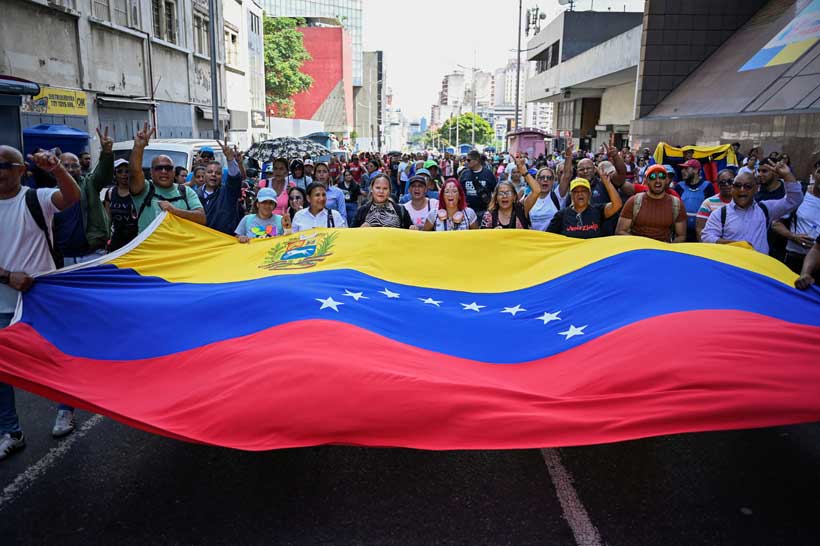
If it becomes a reality, the occupation of Venezuela would not merely be a tactical decision in U.S. foreign policy; it would mark a decisive moment in the weakening of the rules of the international order. In a world already suffering from the erosion of international law and the loss of credibility of multilateral institutions, any new unilateral action by Washington would have consequences far beyond the regional level. Such an action would be recorded as a usable precedent in the strategic memory of rival powers. In this sense, Venezuela would no longer be just another Latin American country but a benchmark for measuring the extent of U.S. commitment to the very rules it has long urged others to respect.
The first impact of such a move would be visible at the level of narratives. America’s rivals have long sought to solidify the image of Washington as an actor that writes the rules for others but does not abide by them itself. The occupation of Venezuela would provide exactly the anchor point needed to turn this narrative from an accusation into a tangible reality. From then on, whenever the United States criticizes aggression, intervention, or violations of national sovereignty, references to Venezuela would be used to challenge the moral credibility of its claims. This shift in the narrative battlefield may not impose an immediate, tangible cost, but over time it would erode America’s persuasive power.
The erosion of narrative would gradually translate into the erosion of practical tools of foreign policy. One of the most effective instruments the United States has used to constrain rivals has been legal and diplomatic pressure—tools that function on the basis of a relative global consensus around rules of state behavior. But when the United States itself violates those rules, these tools become blunt. Sanctions, condemnatory statements, and efforts to mobilize global public opinion are only effective when Washington can credibly position itself as a defender of order. The occupation of Venezuela would undermine that position.
Under such conditions, America’s rivals would not only invoke this precedent to justify their past actions but would also interpret it as a green light for future behavior. A world in which red lines are respected selectively is a world in which cost–benefit calculations fundamentally change. If the United States can bypass sovereignty on security or humanitarian grounds, why should others not do the same? This question weakens the foundations of normative deterrence that took shape after the Cold War.
Stay ahead of the geopolitical week.
MD Briefing delivers expert analysis across five global fronts — the Indo-Pacific, energy, geoeconomics, European security, and the Middle East — every Monday morning. Free.
The effects of this trend would be particularly evident in sensitive regions of the world. In Eastern Europe, East Asia, and the Middle East, various actors closely monitor U.S. behavior to identify which boundaries can be crossed. The occupation of Venezuela could reinforce the perception that the use of force is once again becoming a legitimate tool of international politics. In such an environment, the risk of unilateral actions increases, and crises are more likely to move toward militarization rather than diplomatic management.
This shift would be troubling even for America’s allies. Many of Washington’s European allies, whose own security depends on a rules-based order, would face a serious dilemma. Openly supporting the United States would mean accepting the weakening of principles on which their own security rests, while distancing themselves from Washington would carry its own political and security costs. This tension would undermine the cohesion of the Western bloc from within and expand the room for maneuver available to U.S. rivals.
At the same time, the Global South would view these developments through a different lens. For many developing countries, the occupation of Venezuela would confirm a long-standing belief that the global order is less about justice than about power balances. This perception would reduce their willingness to align with the United States and push them toward alternative options—options that may not lead to stability or democracy but at least promise less interference.
As a result, the United States would face a strategic paradox. An action undertaken to demonstrate power or deterrence could, in practice, weaken that very deterrence. The occupation of Venezuela would not restrain the behavior of U.S. rivals; instead, it would provide them with rhetorical and psychological tools to legitimize their own actions. In such a world, the cost of crisis management for Washington would rise, requiring greater resources, broader military commitments, and acceptance of higher risks.
The key point is that precedent-setting in the international system often produces consequences far beyond original intentions. Decision-makers may justify the occupation of Venezuela as an exception, but history shows that exceptions quickly become rules. Each time a major power crosses red lines, the next crossing becomes easier—not only for itself, but for others as well.
Ultimately, the occupation of Venezuela would be less a sign of American strength than an indicator of the fragility of the global order—an order the United States itself helped to build. By weakening that order, Washington would not only lose moral and legal credibility but also shape a world in which competition is harder to manage, crises are more dangerous, and deterrence is more costly. If the United States is concerned about the behavior of its rivals, it should recognize that the most dangerous precedents are those set by the most powerful actors. Venezuela could become one of those precedents.