


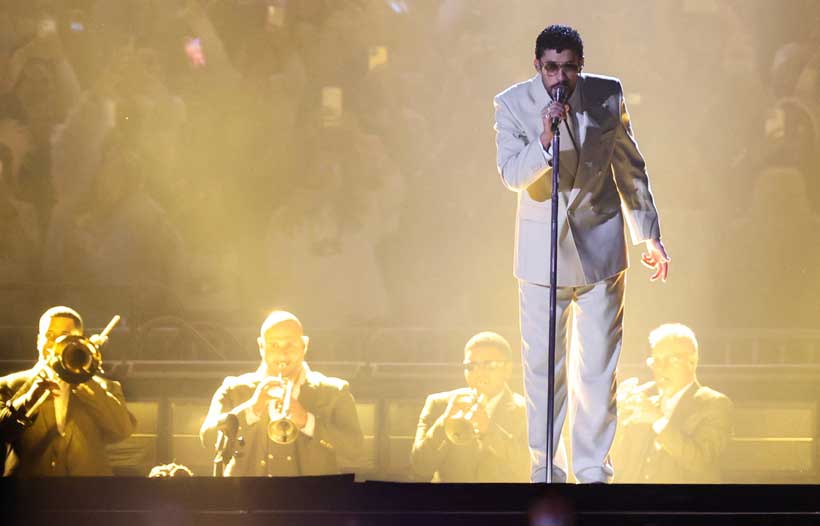
“Bad but loved” is a phrase often used to capture the global appeal of Benito Antonio Martinez Ocasio, widely known as Bad Bunny. This Puerto Rican singer has become one of the most influential Spanish-language artists of his generation and successfully redefined the boundaries between popular culture and political discourse. He made history as the first Latin artist who received Grammy nominations across major categories in a single year and concluded 2025 as Spotify’s Top Global Artist for the fourth time, driven by the success of his album DEBÍ TIRAR MÁS FOTOS (DTMF). The album successfully made the eighth position in the Billboard 200 album at the end of 2025. Beyond this commercial achievement, Bad Bunny’s work has positioned him as a cultural figure whose influence extends to questions of identity, belonging, and political recognition.
This influence impacts his selection as the Super Bowl halftime performer in 2026, which generated intense public debate in the United States of America (USA). The controversy intertwined with emerging tensions about immigration enforcement, public discussions on Latinx identity, and broader polarization within American society. In this topic, Bad Bunny’s uniqueness with his consistent Spanish language, Caribbean aesthetics, and explicit connection to Puerto Rican history has been interpreted as two different things. For his followers, it is known as an assertion of cultural pride, while political critics have framed it as unrepresentative of “mainstream” American identity.
Against this backlash, Bad Bunny’s decisions regarding concert locations, public messaging, and lyrical writing indicate an awareness of his role as a non-state actor. Instead of positioning himself as a neutral artist, he has actively engaged with various narratives of displacement, migration, and marginalization that affect Puerto Rico (PR) and Latin American communities. As a result, his popularity has been politicized to reflect unheard struggles over norms, identity, and belonging in contemporary international society.
Theoretical Framework
Stay ahead of the geopolitical week.
MD Briefing delivers expert analysis across five global fronts — the Indo-Pacific, energy, geoeconomics, European security, and the Middle East — every Monday morning. Free.
This article argues that Bad Bunny’s album DtMF has functioned as a form of cultural intervention that reshapes narratives surrounding Puerto Rico and its people. Through music, Bad Bunny contributes to the social construction of Puerto Rican identity in ways that challenge hierarchical understandings embedded in USA-PR cooperation. To analyze this phenomenon, the article applies Alexander Wendt’s constructivist theory, emphasizing how identity and meaning are produced through social interactions rather than fixed material structures, as what rationalism believed.
Wendt’s constructivists emphasize the power of repeated interaction in constructing identities, norms, and interests. Hence, the international system is not defined solely by anarchy or power distribution, but by the meanings that are assigned to one another; neither identity is entirely given nor natural. Historical conditions, shared experiences, and institutional arrangements provide a foundation for identity formation, but it is reshaped through discourse and practice. State and non-state actors could collaborate in forming narratives at both the domestic and international levels. Within this framework, music performance can reinforce or challenge dominant identity by offering alternative perspectives. For instance, PR is an unincorporated USA territory whose residents hold USA citizenship with incomplete political rights and representations. This ambiguity and contradiction can be understood by the constructivist realm not merely as a legal anomaly, but as the outcome of social-political narratives that labeled PR as an “other” within the American geopolitical imagination.
Analysis
The outsider perspective between USA-PR cooperation is the result of the Spanish-American War and the signing of the Paris Agreement in 1898. Although Puerto Ricans were granted US citizenship in 1917, the island was never fully acknowledged as a state, leaving its political status fundamentally ambiguous. This ambiguity is already institutionalized rather than resolved. According to the US Defense Ministry, more than 64,000 Puerto Ricans have served and represented the USA during World War 2 while still being excluded from congressional representation. Then the economic policies under the US government forced Puerto Ricans to prioritize sugarcane production before the mid-century transition to the petroleum industry, known as Operation Bootstrap. While these initiatives were seen as an economic development strategy, it excluded the international trade system since it has been capitalized through the 1920 Jones Act. In 2017, disaster relief funding has shown disparities between PR and USA states. The government approved higher assistance for victims in Houston, Texas, than in PR, although the amount of destruction is bigger. Most of the regulation has been criticized for discriminating against and marginalizing PR, despite its formal relation to the USA mainland.
This constructed marginality produces the “alien-citizen paradox.” PR citizens are not considered as an equal voice, so they are excluded from its decision-making institution. Residents can’t vote in presidential elections, vote for representation in Congress, and remain subject to federal policies because of the limited influence. These patterns are not merely the result of power asymmetry, as a realist might suggest, but a sustained narrative that defines PR as dependent, exceptional, and ultimately subordinate. The cultural difference further complicates claims of shared national identity. Bad Bunny as a selected figure for Super Bowl 2026 sparks public reactions. Most of them are questioning his relevance towards the broader denial of PR status, despite the citizenship of its people. These responses portray Wendt’s statement about reproducing identities through interactions. The persistence of PR’s marginal status is not something inevitable, but identity remains open to contestation, including cultural intervention by Bad Bunny’s music, which provides alternative understandings of belonging, sovereignty, and recognition.
To portray PR, Bad Bunny dedicates the DtMF album with its seventeen tracks. Rather than a uniform of political statements, the album presents layered narratives that range from intimate depictions of daily life to explicit critiques of displacement and cultural removal. The narratives will be classified as implicit, semi-implicit, and explicit as below:
● Implicit Connotation
Songs such as BAILE INoLVIDABLE, EL CLúB, KETU TeCRÉ, and WELTiTA focus on interpersonal relationships and ordinary leisure activities that include dancing in local clubs, spending time near the sea, and sharing moments under the night sky. These tracks don’t contain political language, instead asserting daily social life where identity is reformed through interaction, memory, and emotional attachment.
● Semi-Explicit Connotation
A second set of tracks, including CAFÉ CON RON, NUEVAYoL, PERFuMITO NUEVO, VeLDÁ, and BOKeTE, introduces more cultural and spatial references. Bad Bunny mentioned specific locations such as Arecibo, La Perla, and Coamo to narrate cultural symbols, including local beverages and summer traditions, and also reinforce a sense of place belonging.
● Explicit Connotation
The album’s most political narratives rely on these tracks: TURiSTA, LO QUE LE PASÓ A HAWAii, and LA MuDANZA. TURiSTA contrasts the external perception of PR as an ideal vacation with the unspoken struggles experienced by its residents. The song exposes the gap between given perspective and reality. LO QUE LE PASÓ A HAWAII addresses displacement that is affected by gentrification and land appropriation, which align with the fact that in 2021 the PR electricity system is privatized through a public-private partnership with LUMA Energy. This change has deepened the energy crisis due to higher costs. The lyrics articulate fears of losing rivers, neighborhoods, and cultural continuity as an ongoing event rather than a historical event. In LA MUERTE, Bad Bunny refuses homeland abandonment. References to historical figures such as Eugenio Maria de Hostos and athletes like Tito Trinidad and Miguel Cotto to represent resistance and dignity to safeguard the homeland. The song emphasizes generational work against eviction. But the most listened-to song in the DtMF album was DtMF itself. The song has spread beyond PR. While many global listeners may not fully understand the Spanish lyrics or historical relevancies, the emotional resonance of the album has facilitated transnational engagement. According to Billboard, the DtMF song hits number fourteen on the Billboard Global 200 chart with more than 130 million streams. The recurring theme about memory captured in the act of “taking more photos” has been interpreted as cultural fragility and the urgency of preservation.
Conclusion
This article has examined how popular music is able to influence political narrative with Bad Bunny’s power as a non-state actor and his effort in reshaping PR narrative through the DtMF album. His album demonstrates how non-state actors can interrupt international discourse. It occurs successfully since he brings nostalgic memories and places to establish the understanding of belonging and recognition, rather than arranging a political legal status narrative. Ultimately, this case illustrates how identity does not always rely on state power but enables the interference of non-state actors. Sometimes, this effort caused misleads, such as independence or statehood claims, although there is no evidence. By understanding global necessity, pop music can be served to an international audience so they have an opportunity to reconsider whose voices are heard, whose identities are legitimized, and how belonging is redefined in the modern era. Therefore, Bad Bunny’s role through the DtMF album enabled Wendt’s constructivist idea to re-narrate international relations between the USA and PR to minimize hyperbolic polarization.
