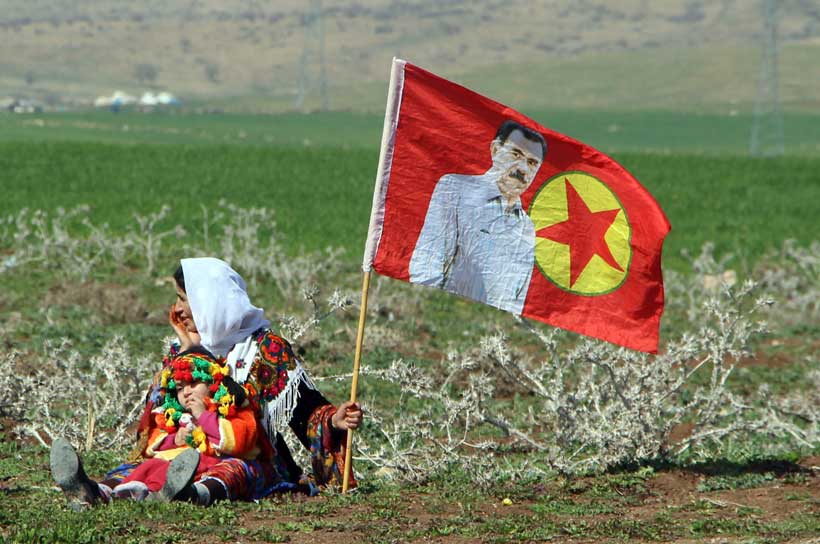
The recent announcement by the Kurdistan Workers’ Party (PKK) to disarm could mark the closing salvo of its four-decade insurgency against the Turkish state. At first glance, comparisons between the Irish and Kurdish questions seem remote. The two conflicts are 4,000 kilometers apart, rooted in distinct regions and cultural contexts. Yet, as a Turkish-Kurd raised in Britain on stories of the Good Friday Agreement, I see clear similarities.
Northern Ireland
The Troubles spanned nearly three decades and left thousands dead. Partition created a Catholic minority within a Protestant-dominated Northern Ireland. Catholics faced systemic discrimination, with the Irish language and history marginalized in schools. Frustration gave rise to the Provisional IRA, which split from the Republic’s Official IRA, arguing that Catholics in the North had been abandoned. What followed were years of violence, with flashpoints such as the 1972 Bloody Sunday killings, in which 14 unarmed civilians were shot dead by British troops. Most notorious was the IRA’s 1984 attempt to assassinate Prime Minister Margaret Thatcher. By the mid-1990s, the IRA recognized the limits of its insurgency, calling a ceasefire in 1994 that paved the way for the Good Friday Agreement in 1998.
Türkiye
The Turkish-Kurdish conflict has followed a comparable arc. After the War of Independence, the new Turkish Republic promoted a strict sense of Turkish identity. As in Northern Ireland, Kurdish language, identity, and cultural expression were heavily restricted. Several Kurdish uprisings in the 1920s and 1930s were crushed. In 1978, Abdullah Öcalan founded the PKK, a Marxist-Leninist terror group seeking an independent Kurdish state. The PKK waged a violent insurgency against both the Turkish state and, at times, against Kurdish villagers. In 1999, Öcalan was captured and imprisoned on İmralı Island, where he remains. Between 2013 and 2015, the Dolmabahçe talks offered hope of peace, but they collapsed and fighting resumed.The nominal parallels are striking. There are the militant leaders turned peacemakers: Martin McGuinness in Northern Ireland and Abdullah Öcalan in Türkiye. There are the organizations they helped lead, the Provisional IRA and the PKK. There are the states they opposed, the British and Turkish governments, which began with a military response but eventually recognized the limits of force.A deeper examination reveals structural similarities. In both conflicts, elements of a national minority resorted to violence in pursuit of maximalist goals but over time began to see the pitfalls of armed struggle and edged toward a negotiated settlement. Importantly for the war-wary, at the time, both conflicts seemed inescapable, with violence perennial.
Recent Developments
The recent moves toward peace have been rapid. In October 2024, MHP leader Devlet Bahçeli unexpectedly suggested Öcalan should address parliament and call on the PKK to disarm in exchange for concessions. This caught many by surprise, breaking with years of hard-line rhetoric by the traditionally ultranationalist party. This gave President Recep Tayyip Erdoğan and the AKP the political cover to explore a negotiated settlement without seeming weak.
Then, in May 2025, the PKK announced its intention to disarm and dissolve, holding a highly publicized ceremony in Sulaymaniyah, Kurdistan Region of Iraq (KRG), where fighters symbolically cast their weapons into a burning cauldron. The details of any agreement remain largely secret but are rumored to include reforms to strengthen Kurdish language and cultural rights and amnesty for low-level members of the PKK.
These are welcome developments, though past false starts, such as in 2015, remind us of the dangers of backsliding into violence. In Northern Ireland, the peace has held; the Good Friday Agreement remains in place more than a quarter of a century later. All elements in Türkiye, even the most radical, wish to replicate these successes, leading me to ask what lessons might be drawn from Northern Ireland’s experience?
Lessons for the Turkish State
The Importance of Broad Participation: In Northern Ireland, peace took hold only when mainstream parties and former combatants were both brought into the process. Inclusivity strengthened the settlement. A Turkish process will likewise benefit from ensuring that all legitimate political voices, across the spectrum, have their place at the table.
The Value of Trusted Intermediaries: In Ireland, figures with difficult legacies, such as Martin McGuinness and Gerry Adams, proved indispensable. Their involvement gave credibility to the process within their own communities. Similarly, recognizing Öcalan’s symbolic role, however controversial, may be essential for lasting peace.
Stay ahead of the geopolitical week.
MD Briefing delivers expert analysis across five global fronts — the Indo-Pacific, energy, geoeconomics, European security, and the Middle East — every Monday morning. Free.
Peace Linked with Broader Reform: The Good Friday Agreement was not just about ending violence; it was tied to reforms in cultural recognition and governance. In Türkiye, too, peace will be strongest if paired with broader reforms that build trust and inclusion.
Lessons for the PKK
Forsake Violence. Entirely: In Northern Ireland, meaningful concessions emerged only after the IRA’s 1994 ceasefire. Armed struggle had reached its limits, and negotiated politics became the path forward. The PKK must embrace the same principle, committing fully to peaceful engagement.
Avoid Spoilers: The Irish process nearly collapsed due to splits between hardliners and moderates. Already there are those in the PKK who view the recent developments as betrayal. They must hold their diverse factions together and resist those who would sabotage peace.
Embrace Incremental Gains: The Good Friday Agreement did not deliver a united Ireland, but it did provide recognition, equality, and a framework for the future. The PKK must recognize a negotiated settlement often results in small, incremental changes. They should abate the revolutionary urge for rapid change, recalibrating their time horizons for the democratic context.
Of course, these comparisons are never exact. As Mark Twain quipped, “History doesn’t repeat itself, but it often rhymes.” Britain is not Türkiye. The IRA is not the PKK. It is unlikely the Turkish public will allow for Öcalan’s freedom, regardless of practical considerations. Additionally, the Turkish state is strictly unitary in nature, lacking Britain’s devolved power-sharing traditions. This makes it unlikely the Turkish state would cede sovereignty to Turkish-Kurdish political groups like Westminster did for Stormont.
Nevertheless, the broad echoes remain: the struggle for recognition, the allure of violence, the eventual acceptance of political realities, and hopefully, a move toward a lasting peace. Londonderry and Diyarbakir may be worlds apart, but the human story is remarkably similar. Let us hope the similarities extend to the peace, with the successes of the Good Friday Agreement offering a guide for Türkiye and the Turkish-Kurdish political movement.