



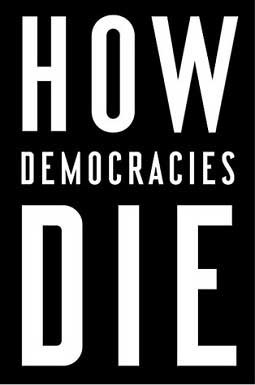
In our collective imagination, the death of democracy is a dramatic event: the roar of the tanks in the streets, the seizure of broadcast towers, a dictator announcing a new regime to a terrified populace. In their indispensable and chilling book, How Democracies Die, Harvard professors Steven Levitsky and Daniel Ziblatt, systematically dismantle this comforting myth. They present a far more insidious and accurate reality: Democracies today are not murdered in a revolution, they are slowly, legally poisoned from within by the very leader elected to protect them. This book is not a partisan polemic, but a rigorous historical diagnosis, and its persuasive power lies in its terrifying, evidence-based clarity. It is, without exaggeration, one of the most significant books of our time.
The genius of Levitsky and Ziblatt’s work is their distillation of complex political erosion into a recognizable pattern. They argue that two unwritten conventions that lay the bedrock of a healthy democracy are “mutual toleration” and “institutional forbearance” rather than the constitution itself. Mutual toleration is the plain thing that your enemies are not your enemies, but they are good loyal patriots but with another vision. Institutional forbearance is restraint—or a refusal to exercise every legal weapon at your disposal simply because you can. Once these norms start to decay, the constitution becomes a mere piece of paper, easily subjected to the whims of those who could engage in “constitutional hardball”.
The authors use a four point checklist in order to make citizens recognize the future autocrat. Does a leader:
Abandon the democratic rules of the game?
Stay ahead of the geopolitical week.
MD Briefing delivers expert analysis across five global fronts — the Indo-Pacific, energy, geoeconomics, European security, and the Middle East — every Monday morning. Free.
Deny the legitimacy of their opponents?
Promote and/or condone violence?
Demonstrate the desire to suppress the civil liberties of critics?
Applying this litmus test to the 2016 Campaign of Donald Trump and finding a resounding and alarming yes on all counts. However, their examination is much more than a mere Trump critique. They put him in a world historical context, demonstrating how his strategies follow others such as Venezuela’s Hugo Chavez, Peru’s Alberto Fujimori and even European dictators of the 1930s. This is neither name-calling nor propaganda; it is a comparative political science at its most compelling and accessible.
This perhaps is the most vital, and, to the Americans, the most uncomfortable part of the book describes a failure of “gatekeeping”. The authors assume that the line of defense is the most important and the initial one, i.e., political parties. In their argument, during the 20th century, the Republican and Democratic elite groups managed to work together to ensure that political extremists such as the racist demagogue George Wallace were out of office. This changed. The authors trace its de-functioning as due to the post-civil rights realignment, increased partisan media, and, most importantly, reform of party nomination procedures that put less experienced elites in the hands of primary voters.
But this perfect storm has rendered the Republican establishment helpless, and in the end uninspired, to prevent a figure known to be dangerous. The fateful decision to normalize Trump instead of opposing him unequivocally, is presented as a colossal failure in political responsibility that had a historic impact.
Yet, the book is not a counsel of despair. Although the former half is a frightening diagnosis, the latter half is an urgent prescription. According to Levitsky and Ziblatt, the future of the Republic hinges on the following three factors: the independence of the institutions such as the judiciary and the freedom of the press, the willingness of the party elites to ultimately reassert their gatekeeping role, and the vigilance of the populace. Their message is clear: democracy requires moving beyond panicking and getting into a place of committed, informed defense in order to save democracy. It involves rebuilding the norms of mutual respect and restraint from the ground up.
How Democracies Die is an art masterpiece in explaining why political science is so vital and urgent to the common person. Its persuasion power is rooted not in hysterical prediction, but in the cold, hard, historical facts. It breaks down complex academic concepts into a language of survival. Reading this book will enable you to have a new lens through which to interpret the political world–they are the glasses that will make you aware of the warning signs we can no longer afford to ignore.
Why This Book Matters
How Democracies Die transcends being a mere political science text; it is a vital diagnostic tool of our time. It is a book that should be read not only by every student of history and political science, but by all active citizens, journalists, and servants of the populace who want to rise above partisan alarmism and learn precise mechanisms that can destroy any democracy. It provides the foundational knowledge necessary for anyone committed to the vigilant defense of self-governance. It is a sobering, powerful and ultimately essential blueprint for democratic preservation. Our collective response will write the next chapter.
