


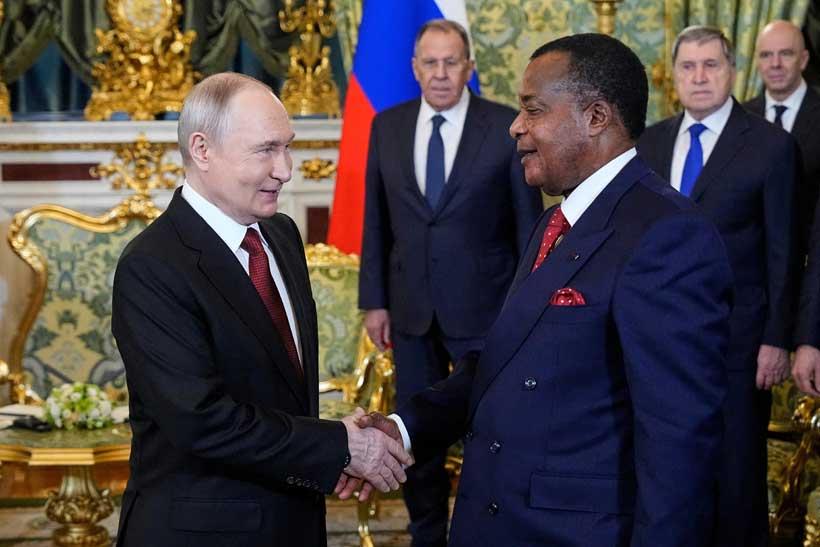
Congolese President Denis Sassou Nguesso tightly embraced and shook hands with President Vladimir Putin, signaling the highest cordial friendship, and later settled down for official talks focusing on strengthening the multifaceted Russian-Congolese comprehensive strategic economic partnership, including in the context of the upcoming high-level third Russia-Africa Summit scheduled for October 2026.
In St. George’s Hall of the Grand Kremlin Palace, Putin told his Congolese counterpart, Denis Nguesso, and the delegation that there were “good prospects for developing relations in a variety of areas” and reminded them that the full-fledged relations between Russia and the Congo have been making strides. Russian companies are ready and eager to work on the country’s market, primarily because the political situation has been stable, which is good for business. The intergovernmental commissions are operational.
Denis Nguesso’s official visit, from April 28 to 29, has immense significance for the Kremlin. Moscow is stepping up to tackle important corporate investments ranging from an industrial and technological standpoint that open pathways for knowledge transfer, human capital development, and Congo’s integration into defense innovation value chains. At the geo-strategic level, Moscow is seemingly positioning itself as a regional security hub and as an incredible partner, particularly in Congo, while strengthening a broader strategic influence in the Central African region.
On the agenda, Russia will begin design work this year for the construction of an oil product pipeline in Congo, under an agreement signed in 2024. The Pointe-Noire – Loutete – Moluko-Tresho oil product pipeline that Russia plans to build in the African country under an intergovernmental agreement is supposed to go into operation by the end of 2029.
Stay ahead of the geopolitical week.
MD Briefing delivers expert analysis across five global fronts — the Indo-Pacific, energy, geoeconomics, European security, and the Middle East — every Monday morning. Free.
It was reported earlier that Russia is hoping to create a channel for shipping oil products that is protected from sanctions by building this pipeline in the Congo as well as become a strategic partner in ensuring the energy security of the whole region. The agreement on the project, which was signed in Moscow on September 28, 2024, provides for the creation of favorable conditions to carry out the pipeline’s construction.
Under the agreement, the authorized organizations responsible for the implementation of the project are Zakneftegazstroy-Prometei LLC and the National Petroleum Company of Congo (SNPC), which is the client of the project. They will form a joint venture to carry out the project in which the Russian side will own a 90% stake and the Congolese side will hold 10%.
A build-own-operate-transfer concession agreement will be signed with the joint venture to build and operate the pipeline for 25 years, with a guaranteed price for transport that will ensure the utilization of the pipeline and a return on investment in the project. The Russian ambassador to Congo, Georgy Chepik, said earlier that the pipeline will run between the country’s two largest cities, Pointe-Noire and the capital, Brazzaville.
In particular, the two sides discussed the prospects of implementing joint projects and forging mutual cooperation prospects in a wide range of areas, including in geological prospecting, energy, logistics, agriculture, trade, and manufacturing. The sides also “noted readiness to gradually increase their transport cooperation.” The Republic of Congo is seen as a key logistics hub in Central Africa and a crucial participant in a promising international transport route between Russia and the African continent,” the statement said.
Nearly 80% of the population still lives in abject poverty, despite the fact that the country boasts huge resources. Congo is the fourth largest oil producer in the Gulf of Guinea, providing the country with a high degree of potential prosperity, despite its internal ethnic conflicts and economic disparity. It has a large untapped mineral wealth and large untapped metal, gold, iron, and phosphate deposits. In 2018, the Republic of the Congo joined the Organisation of Petroleum Exporting Countries (OPEC).
Historical records show that Denis Nguesso, several times as a civil servant during the Soviet era and as president, visited Russia, including participation in the two Russia-Africa summits held in Sochi and St. Petersburg, and consequently was gifted with a collage of photographs and Pravda newspaper clips documenting these visits. President Putin has also awarded (decorated) him with the Order of Honor, while Moscow State University of International Relations (MGIMO) gifted him with a doctorate degree. The document, published on the Kremlin website, for instance, says Nguesso has been honored with the award “for his major contribution to boosting and strengthening relations between the Russian Federation and the Republic of the Congo.”
Congolese Denis Nguesso, who has shuttled frequently between his city and Moscow, underlined the fact that bilateral relations have been developing for many decades. These are ties of solidarity and cooperation that bind the two parties in all areas, including security, defense, and the economy. He emphasized the point that time has arrived to act more concretely and accelerate the implementation of the jointly elaborated program. Both parties will have the opportunity to sign more bilateral agreements in Brazzaville in September 2026, before the new Russia-Africa summit to be held in Moscow.
The third summit is expected to solidly reaffirm the development of relations of African states with the Russian Federation. For decades, Russia has supported Africa’s ideals for freedom, independence, and sovereignty. Next, Russia-Africa cooperation has a big future. Africa is rich in resources. And Russia contributes to efforts to ease the debt burden African countries are facing. The total debt Russia has cancelled, previously so far, stands at $23 billion, according to reports.
In addition, Russia and African states have coordinated efforts for building a new, fairer global architecture and further working together to protect international law, the UN Charter, and the central role of that global organization, while at the same time trying to coordinate their positions on the main issues on the international agenda. African regional structures have substantially enhanced these geopolitical profiles and the general objectives of the African Union.
