


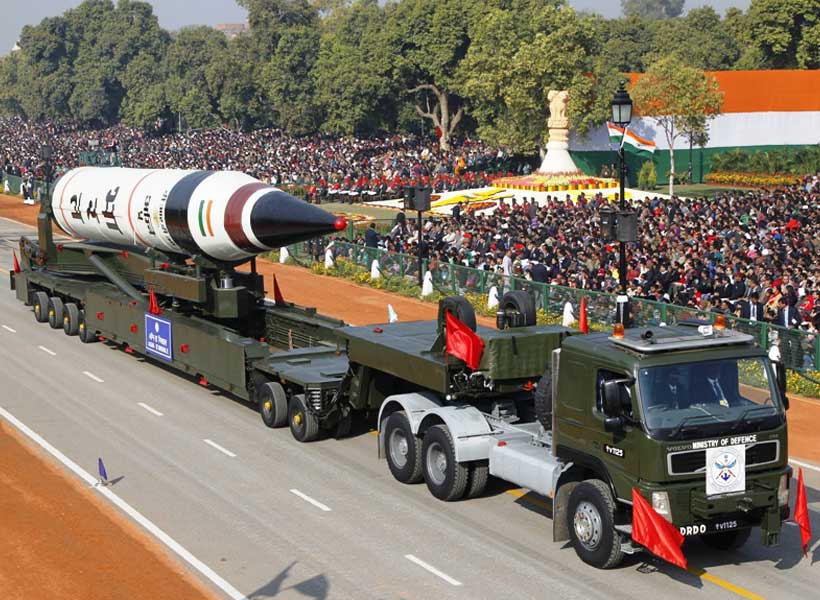
India’s nuclear doctrine has been cloaked in the rhetoric of “No First Use” and “credible minimum deterrence.” But recent developments, especially in its sea-based nuclear program, suggest a drift away from regional deterrence to a more ambitious global strategic reach. According to an Indian defense analyst, Commodore Anil Jai Singh (Retd.), “The addition of warships and submarines is for the replacement of the old platforms with those equipped with modern and improved technologies. These additions are also to cater for renewals.” With the expansion of its nuclear submarine fleet, submarine-launched ballistic missiles (SLBMs), and ocean surveillance capabilities, India is quietly yet steadily stepping into the club of global nuclear powers without the scrutiny or accountability that usually accompanies such a transition.
India currently operates two SSBNs. The SSBN-I, INS Arihant (formally commissioned in 2016), which can carry up to 12 K-15 Sagarika SLBMs (750 km range) or 4 K-4 (3,500 km) missiles, completed its first 20-day deterrent patrol in November 2018, marking full nuclear triad operationalization. The SSBN-II, INS Arighaat (commissioned August 2024), is capable of equipping both the K-15 and the longer-range K-4 SLBMs. The INS Arihant was initially portrayed as a stabilizing tool to complete India’s nuclear triad. Yet the induction of a second SSBN, INS Arighat, and the development of longer-range SLBMs like the K-4 and upcoming K-5 missiles, capable of targeting beyond Pakistan’s territory, signal a recalibration of India’s deterrence architecture. Moreover, India launched its third and fourth SSBN, the INS Aridhaman, in 2021, which is undergoing sea trials and is reported to be commissioned in 2025. This more advanced SSBN has 8 launch tubes carrying K‑15, K‑4, or future K‑5 (ranges 6,000 km) missiles. Additionally, India is planning to build the next-Gen SSBNs (SSBN-V), the larger SSBNs (13500 tones), which are designed to carry up to 12 long-range SLBMs (like K-5 or K-6) up to 6,000 km.
According to the Indian news platforms, India is also planning to expand its naval assets, as it has proposed shipbuilding projects that include 17 warships and 9 submarines awaiting approval, alongside 61 vessels under construction, with major projects like Project 17B, Project 75-I, and Next Generation Corvettes. These projects are expected to cost over 2.4 trillion Indian Rupees or approximately 28.74 billion USD, which is a huge amount allocated for naval shipbuilding. Furthermore, New Delhi plans to replace the over-aging platforms, especially submarines and destroyers, with more modern ones to reach the Indian Navy’s goal of a 175-ship fleet by 2035. Notably, these are not strategic projects or systems not merely aimed at gaining strategic advantage over India’s rivals in South Asia—China and Pakistan—but represent a pursuit of power projection in the wider Asia-Pacific theater, where India has long held ambitions for dominance.
India’s growing naval nuclear capabilities reflect a substantial maritime militarization posing serious threats in the region and beyond. Its SSBN deployments could destabilize South Asia by undermining deterrence stability and triggering an arms race at sea, especially among nuclear states of Asia. It will also erode nuclear non-proliferation norms, setting a precedent that undermines global disarmament and increases the risk of miscalculation in future India-China or India-Pakistan conflicts due to the inherent fog-of-war associated with submerged SSBNs. India’s opaque strategies and lack of transparency in its military policies further fuel global suspicion.
Stay ahead of the geopolitical week.
MD Briefing delivers expert analysis across five global fronts — the Indo-Pacific, energy, geoeconomics, European security, and the Middle East — every Monday morning. Free.
It is hard to ignore that India’s expanding nuclear inventory contradicts the principles it claims to uphold. “Minimum deterrence” is a flexible term, but when a country fields multiple SSBNs, develops new generations of SLBMs, and enhances surveillance infrastructure to protect its nuclear assets, the line between deterrence and strategic overreach becomes blurry. With no official cap on its arsenal and no participation in any arms limitation regime, India’s nuclear posture raises uncomfortable questions about double standards in the global non-proliferation order.
What makes it even more alarming is the silence of the international community. India remains outside the Nuclear Non-Proliferation Treaty (NPT) but continues to receive waivers and strategic indulgence from global powers. The Nuclear Suppliers Group (NSG) exemption in 2008, largely pushed through by the US, normalized India’s status as a de facto nuclear weapons state. Today, its unmonitored expansion in sea-based nuclear assets remains unchallenged, even as it increases risks of regional instability, thereby posing the question of why the West remains silent on such developments.
