


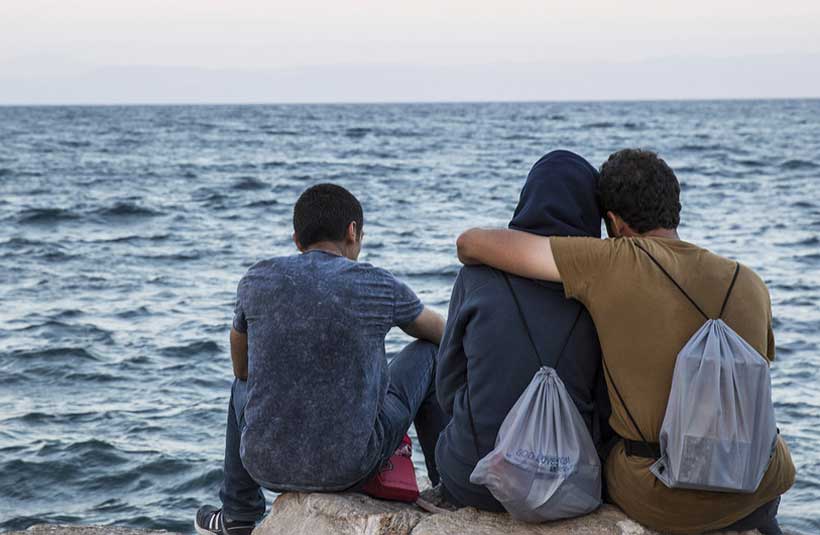
Bombs are falling on Tehran and Tel Aviv. Once again, the Middle East is spiraling into chaos—a region trapped in a cycle of war, instability, and foreign entanglements for over a century. As usual, the United States stands firmly beside Israel. Europe, meanwhile, watches uneasily from what it believes is a safe distance. But that distance is an illusion. Despite its colonial legacy in the region, Europe is no longer a leading actor—it’s a passive observer, hesitant and unsure. Yet the Middle East is not some remote theater. It is Europe’s neighbor, and what happens in Baghdad, Damascus, or Tehran inevitably spills into Berlin, Paris, and London. The last 25 years have proven that instability in the East leads directly to migration in the West. If Europe continues to treat the Israel–Iran conflict as someone else’s war, it may soon face its consequences on home soil—not as headlines, but as millions of refugees seeking safety. This article explores that growing connection.
From ‘Guest Workers’ to Citizen Neighbors
In the decades following the Second World War, Europe became a beacon for migrants seeking stability, prosperity, and opportunity. Rapid reconstruction and economic growth turned the continent into a magnet for labor from across the world. Initially, this migration was welcomed—many European governments not only accepted but actively encouraged it to fuel their booming post-war economies.
Germany, for instance, led initiatives in the 1960s and ’70s to invite “guest workers” from countries like Turkey, Yugoslavia, and Greece. At the time, this made sense: Europe’s birth rates were falling, and its economies were desperate for manpower. However, the expectation that these workers would one day return home proved naive. By the 1980s, many had settled permanently, prompting governments to reconsider their strategies.
Stay ahead of the geopolitical week.
MD Briefing delivers expert analysis across five global fronts — the Indo-Pacific, energy, geoeconomics, European security, and the Middle East — every Monday morning. Free.
Instead of halting migration altogether, authorities shifted focus—diversifying labor sources and offering incentives for voluntary return. Still, with native populations declining and labor shortages deepening, immigration remained an unavoidable reality.
The 1990s: Turning Point
By the 1990s, migration accelerated. More migrants sought citizenship, and for the first time, public resentment began to simmer. Right-wing and racist attacks rose sharply in some countries, though at the time, these remained isolated incidents. The general mood in Europe was still tolerant, thanks largely to its broad prosperity. High employment, strong welfare systems, and equitable income distribution meant native populations didn’t feel threatened—yet. That began to change in the early 2000s.
Globalization and the Erosion of Stability
As globalization shifted Europe’s industrial base to Asia, jobs vanished. Many factories moved to China, India, and Vietnam. At the same time, Europe’s welfare state began to shrink. For working-class Europeans, wages stagnated, costs soared, and inequality widened. Amid these pressures, immigration surged once more—this time, on an unprecedented scale.
Between 2000 and 2025, tens of millions of people migrated to Europe. The UK alone absorbed more than 15 million, while Germany welcomed between 15 and 20 million. It was a transformation without precedent—and one for which Europe was woefully unprepared.
The Real Crisis: Capacity, Not Numbers
Europe’s mistake was not in accepting immigrants but in overestimating its ability to absorb them. As welfare systems eroded and public services strained under pressure, migration became a convenient scapegoat. Rising rents, inflation, and unemployment were all pinned on the most visible “outsiders.”
Adding to the strain was a shift in who was arriving. Unlike earlier economic migrants, many of those who arrived in the past 25 years were fleeing war, state collapse, and persecution—in Syria, Afghanistan, Ukraine, and across Africa. These were people running from danger, not toward opportunity. Their ability to integrate and contribute economically was often limited. In turn, this made it harder for host societies to accept them.
By 2025, immigration and integration had become Europe’s most divisive political issues.
A Fertile Ground for Populism
Populist and far-right movements across Europe quickly seized on the discontent. With lower-income citizens increasingly frustrated, populists framed migrants as the cause of every major problem—from crime to economic decline. The consequences have been profound. Neo-Nazi movements are gaining ground and, in some countries, entering the political mainstream. If left unchecked, racism and xenophobia could soon become pillars of governance in parts of the continent.
What’s worse, these developments threaten more than national politics—they could unravel the European Union itself. The rise of populism is undermining the principles of unity, solidarity, and open borders that the EU was built upon.
Short-Term Fixes, Long-Term Peril
Cornered by political pressure, many European governments are now turning to short-term, hardline solutions. Some are paying North African governments to block migrants from crossing the Mediterranean. Others are tightening asylum rules and increasing deportations. These measures may offer fleeting relief, but they violate human rights—and more importantly, they don’t work.
You can’t stop migration with force if its root causes remain. Where there is civil war, state failure, or economic collapse, people will flee, no matter how many fences or patrol boats are deployed.
Time for Strategic Thinking
The only lasting solution is to address the causes of migration at their source. That means Europe must take a more active role in promoting peace and stability in its neighboring regions. Had Europe acted decisively in Syria, millions might never have been forced to flee. The same goes for Iraq, Lebanon, Afghanistan, and now—potentially—Iran.
Europe continues to view these crises solely through geopolitical or military lenses. The ongoing Israel–Iran conflict, for example, is being assessed in terms of regional strategy. But few European leaders seem to recognize the migration tsunami it could unleash. Iran, with a population of nearly 90 million, could become the next Syria—on a much larger scale. If the Iranian state collapses, tens of millions of refugees could head for Europe. No wall or warship will stop that.
The Stakes: Higher Than Ever
Recently, German Chancellor Friedrich Merz remarked—speaking of Iran—that “Israel is doing the dirty work for us,” a thinly veiled endorsement of Israeli strikes on Iranian targets. But those bombs dropped on Tehran may soon return—as waves of displaced Iranians knocking on the gates of Berlin, Munich, and Paris.
Europe must wake up to the reality that mass migration is now a greater strategic threat than even nuclear weapons. The continent must act proactively—before the next crisis arrives. That means investing in peace, reconstruction, and diplomacy in the Middle East and Africa.
European leaders can no longer afford to see the problems of Asia and Africa as someone else’s. Left unaddressed, those problems will continue to arrive—on boats, in buses, or on foot—and threaten the very fabric of European peace, unity, and prosperity.
