


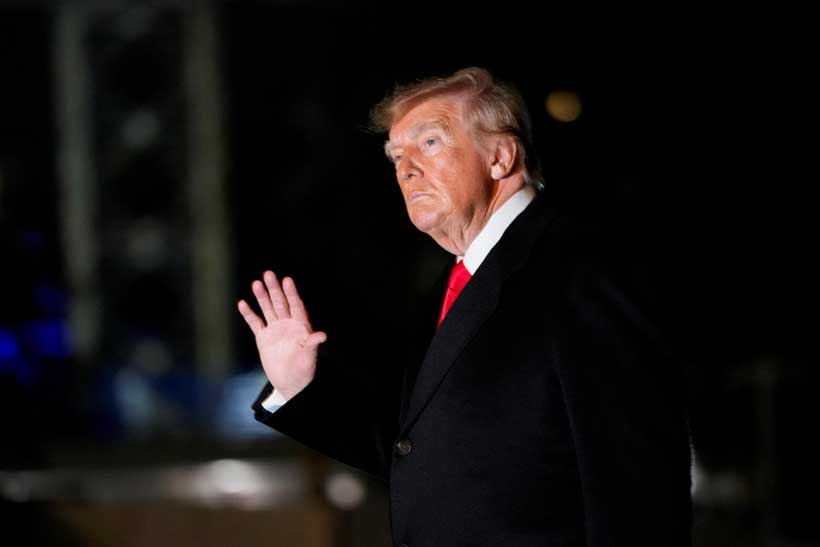
US President Donald Trump heads to Asia facing mounting political and diplomatic pressure ahead of his expected meeting with Chinese President Xi Jinping in Shenzhen. A major Republican defeat in the US midterm elections and allegations surrounding a suspected Chinese intelligence operation involving Nvidia CEO Jensen Huang have complicated what was initially expected to be a relatively low-risk diplomatic encounter.
Trump will first travel to Manila for meetings with Southeast Asian and other regional leaders before attending the Asia-Pacific Economic Cooperation (APEC) forum in Shenzhen. His visit will include a bilateral meeting with Xi and planned three-way discussions involving Russian President Vladimir Putin.
The talks come as Washington and Beijing attempt to preserve a fragile trade-war truce, currently extended until early next year. Although another Trump-Xi meeting is expected in December at the G20 summit in Miami, the political developments in Washington and renewed scrutiny of Chinese access to advanced American technology have raised the stakes of the Shenzhen encounter.
The central question is whether Trump will prioritise maintaining economic stability with Beijing or use his weakened domestic political position to adopt a more confrontational approach.
Stay ahead of the geopolitical week.
MD Briefing delivers expert analysis across five global fronts — the Indo-Pacific, energy, geoeconomics, European security, and the Middle East — every Monday morning. Free.
Midterm Defeat Changes Trump’s Negotiating Position
The Republican Party’s poor performance in the midterm elections has weakened Trump’s political standing and increased scrutiny of his administration’s foreign policy decisions.
Before the elections, the Shenzhen meeting was widely viewed as an opportunity to preserve the trade truce rather than pursue major new agreements. However, the electoral setback could change Trump’s calculations.
Ruby Osman, a senior China policy adviser at the Tony Blair Institute, argues that the president may now be more willing to consider disruptive measures because he has fewer immediate electoral consequences to worry about.
Washington has already signalled a tougher approach by urging China to fulfil commitments made under the trade agreement reached between Trump and Xi a year ago. The administration’s concerns include Chinese compliance with the terms of the truce and the broader balance of economic relations between the two countries.
However, a more confrontational strategy carries risks. Last year’s trade dispute demonstrated how quickly tensions between the world’s two largest economies can affect international markets, supply chains and business confidence.
Both governments therefore have incentives to avoid another escalation, even as disagreements over technology, trade and regional security continue.
Nvidia Spy Allegations Increase Pressure on China
The allegations surrounding Nvidia have added an unexpected national security dimension to Trump’s visit.
The controversy centres on claims involving Jensen Huang, whose close relationship with Trump has attracted attention following allegations that he had an affair with a Chinese businesswoman suspected by US authorities of having intelligence links to Beijing.
The scandal has also been linked to allegations that restricted Nvidia semiconductors were diverted to Chinese customers. These claims have intensified concerns in Washington about whether existing export controls are sufficiently effective.
The allegations remain subject to scrutiny, and they should not be treated as established evidence of wrongdoing by Huang or proof that Chinese intelligence obtained sensitive American technology.
Nevertheless, the political consequences are already becoming visible. US House Speaker Mike Johnson said last week that bipartisan support was growing for further restrictions on China’s access to advanced semiconductors. Democrats are also expected to push aggressively for tighter controls when they assume majorities in both chambers of Congress in January.
Chinese analysts fear that the controversy could harden Washington’s position and accelerate technological separation between the two countries.
Beijing has rejected the spy narrative, accusing the United States of fabricating allegations to justify a broader technological blockade.
Zhu Feng, director of the Institute of International Studies at Nanjing University, has warned that the dispute could accelerate the decoupling of artificial intelligence industries between the two powers, even as they explore cooperation on managing the technology’s risks.
Despite the growing controversy, a senior US administration official said Trump was not expected to raise the allegations directly with Xi, arguing that the Nvidia situation should not determine the direction of the presidential visit.
Trump Seeks a Foreign Policy Legacy Beyond China
Beyond trade and technology, Trump may use the Asian trip to pursue diplomatic initiatives that could strengthen his international legacy.
One possibility involves nuclear arms control discussions with China and Russia. The proposed three-way meeting between Trump, Xi and Putin has generated speculation about whether the leaders could explore a framework for reducing nuclear risks.
However, expectations for a major agreement remain limited. China possesses a substantially smaller nuclear arsenal than the United States and Russia, and Chinese analysts see little incentive for Beijing to enter negotiations under arrangements designed primarily around the two larger nuclear powers.
Another potential objective is renewed diplomacy with North Korean leader Kim Jong Un. Trump has invested considerable political attention in his relationship with Kim during both of his presidential terms and could seek support from Xi and Putin in arranging another meeting.
Victor Cha of the Center for Strategic and International Studies argues that Trump is focused on building his foreign policy legacy, with North Korea diplomacy remaining an important part of that ambition.
The possibility of a three-way meeting involving Trump, Xi and Putin has also attracted comparisons with the 1945 Yalta Conference, when the United States, Britain and the Soviet Union discussed the post-war international order.
Such comparisons are particularly sensitive for Ukraine, which remains engaged in a prolonged war with Russia. The concern is that major powers could reach understandings over regional security without adequately considering the interests of smaller countries.
However, a senior US official indicated that Ukraine was not expected to feature prominently in the Shenzhen discussions.
Taiwan Could Become China’s Most Important Demand
Xi may also seek to use Trump’s weakened domestic political position to secure concessions on Taiwan.
One of Beijing’s main objectives is to prevent Washington from approving a proposed $14 billion arms package for the island. China considers Taiwan part of its territory and strongly opposes American military support for Taipei.
Trump has described the arms package as a negotiating chip in discussions with Beijing, creating uncertainty about the future of US security assistance.
For China, delaying or preventing the sale would represent a significant diplomatic gain. It could also reinforce perceptions that Washington’s commitment to Taiwan is influenced by broader trade negotiations with Beijing.
Jonathan Czin, a foreign policy analyst at the Brookings Institution and former US intelligence and National Security Council official, argues that Xi may not need a major concession from Trump. Simply preventing the American president from adopting a more competitive approach towards China could provide Beijing with valuable time.
China’s strong export performance and continuing efforts to strengthen domestic industrial capabilities give its leadership an incentive to preserve the current period of relative stability.
However, Beijing must also consider the possibility that Trump’s successor could adopt a tougher position. Potential Republican successors, including Secretary of State Marco Rubio, are generally regarded as more hawkish on China.
Former President Joe Biden also repeatedly challenged Beijing over human rights and Taiwan, including statements indicating that the United States would defend the island if attacked.
Consequently, Xi may view the remaining period of Trump’s presidency as an opportunity to consolidate China’s strategic position before a potentially less accommodating administration takes office.
Trade Stability Remains in Both Leaders’ Interests
Despite their growing disagreements, Washington and Beijing have strong economic reasons to prevent another trade confrontation.
The previous dispute threatened to destabilise international markets and disrupt global supply chains. Both governments remain aware that a renewed escalation could damage economic confidence and create costs extending well beyond their bilateral relationship.
Kurt Tong, a former senior US State Department official now associated with the Asia Group, argues that both leaders will be cautious about reigniting a trade conflict with potentially serious global consequences.
The current truce is due to expire on January 10, but analysts expect the two governments to seek another extension.
Chim Lee, a senior China analyst at the Economist Intelligence Unit, similarly argues that both countries have strong incentives to preserve fragile stability despite their disagreements.
This does not mean that the underlying tensions have disappeared. Semiconductor restrictions, Taiwan, trade imbalances and strategic competition will continue to complicate relations.
However, an extended truce would give both governments additional time to negotiate without immediately returning to the economic confrontation that previously threatened global markets.
What Happens Next?
The Shenzhen meeting will test whether Trump and Xi can maintain their fragile understanding despite growing political pressure in Washington and renewed concerns over Chinese access to advanced technology.
For Trump, the challenge is to demonstrate that his administration can protect American national security interests while preserving economic stability. His domestic political setback may encourage a tougher negotiating posture, but a renewed trade confrontation could undermine the economic objectives he has pursued with Beijing.
Xi, meanwhile, has an opportunity to seek concessions on Taiwan, technology restrictions and trade while avoiding an escalation that could disrupt China’s export-driven economy.
The Nvidia controversy may not feature directly in the presidential discussions, but its consequences could shape the political environment surrounding them. Greater congressional support for semiconductor restrictions could narrow the administration’s room for compromise, regardless of the outcome of the meeting.
Ultimately, neither leader has much to gain from an immediate breakdown in relations. Washington wants to maintain pressure on China without destabilising the global economy, while Beijing seeks time to strengthen its economic and technological position.
The Shenzhen summit is therefore unlikely to resolve the deeper strategic rivalry. Its significance will lie in whether Trump and Xi can preserve diplomatic and economic stability while their competition over technology, Taiwan and global influence continues.
With information from Reuters.
