


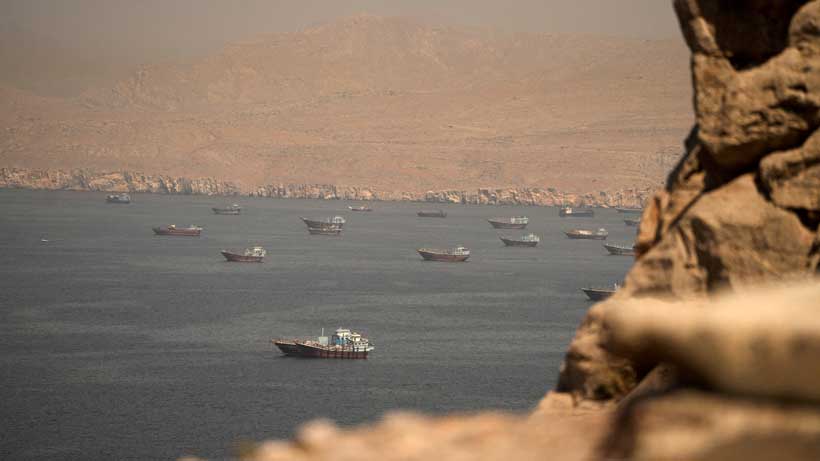
Crude oil is flowing out of the Gulf again, but the market is no better prepared for another disruption in the Strait of Hormuz. It has assembled a temporary system for managing one. Crude exports from the Gulf, excluding Iran, returned to pre-war levels in September, while total Gulf shipments reached 15.5 million barrels a day, more than 80% of the pre-conflict volume.
More than seven months into the U.S.-Israeli war with Iran, the market has coped with a closed or contested Strait of Hormuz by drawing down inventories, curbing consumption, and leaning on U.S. military power. Each has limits: inventories are finite, replenishment takes time, and reliance on U.S. military power carries strategic costs. Four indicators—onshore inventories, exposed importers, European gas storage, and U.S. naval capacity—will show whether this workaround is holding.
Recovery, Defined Carefully
Recovery remains uneven. Crude flows through Hormuz returned to pre-war levels in late September, but combined crude and refined-product flows reached only about 80% of baseline. The IEA estimates Gulf crude exports at 13.9 million barrels a day, just over three-quarters of pre-war levels, with refined products lagging further behind. Peak-day throughput is not sustained recovery, nor are bypass exports Hormuz transits.
Stay ahead of the geopolitical week.
MD Briefing delivers expert analysis across five global fronts — the Indo-Pacific, energy, geoeconomics, European security, and the Middle East — every Monday morning. Free.
Inventories Under Strain
Inventories are central to the workaround, but they are shrinking. The IEA’s October report put global stocks 509 million barrels below pre-war levels at September’s end. The modest net September draw of 10 million barrels masked a 113-million-barrel decline in onshore stocks, partly offset by a 103-million-barrel increase in oil at sea. Onshore inventories fell to their lowest level since at least 2016. Oil aboard tankers offers little immediate cushion to refineries or governments.
Emergency reserves are also being used up. IEA chief Fatih Birol said on October 3 that about 325 million barrels of a 400-million-barrel emergency release had been delivered. The G7 agreed to release up to 100 million more. These measures buy time but do not rebuild the lost buffer.
Aramco’s Amin Nasser said governments had released more than 300 million barrels and that commercial inventories supplied much of the remaining flexibility. Rebuilding that cushion could take two years. China accounted for 78% of September’s 76-million-barrel decline in non-OECD crude stocks. Its eventual restocking will compete with current demand for available cargoes.
Prices reveal the gap between market expectations and physical supply. Brent futures are near $107 a barrel, up 13% since early September, according to the IEA, while WTI is near $95. North Sea Dated, a benchmark for physical crude, is near $134, with some grades approaching $160 amid higher freight costs and attacks on Saudi infrastructure. The premium for physical oil exposes the strain beneath the apparent recovery.
The Demand That Disappeared
As inventories tightened, higher prices and disrupted supplies forced consumers to cut back. The IEA expects global demand to fall by 2.6 million barrels a day in 2026 and 2.5 million in the fourth quarter alone, with diesel accounting for a quarter of the decline. Even after a partial recovery in 2027, oil use is projected to remain 620,000 barrels a day below 2025 levels.
This is less resilience than demand destruction: higher prices shift the burden onto importers with few alternatives and limited inventories. Diesel illustrates the pressure. Wholesale prices topped $200 a barrel in September, nearly twice crude prices, and the IEA does not expect diesel stocks to be replenished before the second half of 2027.
The Cost of Security
Reduced consumption eases pressure on supply, but keeping the remaining flows moving carries its own price. Oil moves through Hormuz partly because U.S. naval power makes commercial transit possible. The blockade of Iran has tied up more than 30% of Navy warships, at an estimated cost of $32.5 million a day since it was reimposed on July 14. The Congressional Budget Office puts Pentagon war costs at $38 billion through August 1 and estimates that the conflict has consumed about two-thirds of certain U.S. interceptor stocks.
Navy air-defense missiles can run $1 million to $6 million each, while interceptors costing millions have been used against drones worth roughly $20,000. The greater strategic price is the diversion of forces securing Hormuz that Washington may need elsewhere, particularly in the Indo-Pacific.
Commercial expenses compound the burden. Tanker charters for passage can exceed $500,000 a day, while sailors willing to make the trips have reportedly been offered as much as $25,000 per voyage.
The Spoiler’s Logic
The more successfully the workaround restores Gulf exports, the more valuable it becomes as a target. The U.S. blockade prevents Tehran from moving its own oil. As other Gulf producers recover, Iran loses leverage; making commercial traffic riskier can help preserve it.
The evidence is suggestive, not conclusive. Analysts quoted by CNN link rising Iranian tanker attacks to increased strait traffic, while the Revolutionary Guards’ chief has called Hormuz a “strategic red line.” UKMTO logged 20 warnings involving the strait and southern Red Sea approaches in September and five more in early October. On October 14, Iran reportedly attacked two vessels using new tactics.
The targeting also appears selective. Periods where Iran paused or adjusted its targeting behavior might have been influenced by direct financial negotiations rather than pure military calibration. Retaliation for the blockade is another possible motive. But as flows increase, so does the incentive to disrupt them.
The Bypass Under Fire
Alternative routes are under pressure too. Reuters reports that ship-to-ship transfers outside Hormuz have reached capacity. Saudi Arabia’s East-West pipeline, which carries crude to the Red Sea coast, was bombed on September 11, though the IEA says flows recovered swiftly. Proxies in Iraq and Yemen have previously attacked Aramco pipelines, refineries, and ports.
The Houthis have escalated their threats. Al Jazeera reported that they claimed strikes on Aramco facilities in Yanbu in late September, which Saudi Arabia said it intercepted without damage, and on a facility near Riyadh on October 3, a claim the Saudi-led coalition called “misleading” that could not be independently verified. An attack on an Aramco building in eastern Saudi Arabia on October 14 caused a limited fire.
The Saudi-led coalition says the Houthis have struck Riyadh airport 20 times this month; the EU and Gulf states postponed a summit planned for October 24. AP also reports that the Houthis seized territory along the Bab el-Mandeb coast, another critical maritime chokepoint, while a Saudi diplomat accused Iran of encouraging the escalation. The bypass is not independent of the Hormuz crisis; it exposes the system to a second front.
Maritime risk mitigation relies on a fragile, layered workaround, consisting of naval escorts, ship-to-ship transfers, bypass pipelines, specialized insurance, and AIS-dark transits. Because each layer has limited capacity, failure in one overburdens the others.
Furthermore, the increasing weaponization of satellite imagery and shipping data against tankers and infrastructure creates a situation in which markets and insurers demand transparency, but vulnerable vessels require opacity to survive.
Logistics are now a major constraint. Freight and insurance have become major cost drivers, while record tanker rates raise delivered crude prices and squeeze refinery margins in Europe and Asia. Lost refining capacity in the Middle East and Russia compounds the problem, particularly for diesel. The IEA warns that the global refining system is under considerable strain and that a full recovery of Middle Eastern flows has slipped into next year.
Gas: The Harder Constraint
Gas may prove the tighter constraint because unlike oil, it has few bypass routes or comparable coordinated stock releases. Qatar’s LNG exports have plummeted. QatarEnergy has extended force majeure for Asian buyers through November and European buyers through December.
Europe is particularly exposed. EU gas storage was about 73% full on October 6, the lowest for that date since records began in 2011 and 15 percentage points below the five-year average. It is also below the European Commission’s reduced 80% target for this year. Europe is competing with Asia for LNG cargoes that avoid Hormuz, just as a ban on Russian LNG imports takes effect on January 1.
Dutch TTF gas is near €86 per megawatt-hour, close to a four-year high. Morgan Stanley forecasts a winter average around €85, with prices above €100 in a cold winter or if Qatari supplies deteriorate further. Japan’s JERA does not expect Qatari supply to return soon and anticipates a difficult winter for Europe. Every cargo Asia secures is one Europe cannot; a cold January could test storage before diplomacy or naval measures take effect.
An Empty Diplomatic Account
Diplomacy has yielded little. A Pakistan-brokered memorandum briefly reopened Hormuz on June 18, but the truce collapsed on July 8, and Washington reinstated its blockade six days later. In October, Iranian Parliament Speaker Mohammad Bagher Ghalibaf said Hormuz would remain closed until seven conditions tied to the memorandum were met. Defense Secretary Pete Hegseth has called the blockade “ironclad.” Tehran prioritizes control of the strait; Washington, denuclearization.
Neither side has reconciled these priorities. On August 25, Iran’s deputy foreign minister announced a temporary Iran-Oman shipping corridor with revenue sharing, and Tehran later reiterated that an understanding had been reached. Yet Iran refuses to reopen the strait while the U.S. blockade remains in place. President Trump has defended the blockade as effective and threatened Oman over interference with U.S. policy.
Iran’s currency has roughly halved against the dollar in under a year, giving Tehran reason to seek accommodation. Yet its remaining leverage depends on keeping the strait contested.
There is one faint sign of movement. A Saudi diplomat said mediators are exploring guaranteed safe passage through Hormuz in exchange for ending the U.S. blockade of Iranian ports, though Tehran has been slow to respond. No agreement is in sight. For now, the workaround must sustain the system through winter.
What Would Prove This Wrong?
The strongest counterargument is that the market may be closer to balance than it appears. The IEA projects a 7.7-million-barrel-a-day supply increase in 2027, while the EIA forecasts a 4.9-million-barrel-a-day surplus and Brent averaging $67 in the second half of the year as shut-in production returns. If those forecasts hold, supply could recover sufficiently to replenish inventories, ease prices, and reduce pressure on importers.
But forecasts of ample supply do not establish that the market can withstand another disruption before that recovery materializes. The distinction will become clearer over the coming months, as inventories, importers’ ability to secure cargoes, European gas storage, and the demands on U.S. forces reveal whether the current workaround is buying enough time.
Four Warning Signs to Watch
Four indicators will help distinguish a recovery that is gaining traction from one that remains dependent on temporary buffers and costly workarounds.
1. Onshore oil inventories. Watch the November and December data for another substantial drawdown in onshore stocks after the September decline. A further fall would suggest that the apparent recovery in flows is not yet translating into a rebuilt cushion. The key test is whether inventories begin recovering as supply returns, not simply whether oil continues to move.
2. Exposed importers. Pakistan’s estimated 28–30 days of oil cover and Vietnam’s reported 7–10 days of strategic reserves leave limited room for a prolonged interruption. Formal fuel rationing, missed cargo payments, or repeated failures to secure scheduled deliveries would offer more concrete evidence of stress than high prices alone.
3. European gas storage. The critical test is whether storage levels fall below 75% by the end of December while Dutch TTF prices exceed €100 per megawatt-hour. That combination would suggest that Europe is entering the winter with a thinner buffer and more expensive replacement supplies than the market can comfortably absorb. A cold January would intensify the pressure.
4. U.S. naval capacity. Be on the lookout for evidence that sustaining the blockade and protecting maritime traffic requires further deployments from other theaters, particularly the Indo-Pacific, or that depleted interceptor stocks constrain the military’s ability to respond elsewhere. The share of the fleet tied up in the operation matters, but the more consequential signal is whether the commitment begins to impair other missions.
Washington’s response to diplomatic openings, including the proposed Iran–Oman shipping corridor and possible mediation, could change all four trajectories. Restored flows alone will not establish that the market is secure. For now, oil is moving because inventories, reduced demand, alternative routes, and U.S. military power are buying time. The test is whether those buffers can be replenished and those risks contained before the next disruption. Until then, the time bought is borrowed.
