


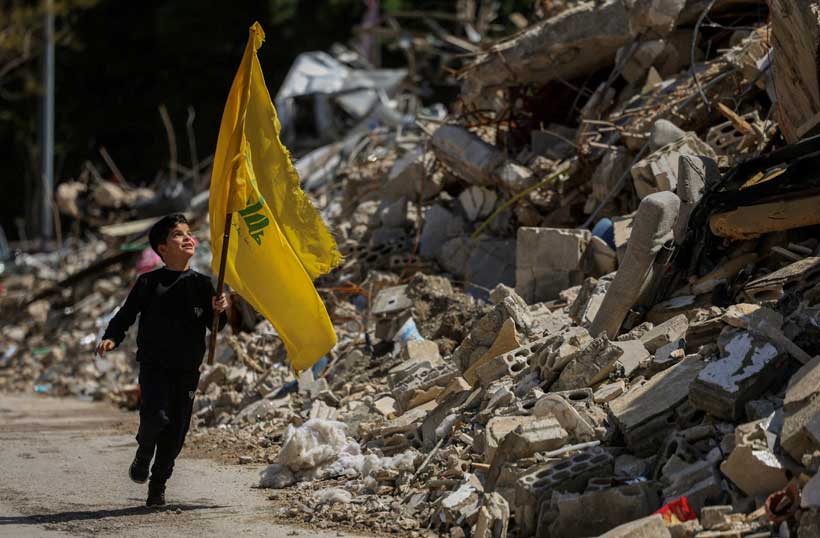
Hezbollah will provide up to $14,000 in financial assistance to Lebanese families whose primary homes were destroyed or made uninhabitable during the war with Israel, the group’s Executive Council chairman Ali Damoush announced on Tuesday.
The assistance plan aims to help displaced families cover rental costs and replace furniture as they face the challenge of returning to damaged neighbourhoods or finding alternative accommodation.
Families in Beirut and its southern suburbs will receive $14,000, including $8,000 for furniture and $6,000 for rent. Eligible families elsewhere in Lebanon will receive $12,000, comprising $8,000 for furniture and $4,000 for rent.
The payments will be distributed in four instalments over one year, with the first payment set at $3,500 for families in Beirut and its southern suburbs and $3,000 for those elsewhere.
Stay ahead of the geopolitical week.
MD Briefing delivers expert analysis across five global fronts — the Indo-Pacific, energy, geoeconomics, European security, and the Middle East — every Monday morning. Free.
Who Qualifies for the Assistance?
Damoush said the programme would cover families whose homes were destroyed, severely damaged or declared uninhabitable following technical assessments. It would also include eligible families displaced from Israeli-occupied areas and nearby locations.
The assistance is restricted to households that used the affected properties as their primary residences. Families who own a second home will be excluded, as will owners of summer homes and abandoned properties.
Eligibility and the type of assistance provided will depend on criteria assessing the extent of damage to each property.
The programme maintains the same assistance rates Hezbollah offered in 2024, according to Damoush.
Questions Over Funding From Iran
The announcement comes amid questions about how Hezbollah will finance the relief programme.
Reuters reported last week, citing two people with direct knowledge of the transfer, that Hezbollah had received $200 million from Iran to support displaced Lebanese families. A Hezbollah official had previously said funding had been secured and that a distribution plan would be announced.
The United States disputed the report, questioning whether Tehran had provided the money. Iran has not publicly commented on the reported transfer.
Damoush declined on Tuesday to comment on the report or Washington’s response. He also did not disclose the total amount Hezbollah would allocate to housing and shelter assistance.
The reported transfer comes as the United States increases economic pressure on Iran and authorities face difficulties moving funds to Tehran’s Lebanese ally.
War Leaves Hundreds of Thousands Displaced
The conflict has uprooted hundreds of thousands of people in Lebanon, many of them from communities that form Hezbollah’s support base.
Hezbollah entered the regional war in support of Iran on March 2, days after the United States and Israel began attacking Iranian targets. Israel subsequently intensified its bombardment and launched a ground invasion of Lebanon.
Lebanon’s health ministry has reported more than 4,300 deaths from Israeli attacks, without distinguishing between civilians and combatants.
For displaced families, financial assistance could help cover immediate housing and household needs. However, the effectiveness of the programme will depend on the availability of funds, the assessment of property damage and whether families can safely return to their homes.
Hezbollah has not disclosed the total budget for the programme, leaving the overall scale of the assistance and its capacity to support all eligible households unclear.
With information from Reuters.
