


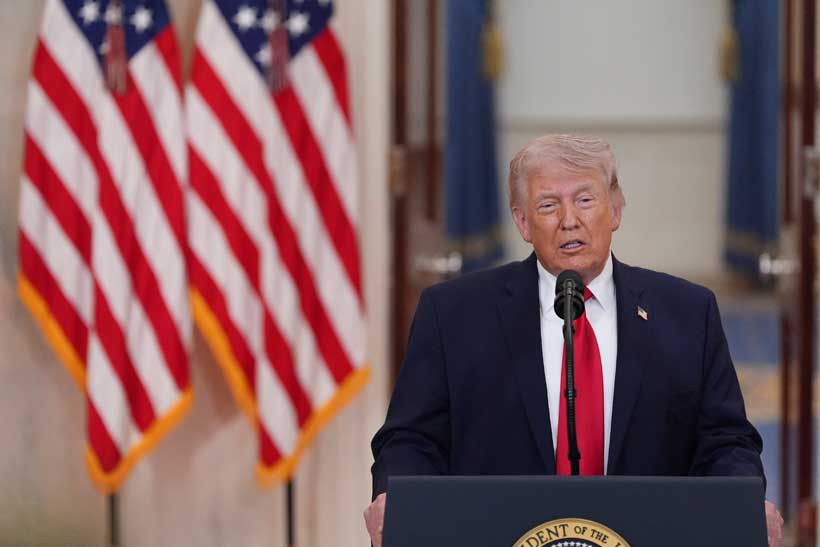
US President Donald Trump has denied reports that Washington is prepared to offer Iran sanctions relief and access to frozen funds in exchange for concessions on its nuclear program, adding fresh uncertainty to diplomatic efforts to end the seven month war.
Trump made the denial on Monday after Axios reported, citing unnamed US officials, that he was willing to ease sanctions and release Iranian funds frozen overseas if Tehran took concrete steps on its nuclear activities.
“This is untrue. I offered them NOTHING,” Trump wrote on Truth Social.
Trump Rejects Reports of a Nuclear Bargain
The Axios report did not identify the US officials who described the reported offer. CNN separately reported, also citing an unidentified US official, that sanctions relief and the release of frozen Iranian funds could form part of a final agreement if Tehran demonstrated concrete progress on the nuclear issue.
Stay ahead of the geopolitical week.
MD Briefing delivers expert analysis across five global fronts — the Indo-Pacific, energy, geoeconomics, European security, and the Middle East — every Monday morning. Free.
The conflicting accounts come as Washington and Tehran are once again engaging indirectly through mediators. US and Iranian officials held separate discussions with mediators on Monday as efforts intensified to find a way out of a conflict that has now lasted seven months.
The disagreement over the reported offer comes at a particularly sensitive moment, with both sides facing pressure to define what a potential diplomatic settlement could look like.
Sanctions Relief Could Become a Major Bargaining Chip
Economic pressure has been one of Washington’s main tools against Tehran. Any decision to loosen sanctions or provide access to frozen Iranian funds would therefore represent a significant bargaining chip in negotiations over Iran’s nuclear activities.
For Tehran, access to frozen funds and relief from sanctions could provide substantial economic benefits after years of restrictions. For Washington, such measures could be used to secure verifiable limits on Iran’s nuclear program.
But Trump’s categorical denial leaves unclear whether economic concessions are actually being considered as part of the current negotiations or whether the reports reflect proposals discussed within the broader US policy process.
The War’s Objectives Remain in Flux
The dispute over the possible deal is also tied to the broader uncertainty surrounding the war. Trump has offered shifting goals and timelines for the conflict while continuing to identify the weakening of Iran’s nuclear capabilities as one of the main US objectives.
The war began on February 28, when the United States and Israel launched attacks on Iran. Tehran responded with strikes against Israel and Gulf states hosting US military bases, expanding the conflict across the region.
Seven months of fighting have since made a diplomatic settlement increasingly consequential. US and Israeli strikes on Iran, along with Israeli attacks on Lebanon, have killed thousands and displaced millions.
The continued military confrontation has also increased the stakes of any negotiations between Washington and Tehran, particularly over the conditions required for a lasting halt to hostilities.
Iran Continues to Reject Nuclear Weapons Claims
Iran remains at the center of the dispute over its nuclear program, although Tehran denies seeking nuclear weapons.
Iran says it has the right to develop nuclear technology for peaceful purposes as a party to the Nuclear Non Proliferation Treaty. Washington, meanwhile, has focused on preventing Tehran from developing the ability to produce a nuclear weapon.
That difference lies at the heart of the diplomatic challenge. Any agreement would have to address US demands for meaningful limits and verification while giving Iran a reason to accept restrictions on activities it says are intended for peaceful purposes.
Conflicting Reports Complicate the Diplomatic Track
The conflicting accounts over sanctions relief highlight the uncertainty surrounding the latest diplomatic push.
If Washington is prepared to exchange economic concessions for concrete and verifiable nuclear steps, sanctions relief could become one of the central elements of a potential settlement. But Trump’s public rejection of the reports suggests that the scope of any proposed arrangement remains unsettled.
The question is also whether the two sides can agree on the sequence of concessions. Tehran is likely to seek tangible economic relief, while Washington is focused on obtaining measurable restrictions on Iran’s nuclear capabilities.
As indirect talks continue, the central challenge will be turning those competing demands into a framework that both sides can accept. Until that happens, the disagreement over what Trump has actually offered Iran reflects a broader uncertainty over whether diplomacy can produce a workable exit from the war.
With information from Reuters.
