


With the current geopolitical shifts and the emergence of a multipolar world, political, economic, and diplomatic relations between countries are changing. Through BRICS and the Global South, China seeks to challenge the perceived Western hegemony of the global political and economic order. In that regard, Beijing engages with African countries by expanding its influence on the continent using mechanisms, narratives, and also targeting sectors outside the economic space to engage in the political, information, culture, and education spaces, which serve as the basis of China’s strategy for the continent. However, the current trends in Africa’s engagement with both traditional and emerging partners are driven by a shift in focus. Rather than the political governance championed by the EU as a core foreign policy objective, African nations increasingly respond to the economic pragmatism offered by emerging global powers.
The piece argues that while African countries seek to diversify their partnerships with China and other emerging economies (such as India, Brazil, Turkey, the United Arab Emirates, Saudi Arabia, and Malaysia) for economic pragmatism—aiming to redefine, restructure, and rebalance their engagement with traditional partners like the US and the EU—Beijing views a multipolar world with Africa at its heart as a means to counter and challenge Western influence on the continent. In that regard, African nations are central to Beijing’s strategy to expand its global reach.
The piece first highlights how Africa navigates the current geopolitical landscape, focusing on global power shifts and increasing African agency. It then analyses Africa’s role within the Global South. Finally, it discusses Africa-EU relations in this new era and provides concrete recommendations for EU policymakers regarding how to approach African countries’ growing engagement with emerging economies in a challenging international environment.
Africa in the context of global power shifts
Stay ahead of the geopolitical week.
MD Briefing delivers expert analysis across five global fronts — the Indo-Pacific, energy, geoeconomics, European security, and the Middle East — every Monday morning. Free.
Jockeying for influence in Africa by various external powers seeking global expansion is more overt today with the arrival of new actors, rising power rivalries, and the redefinition of the global order. In the current geopolitical and multipolar world, never before have Africa’s place and role been so important. Africa can now influence the rules and systems that have historically held back its development, but it must improve its collective negotiation capacity to ensure its voice is heard internationally.
In the context of global power shifts, African countries increasingly seek strategic partnerships that prioritize economic pragmatism over traditional political governance conditions. The EU’s traditional approach to engaging with Africa based on demands for political governance, respect for human rights, and democratic reforms faces major structural limitations and is losing its influence on the continent. African nations are increasingly turning to a pragmatic, economy-focused approach, favoring partnerships offered by emerging powers such as China, India, and Saudi Arabia, among others. These actors offer a model based on trade, the development of large-scale infrastructure, and a strict principle of non-interference in internal affairs, thereby providing a faster and more flexible alternative, free from political conditions. This loss of influence is forcing the European Union to fundamentally rethink its strategy towards Africa. To remain a leading partner, the EU must abandon its patronizing stance and build a relationship on an equal footing, centered on mutually beneficial strategic investments (such as the Global Gateway initiative) and genuine economic added value.
The formation of new alliances and power blocs—such as BRICS and the Global South—counters a unipolar world and rebalances international relations. For Africa, strengthening multipolarity means actively participating in global political, economic, financial, and diplomatic structures to shape decisions that serve the continent’s core interests.
· Global power shifts and increasing African agency
Africa is taking on increasing geostrategic importance in the evolving global order. Amid current geopolitical shifts—characterized by the reshuffling of global political, economic, and diplomatic ties—African agency is visibly unfolding. African countries now leverage new opportunities through the pursuit of mutually beneficial alliances. This agency is key to reshaping how African governments engage with external actors.
In the context of current international relations, African agency means placing African decision-makers at the center of their engagement with external partners. It allows them to contribute to negotiations that benefit individual nations, the continent, and its populations. Furthermore, it enables African policymakers and institutions to actively shape debates concerning the continent’s future, as well as broader negotiations impacting the global political economy.
· Africa in the Global South in the context of global power shifts
For a long time, African governments have felt that engagement with traditional partners has failed to meet the continent’s development expectations, which remain constrained by a Western-dominated political-economic governance system, financial architecture, and trade regime. The influence of the U.S. and the EU on the continent is declining, challenged by major emerging actors such as China, Russia, Turkey, and the UAE. This influence is also facing opposition from growing calls by African governments, academics, media, and civil society for national sovereignty and a retreat from traditional, Western-centric governance. This push aims to reform a global system that the Global South, including African nations, considers unjust and unfavorable to developing countries because it sidelines their development priorities, voices, and solutions. Positioned at the center of the Global South, Africa has triggered intense geopolitical rivalry and competition among major powers—primarily between the U.S. and the EU on one side and China and Russia on the other.
Changing Africa-EU relations in the era of global power shifts
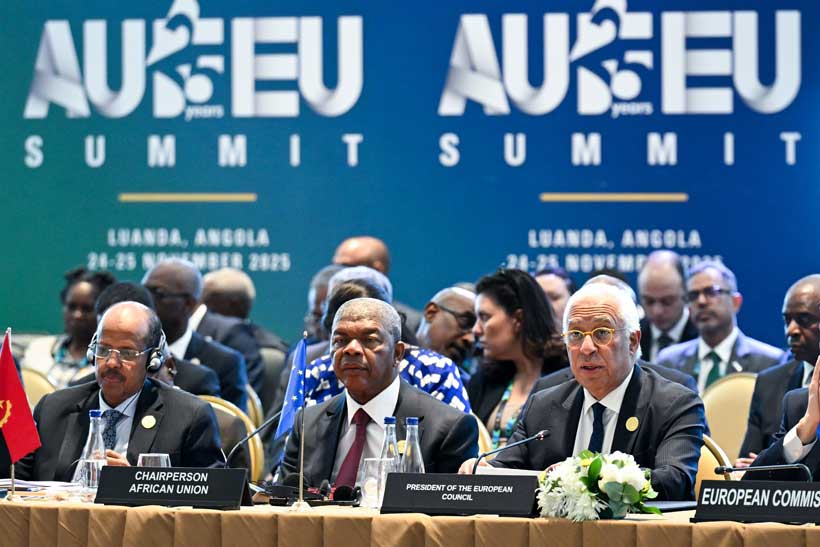
Pragmatism in pursuit of economic development and the rupture with Western influence across the continent are driving new directions in Africa–EU relations. The rebalancing and restructuring of African countries’ engagement with the EU reflect the changing global geopolitical landscape, as African states seek to counter and challenge a Western-based political and economic system largely dominated by the US and the EU. Increasing calls for sovereignty, alongside the growing influence of other external actors across the continent, are driving structural changes in Africa–EU relations. With China’s growing influence in Africa and the EU’s declining clout on the continent, Africa–EU relations are undergoing significant changes, prompting the EU to renew its engagement with African countries. China’s growing role in Africa, particularly in infrastructure, trade, and development financing, has encouraged the EU to reassess its approach and align its engagement more closely with Africa’s aspirations through a more inclusive approach that takes the continent’s development priorities into account.
Until recently, the EU had been Africa’s largest trading partner, with trade in goods exceeding €280 billion in 2021. However, Africa’s trade partnerships have shifted significantly, with Asia emerging as a major trading partner. To strengthen its influence on the continent and counter China’s growing clout in Africa, particularly through the Belt and Road Initiative, Brussels launched the Global Gateway Africa–Europe Investment Package, which pledged €150 billion in investment between 2021 and 2027 in sectors considered critical to Africa’s development, including digitalization, education, the energy transition, transport, and pharmaceuticals.
Moreover, the EU faces increasing competition from China in securing the critical minerals needed for Europe’s future industrial and digital development. The EU’s dependence on China in this area has become a central issue in policy debates in Brussels. For Europe, Africa’s abundant mineral resources therefore remain important to reducing this dependency. In this regard, the EU adopted the Critical Raw Materials Act (CRMA), which entered into force on 23 May 2024, with the aim of strengthening the resilience of its critical raw-material supply chains, including through extraction, refining, and processing. The EU has also established strategic partnerships with Namibia, the Democratic Republic of the Congo (DRC), Zambia, Angola, and Rwanda to facilitate access to critical and strategic raw materials for European industries, including the digital, defense, aerospace, and green-technology sectors.
At the same time, Africa’s development has been constrained by the limited industrialization of many of its economies. African governments increasingly seek to reverse this trend by pursuing economic transformation and industrial development policies aimed at processing raw materials on the continent and generating greater value addition locally.
The EU’s need for critical raw materials meets this demand and can help support local value addition and processing in African countries, rather than just raw material extraction. EU initiatives related to the Global Gateway and access to critical minerals in Africa aim to counter China’s growing influence on the continent, which Brussels considers a threat. However, most of the projects included in these EU initiatives regarding Africa have yet to materialize, are still in their early stages, or remain mere promises for now.
Power rivalry in Africa and global power shifts
Geopolitics has taken center stage in Africa amidst the competing interests and values of external actors. China’s growing presence in Africa has challenged the European Union’s and the United States’ influence on the continent by offering an alternative to conventional Western partners.
Besides financing and building infrastructure in African countries to enhance regional connectivity across the continent, China also promotes alternative ideas and concepts of development favorable to a China-centric order in Africa. Geopolitical competition between China, the United States, and the European Union plays a major role in Africa, as different external actors seek to contrast their commitments with those of their competitors in order to influence public perception of the risks and opportunities arising from investments made by the other party. Through the great power rivalry and competition between China, the United States, and the European Union, African countries exert their agency for a diversified partnership.
By politically engaging with African governments, China expands its economic interests across the continent. This engagement secures Beijing’s diplomatic backing among African officials, enhancing its global influence—particularly within the United Nations and other international fora. In these multilateral spaces, China relies on African support when negotiating global issues and defending its domestic policies. These close ties strengthen China’s international standing vis-à-vis the United States and the European Union. Ultimately, great power rivalry directly and indirectly shapes how Beijing, Washington, and Brussels engage with Africa.
Conclusion and recommendations for EU policymakers
The rise of global emerging powers, mainly China and Russia, and their growing influence in Africa are undermining the EU’s traditional leverage on the continent. The EU’s persistent desire to strengthen its political partnership with African nations as a core foreign policy objective often clashes with calls from African governments, civil society, academics, and youth for a just, sustainable relationship that prioritizes the needs of the continent and its people. Africa’s push to increase trade and foster investment over aid—combined with its shifting alliances toward emerging powers—directly challenges traditional partners like the EU. To remain relevant, the EU must break away from its conventional aid-centric approaches and move past its legacy of neocolonial economic engagement on the continent.
Regarding the current global geopolitical shifts and issues, the EU should not neglect African agency. African governments increasingly exercise this agency by leveraging partnerships between traditional and emerging actors to meet their strategic interests. The EU should refrain from criticizing African countries’ engagement—particularly with emerging global powers like China and Russia, which Brussels often views as competitors, rivals, or even adversaries. African governments refuse to be dictated to by EU policymakers regarding their choice of global partners.
Driven by its renewed interest in the continent, the EU should balance its political engagement with active investment in sectors that promote value addition, industrialisation, balanced trade, sustainable development, technology transfer, and the energy transition. The African Continental Free Trade Area (AfCFTA) offers an ideal framework for the EU to pursue this direction.
The EU should particularly ensure that its economic engagement on the continent produces concrete and positive outcomes rather than primarily advancing its geopolitical ambitions or competing for influence with other external actors.
The EU should also coordinate the efforts of its member states to engage with Africa, given the fragmentation of interests among individual European countries, even within Brussels’ seemingly integrated regional bloc.
