


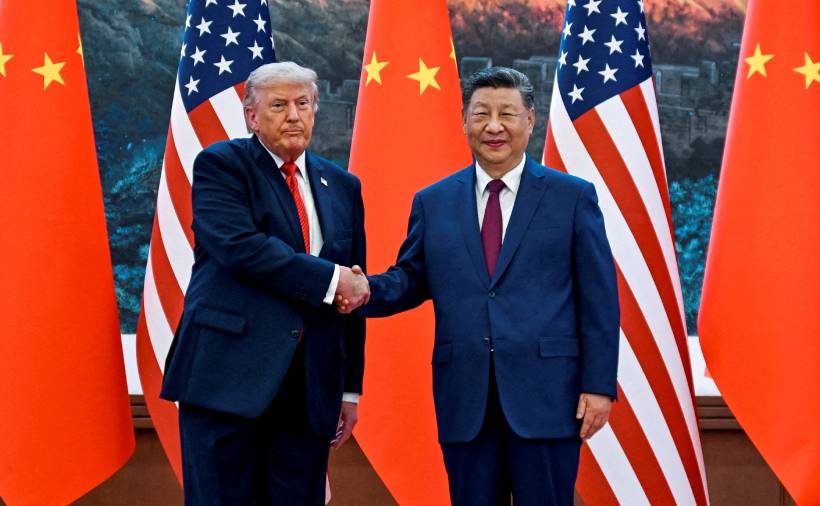
As world leaders gather in New York for the annual United Nations General Assembly, US President Donald Trump and Chinese President Xi Jinping are meeting in Washington, creating a striking contrast between traditional multilateral diplomacy and direct great power engagement.
Trump and Xi are expected to discuss artificial intelligence, trade and defense during their second meeting of the year. Their talks come as the United States and China continue to shape the global agenda on issues ranging from technology and economic competition to security and international diplomacy.
The timing has raised a broader question about the role of the United Nations: does the organization still sit at the center of global decision making when the world’s most powerful states increasingly rely on direct negotiations?
Richard Gowan of the International Crisis Group said Xi’s decision to meet Trump in Washington rather than travel to New York for the General Assembly was notable. Xi rarely attends the annual gathering in person, but the contrast this year is particularly visible as leaders debate the future of multilateralism while the two major powers conduct their own high level diplomacy.
Stay ahead of the geopolitical week.
MD Briefing delivers expert analysis across five global fronts — the Indo-Pacific, energy, geoeconomics, European security, and the Middle East — every Monday morning. Free.
The issue is not new, but pressure on the UN has intensified. The organization is facing severe financial constraints, divisions among major powers and persistent deadlock over conflicts including Ukraine and the Middle East.
A UN Under Financial Pressure
The United Nations is confronting a growing budget shortfall that has forced the Secretariat to reduce its 2026 budget by 9.2%. The organization has cut thousands of jobs, reduced peacekeeping operations and scaled back parts of its humanitarian and human rights work.
The United States remains one of the organization’s largest financial contributors, but Washington has also accumulated substantial unpaid obligations. The Trump administration recently paid $725 million toward the regular UN budget, allowing the United States to retain its voting rights in the General Assembly. The country still owes about $1.3 billion to the regular budget and $2.9 billion for peacekeeping operations, according to the UN.
Trump has also taken a more confrontational approach toward the organization since returning to office. His administration has withdrawn the United States from several UN agencies and reduced Washington’s contributions.
In his General Assembly speech, Trump criticized what he described as an unelected globalist bureaucracy and attacked the UN Human Rights Council and UNESCO.
The UN has defended both institutions, saying UNESCO’s work has received broad recognition from specialized organizations and that the Human Rights Council plays an important role in promoting and protecting human rights.
Great Power Rivalry Is Reshaping the UN
The UN’s difficulties extend beyond its finances.
The Security Council remains frequently divided, particularly among its five permanent members: the United States, China, Russia, France and Britain. Their competing interests have repeatedly limited the council’s ability to reach agreement on major international crises.
Former UN official Eugene Chen described the financial crisis as only one part of a wider problem, arguing that member states increasingly disagree over what the UN should do and how it should function in a changing international system.
The organization has attempted to respond through the UN80 reform initiative launched by Secretary General Antonio Guterres. The initiative aims to reduce duplication, lower operating costs, relocate some positions to cheaper locations and improve institutional efficiency.
The reform plan includes a proposed 21% reduction in Secretariat posts and a review of more than 600 series of mandated reports, with the aim of reducing reporting by roughly 700,000 words during 2026.
China Seeks Greater Multilateral Influence
The contrast between Washington and New York also reflects the different ways the United States and China approach the international system.
Trump has increasingly emphasized direct negotiations and bilateral deals, while Xi has sought to present China as a predictable international partner, particularly for developing countries. Beijing has also used the UN system to promote its vision of a more multipolar international order.
That does not mean the UN has become irrelevant.
The General Assembly remains one of the world’s largest diplomatic meeting points. More than 1,000 bilateral meetings were planned among member states during this year’s gathering, according to UN data.
Diplomacy around the Iran conflict illustrates why the organization continues to matter even when formal UN mechanisms struggle to resolve disputes. Iranian Foreign Minister Abbas Araqchi and US envoys Steve Witkoff and Jared Kushner communicated through mediators on the sidelines of the General Assembly, marking the first such contacts since an interim ceasefire collapsed in July.
European Union foreign policy chief Kaja Kallas similarly argued that the UN remains relevant, while criticizing its inability to prevent or end major conflicts.
Ukrainian President Volodymyr Zelenskiy also used the General Assembly gathering to meet Trump and discuss possible steps toward ending the war with Russia, including a potential ceasefire involving energy infrastructure.
When asked whether years of UN meetings had produced concrete results, Zelenskiy acknowledged the limitations but pointed to one continuing function: the organization brings leaders together.
That may be a modest achievement compared with the UN’s original ambitions. But at a time of intensifying great power rivalry, the ability to bring adversaries into the same diplomatic space remains one of the institution’s most important functions.
The meeting between Trump and Xi therefore presents a wider dilemma for the international system. Direct engagement between major powers may increasingly determine the course of global crises, but the UN remains one of the few institutions capable of bringing almost every country into the same diplomatic framework.
The future of multilateralism may depend less on whether the UN remains the world’s single center of decision making and more on whether it can adapt to a system in which power is increasingly distributed among competing states and bilateral relationships.
With information from Reuters.
