


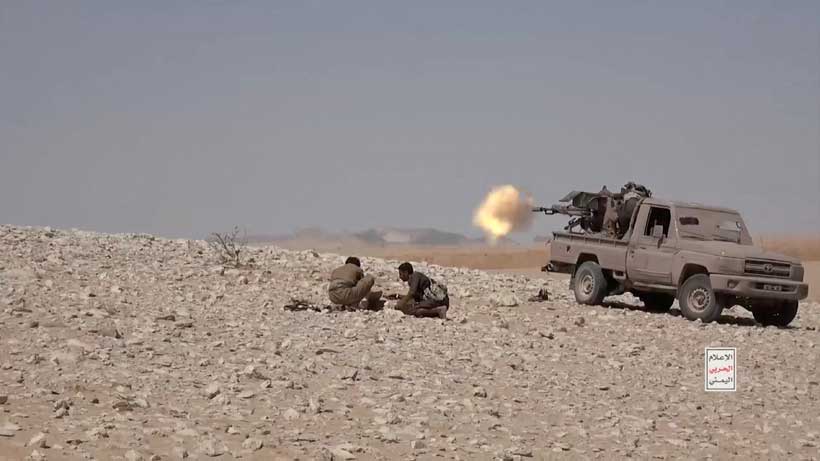
Houthi fighters are pushing to seize strategic mountain positions in Yemen as the Iran aligned group seeks to consolidate its control of the Red Sea coast and strengthen its position around the Bab el Mandeb Strait.
The advance comes as the Trump administration faces growing pressure to support Saudi Arabia against the Houthis, while trying to avoid expanding a wider Middle East war that has already disrupted global energy supplies.
The New York Times reported that the United States prepared airstrikes against Houthi positions on Sunday after renewed appeals from Saudi Crown Prince Mohammed bin Salman, but that President Donald Trump called off the strikes at the last minute.
Reuters could not independently verify the report. US Central Command did not immediately respond to a request for comment.
Stay ahead of the geopolitical week.
MD Briefing delivers expert analysis across five global fronts — the Indo-Pacific, energy, geoeconomics, European security, and the Middle East — every Monday morning. Free.
The reported decision comes after the Houthis claimed on Saturday that they had fired toward Riyadh. Loud explosions were followed by smoke near the Saudi capital’s airport, although Saudi authorities have not publicly confirmed the reported strikes.
Fighting moves into the highlands
The Houthis have controlled Yemen’s capital, Sanaa, since 2014. Earlier this month, the group launched a rapid offensive that pushed Saudi backed forces out of large parts of Yemen’s Red Sea coast.
The advance has opened another front in the broader regional conflict and raised concerns over the security of the Bab el Mandeb Strait, one of the world’s key maritime chokepoints.
Saudi Arabia has responded with hundreds of reported airstrikes against Houthi positions in the highlands. The Houthis say the attacks have failed to halt their advance, while Saudi backed government forces have continued to withdraw from several positions.
The United Nations estimates that nearly 700 people have been killed and thousands injured since the latest escalation began. More than 120,000 Yemenis have been displaced within the country, while thousands more have crossed the Red Sea by boat into Africa.
Five Yemeni military sources told Reuters that the Houthis were now seeking control of the Kahboub Mountains in Taiz and Lahij provinces.
The mountain range separates the Red Sea coast from government held territory farther south.
Fighting has concentrated around Al Wazi’iyah district in Taiz province and Ras al Ara along the coast. The positions are strategically important because they could allow the Houthis to strengthen their control around the Bab el Mandeb Strait and protect territory captured during their recent offensive.
Control of the heights could also give the group additional routes for opening new fronts against Saudi backed forces.
A dilemma for Washington
The Houthi advance presents a difficult choice for Trump.
Washington has close security ties with Saudi Arabia and faces pressure to help defend its ally. At the same time, direct US intervention would risk expanding a regional conflict that the administration has sought to contain.
The United States launched a two month bombing campaign against the Houthis in early 2025. Trump later ended the operation after reaching a ceasefire with the group and has largely stayed out of the conflict since then.
A renewed US campaign would therefore represent a significant change in Washington’s approach.
The reported decision to cancel planned strikes suggests that the administration remains cautious about becoming directly involved in another front, although the White House has not publicly confirmed what happened.
Yemen’s new threat to oil flows
The military situation in Yemen is also directly connected to global energy markets.
Houthi control of the Bab el Mandeb Strait threatens one of Saudi Arabia’s main alternative routes for exporting oil when shipping through the Strait of Hormuz is disrupted.
Saudi Arabia has consequently increased shipments through Hormuz, where some tankers have continued operating despite the security risks.
Satellite data showed Saudi oil exports through Hormuz reaching around 2.9 million barrels per day in recent days, up from approximately 700,000 barrels per day in August.
That increase has partly offset the halt in Saudi oil loadings from the Red Sea port of Yanbu.
The additional flows have helped limit the rise in global crude prices, which have fallen back toward $100 a barrel after approaching $110 last week.
The pressure on consumers, however, remains severe.
US retail diesel prices reached another record on Monday at more than $6.51 a gallon, compared with around $3.75 before Trump launched the war against Iran alongside Israel in February.
Maritime risks remain high
The threat to shipping has also grown.
Britain’s UK Maritime Trade Operations agency said the latest reported incident in the Strait of Hormuz involved a vessel being struck by a projectile, leaving several crew members with minor injuries.
The incident highlights the wider vulnerability of energy transportation routes as fighting spreads across the region.
The Bab el Mandeb and Hormuz are separate chokepoints, but disruption at either can force ships and energy exporters to seek longer or more expensive alternatives.
For Saudi Arabia, losing reliable access to both routes would create a particularly serious challenge for its oil exports.
The wider diplomatic picture
Diplomatic efforts to end the broader conflict have made little progress since an interim US Iran agreement reached in June collapsed within weeks.
Iranian President Masoud Pezeshkian is due to travel to New York on Tuesday for the United Nations General Assembly. It will be his first such visit since Trump launched “Operation Epic Fury” against Iran alongside Israel in February.
His visit could provide an opportunity for renewed diplomatic contacts, but the expansion of fighting in Yemen adds another complication to any effort to contain the conflict.
For Washington, the Houthi advance has therefore created a difficult balance between protecting Saudi interests, securing global shipping routes and avoiding another prolonged military campaign.
If the Houthis consolidate their positions around the Bab el Mandeb, pressure on the United States to respond could increase. But any direct intervention would also risk turning Yemen into a more prominent front in a conflict that is already stretching across the Middle East.
With information from Reuters.
