


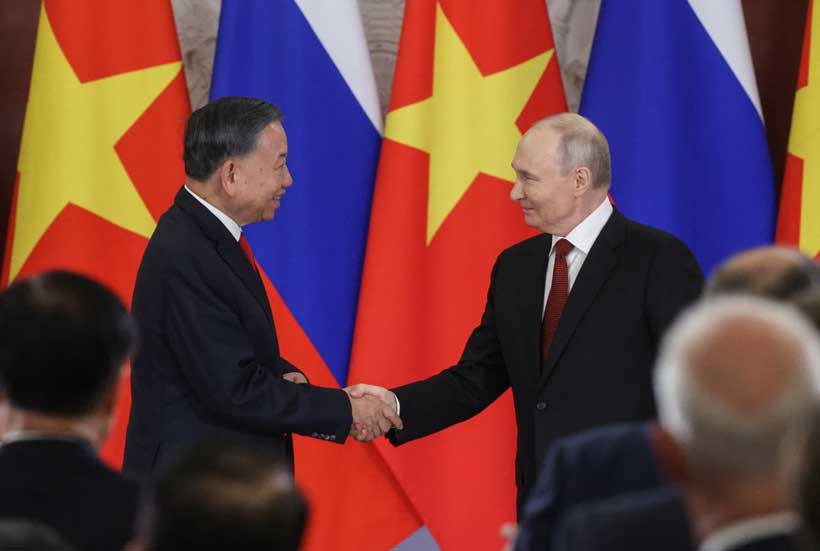
General Secretary and President To Lam’s state visit to Russia from September 7 to 9, 2026, was significant not because it reaffirmed a familiar narrative of traditional friendship, but because it showed how both Hanoi and Moscow are trying to redefine the practical meaning of their Comprehensive Strategic Partnership.
For decades, Vietnam–Russia relations have rested on unusually deep historical and political foundations. Yet historical affinity alone is no longer sufficient to sustain a strategic partnership in an increasingly fragmented international order. The real challenge is whether political trust can be translated into new economic, technological, energy, and security interests.
The September visit suggests that both sides are now moving in that direction.
The most important feature of the emerging framework is the clearer division of roles among different areas of cooperation. Economic and trade relations are being treated as a leading field, defense and security as a strategic pillar, and energy and oil and gas as a strategic breakthrough, while science, technology, innovation, and human resource development are increasingly viewed as long-term drivers of bilateral ties.
Stay ahead of the geopolitical week.
MD Briefing delivers expert analysis across five global fronts — the Indo-Pacific, energy, geoeconomics, European security, and the Middle East — every Monday morning. Free.
This matters because Vietnam–Russia relations have long suffered from a structural imbalance: political relations have remained strong, but economic cooperation has often lagged behind.
A Strong Political Relationship with a Modest Economic Base
Vietnam and Russia share one of the longest-standing diplomatic relationships in Vietnam’s modern foreign policy.
The Soviet Union established diplomatic relations with Vietnam in 1950. After the end of the Cold War, the two countries signed the Treaty on the Basic Principles of Friendly Relations in 1994, established a Strategic Partnership in 2001, and upgraded ties to a Comprehensive Strategic Partnership in 2012.
The legacy of the Soviet period remains visible in Vietnam’s education, science, defense, energy, and industrial development. Generations of Vietnamese officials, engineers, scientists, and military personnel were trained in the Soviet Union and later in Russia. This created a degree of institutional familiarity and political trust that remains important today.
But the weakness of the relationship has always been economic scale.
In 2025, bilateral trade reached approximately USD 4.77 billion. Russia had 199 investment projects in Vietnam with a total registered capital of around USD 990 million, while Vietnam had 16 projects in Russia with a total registered capital of approximately USD 1.6 billion.
These figures are not insignificant, but they remain modest when compared with the political status of the relationship.
This is why the target of raising bilateral trade to USD 15 billion by 2030 should be seen as more than a commercial ambition. It is an attempt to create an economic base more consistent with the political depth of the Comprehensive Strategic Partnership.
The difficulty is obvious.
Reaching that target would require bilateral trade to more than triple from its 2025 level. That cannot be achieved simply by expanding existing trade in coffee, seafood, garments, fertilizers, coal, or other traditional goods.
A broader economic architecture will be required. This means addressing payment mechanisms, financial connectivity, logistics, transportation costs, standards, market access, investment protection, and the limited number of large-scale bilateral projects.
Without progress in those areas, the political relationship will continue to run ahead of its economic foundation.
Energy Is Still the Backbone, but Its Strategic Meaning Is Changing
Energy remains one of the most durable areas of Vietnam–Russia cooperation.
For decades, Vietsovpetro symbolized the practical value of bilateral relations. It was not only an oil and gas venture but also a model of long-term institutional cooperation, technology transfer, and strategic trust.
The emerging energy agenda, however, is broader.
Vietnam and Russia are no longer focusing solely on extracting hydrocarbons. Their discussions now include crude oil and liquefied natural gas supplies, energy storage, strategic reserves, power generation, offshore wind, infrastructure, and nuclear energy.
One of the most important agreements associated with the September visit was the framework between PetroVietnam and Zarubezhneft on studying investment options for a strategic crude oil reserve system in Vietnam. It is significant to two countries because it changes the strategic function of energy cooperation.
Traditional oil cooperation was primarily about production and commercial value. A strategic petroleum reserve, by contrast, is directly linked to national resilience. It could strengthen Vietnam’s ability to respond to supply disruptions, geopolitical shocks, sudden price increases, or instability in international energy markets.
In that sense, cooperation with Russia would no longer concern only energy production. It would also contribute to Vietnam’s capacity to absorb external shocks. That is a much more strategic role.
Other agreements involving PetroVietnam, Zarubezhneft, PVEP, and offshore geological exploration reinforce the same trend. Energy cooperation remains central, but it is increasingly becoming part of a wider framework of energy security rather than simply resource extraction.
Nuclear Power Could Redefine the Relationship
The most politically symbolic area of cooperation may now be nuclear energy.
If Vietsovpetro represented one of the defining achievements of the earlier phase of Vietnam–Russia relations, the Ninh Thuan 1 Nuclear Power Plant could become the defining project of the next one.
The importance of nuclear cooperation goes far beyond electricity generation.
A nuclear power program requires sophisticated capabilities in engineering, construction, materials science, safety regulation, radiation protection, fuel management, waste treatment, emergency response, and specialized education.
This creates an entire technological ecosystem.
For Vietnam, cooperation with Russia in this field could therefore contribute not only to energy security but also to industrial and scientific upgrading.
For Russia, successful participation in Vietnam’s nuclear program would strengthen its long-term technological presence in Southeast Asia. The strategic value lies precisely in this depth.
Unlike conventional infrastructure projects, nuclear cooperation creates relationships that can last for decades. Training, maintenance, fuel supply, regulation, technical assistance, and research all generate long-term institutional links.
That is why the Ninh Thuan 1 project has the potential to become more than an energy project. It could become one of the strongest material anchors of Vietnam–Russia relations in the coming decades.
Technology Is Moving from the Periphery to the Center
Another important change is the role of science and technology.
Historically, education and scientific cooperation were among the strongest elements of Vietnam’s relationship with the Soviet Union and later with Russia. But for many years, these ties were often treated as secondary to defense or energy cooperation.
That is beginning to change.
Artificial intelligence, digital technologies, biotechnology, new materials, automation, quantum technology, nuclear science, and space technologies are increasingly being identified as priority areas. This shift reflects changes on both sides.
Vietnam is placing science, technology, innovation, and digital transformation at the center of its long-term development strategy. Russia, despite economic constraints, retains considerable capabilities in fundamental science, nuclear technology, aerospace, engineering, mathematics, physics, and selected strategic technologies.
The potential complementarity is therefore clear. The key question is whether cooperation can move beyond academic exchanges.
The more important model would connect four stages: research, training, technology transfer, and commercialization. If that happens, Vietnam–Russia technological cooperation could become more relevant to Vietnam’s industrial upgrading and modernization.
Agreements involving the Vietnam Academy of Science and Technology, Russian universities, Russian technology groups, and additive manufacturing initiatives point in this direction.
The real test, however, will be implementation.
Technology cooperation becomes strategically meaningful only when laboratories, universities, firms, and industrial users are connected to one another.
Defense Cooperation Still Matters, but So Does Political Signaling
Defense and security remain a strategic pillar of Vietnam–Russia relations.
This is hardly surprising. Russia has been one of Vietnam’s most important traditional defense partners, and the relationship has included military education, technical cooperation, maintenance, maritime capabilities, and defense technology.
What is more important today is how Hanoi frames that cooperation.
Vietnam has repeatedly emphasized that its defense relations are not directed against any third country. That message is particularly important in the current Indo-Pacific environment.
Vietnam is deepening relations simultaneously with Russia, the United States, China, Japan, India, South Korea, ASEAN members, and European partners. The objective is not to join a bloc but to maintain room for maneuver.
In this context, defense cooperation with Russia is best understood as one element of Vietnam’s broader strategy of diversification. It strengthens an existing strategic relationship without necessarily pulling Vietnam into Moscow’s geopolitical orbit. This distinction matters.
Vietnam’s strategic autonomy depends not only on avoiding formal alliances but also on maintaining sufficiently broad relations so that no single major power becomes indispensable.
Russia remains valuable within that framework because it contributes to diversification in defense, energy, science, and technology.
The Logistics Problem Cannot Be Ignored
One of the least glamorous but most important constraints on Vietnam–Russia cooperation is logistics.
The geographical distance between the two countries, complicated transport routes, high freight costs, financial restrictions, and payment difficulties have all limited the expansion of trade.
This is why discussions of multimodal transportation should be taken seriously.
Options involving Vietnam–China–Russia transport routes, rail connectivity, maritime routes, the International North–South Transport Corridor, and the Northern Sea Route all reflect an attempt to solve a structural problem.
The importance of such connectivity is not limited to bilateral trade.
Vietnam could gain improved access to the wider Eurasian market, while Russia could use Vietnam as one of several gateways into Southeast Asia.
This could gradually transform the relationship from a bilateral partnership into a component of wider interregional connectivity between Southeast Asia and Eurasia.
Such an outcome remains ambitious, but it points to an important principle: the future of Vietnam–Russia economic relations may depend less on tariffs and more on routes, infrastructure, payments, and logistics.
Human Capital May Be the Missing Link
Large strategic projects require more than political agreements.
They require people.
Nuclear energy, advanced manufacturing, artificial intelligence, transport infrastructure, oil and gas engineering, and strategic technologies all depend on specialized human capital.
This makes education more important than it may appear.
Russia has traditionally been a major destination for Vietnamese students, particularly in science, engineering, and technical disciplines. The new challenge is to connect this educational relationship directly to strategic projects.
The most useful model is not simply “study in Russia and return to Vietnam.”
It is project-based training.
Students, engineers, and researchers should be trained specifically for nuclear power, energy systems, advanced materials, transport infrastructure, or high-technology manufacturing projects.
Such an approach would make human resource cooperation part of the implementation mechanism of bilateral agreements.
It would also reduce one of the biggest risks facing large technology projects: the absence of a domestic workforce capable of absorbing and maintaining imported technology.
The Agreements Reveal a Broader Strategic Pattern
The agreements associated with To Lam’s visit are important not because of their number, but because of their structure.
They cover several connected areas: institutional cooperation, investment, energy, strategic reserves, nuclear safety, scientific research, advanced technology, education, and human resource development. This suggests that Vietnam and Russia are trying to build a more layered relationship.
The objective appears to be to move beyond government-to-government diplomacy and create links among state agencies, energy companies, technology firms, universities, research institutions, and financial organizations. That is exactly the kind of structure required if a comprehensive strategic partnership is to become more than a political label.
A strategic partnership becomes durable when interests are distributed across many institutions. The more actors that benefit from cooperation, the more resilient the relationship becomes.
Russia’s Place in Vietnam’s Strategic Autonomy
The broader importance of the visit lies in what it says about Vietnam’s foreign policy.
Vietnam is operating in an international environment characterized by intensifying U.S.–China competition, continuing geopolitical confrontation in Europe, growing technological fragmentation, and increasing pressure on middle and smaller powers to make strategic choices.
Hanoi’s response has been to expand, rather than narrow, its network of partnerships. This is where Russia remains relevant.
Russia is not Vietnam’s largest trading partner. Nor is it Vietnam’s only defense, energy, or technology partner. Its importance comes from the fact that it adds another strategic option.
Vietnam’s relationship with Russia provides access to capabilities in nuclear technology, defense, oil and gas, science, education, and selected strategic technologies while also preserving an important political channel with a major Eurasian power.
This contributes to diversification. And diversification is one of the foundations of strategic autonomy. At the same time, Vietnam is increasingly important to Russia.
Moscow has strong incentives to deepen ties with Asian partners, especially as its economic and political relationships with the West remain constrained.
Vietnam offers political stability, a central position in Southeast Asia, strong ties with ASEAN, a broad network of free trade agreements, and an economy deeply integrated into global supply chains. For Russia, Vietnam is therefore not simply an old friend. It is also a potentially useful economic and strategic bridge to Southeast Asia.
Beyond Nostalgia
For many years, Vietnam–Russia relations were often described through the language of history, gratitude, and traditional friendship.
That language remains politically meaningful. But it is no longer enough. A relationship built primarily on memory will gradually lose strategic relevance unless it produces new interests.
The September 2026 visit suggests that both countries understand this.
Energy security, nuclear power, technology, logistics, investment, human capital, and defense cooperation all provide opportunities to give the relationship a new material base.
The future of Vietnam–Russia relations will therefore depend less on how often the two sides reaffirm their historical friendship and more on whether they can turn political trust into functioning projects.
If the Ninh Thuan 1 Nuclear Power Plant moves forward, if a strategic petroleum reserve is developed, if joint technology programs produce commercial results, if transport corridors become viable, and if bilateral trade approaches the USD 15 billion target, the relationship will look very different by 2030. It would no longer be defined mainly by the legacy of the Soviet era.
It would be defined by contemporary strategic interests. That is the real significance of To Lam’s visit.
Deepening ties with Russia does not necessarily mean Vietnam is looking backward. In a more divided and unpredictable world, it may instead represent another attempt by Hanoi to widen its strategic space, diversify its external relationships, and preserve the freedom to cooperate with multiple major powers without becoming dependent on any one of them.
