


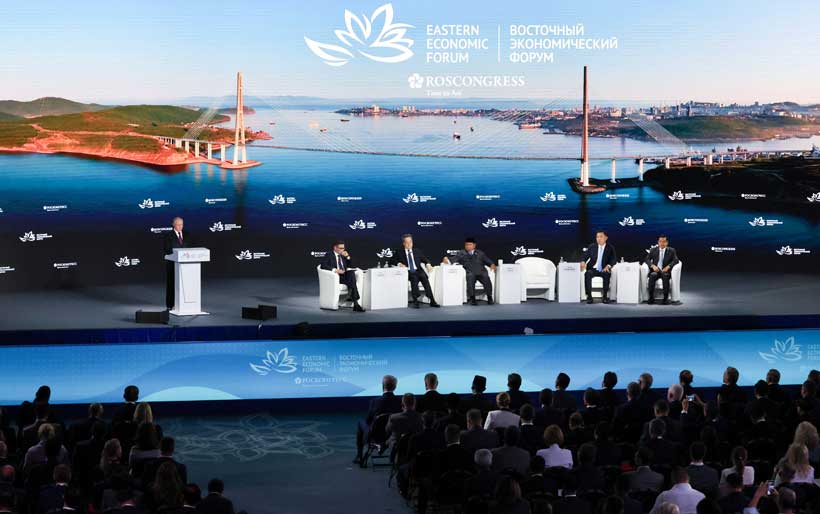
The Eastern Economic Forum (EEF) has been described as a successful solid platform since its creation. It increasingly attracts guests from widely different countries, especially leaders of China, India, Malaysia, Mongolia, and Myanmar. The leaders of Vietnam, Kazakhstan, Laos, and Thailand have visited it in various capacities. The business segment of the forum has long gone far beyond the geographical boundaries of Eurasia. Its frequent unprecedented large number of guests includes businesspeople from South America, Africa, and the Middle East. That, however, it remains open for entrepreneurial contacts with everyone whose natural interests are primarily in the trade, economic, and social spheres. This cross-platform cooperation between the structures is developing, growing deeper and creating a new agenda. The most essential feature is that the platform is guided by the principles of equality, mutual benefit, and honest dialogue, which are entirely different from those of Western-oriented structures.
The EEF, which opened on 1st-4th September, in Russia’s Far Eastern city of Vladivostok, has become a solid platform for open and constructive dialogue among business leaders, government officials, and members of the expert community. It has also become a unique venue for discussing the strategic development of the Russian Far East and the country as a whole, while fostering and strengthening potential partnerships with counterparts, particularly from the Asia-Pacific region, in food production, infrastructure, logistics, industry, energy, and many other sectors of the economy. While recognizing the huge untapped economic potential of the region, it is also understandable that the development of the Far East largely depends on human capital, entrepreneurial efforts, and the ability of regions to create the necessary conditions for realizing the practical expectations.
On 2nd September, as part of the business program, the “Towards a Common Future: Inclusion as a Development Resource for the Far East” discussion was held with a strong focus on how to create an equal opportunity environment, develop human capital, and engage diverse groups in economic and social life. The following day, the majority of the participants in the “Inspiring Investments: A Development Strategy for Growth and Scaling” session touched on funding mechanisms for creative projects, opportunities to enter foreign markets, and collaboration between businesses, investors, development institutions, and government agencies. The key point focused on the development of the creative economy and international cooperation with Asia-Pacific countries, industry investments, the export of intellectual property and creative products, the media’s role in the development and positioning of regions in the Far East, new content formats, and training personnel for the economy of the future.
As part of the discussions at the forum, Russia and the United States continued their business dialogue, headed by Robert Agee, president and CEO of the American Chamber of Commerce in Russia (AmCham Russia), and with the participation of US representatives. It was spearheaded by the Roscongress Foundation in Russia. Anton Kobyakov, Adviser to the President of the Russian Federation, noted, however, that there is a strong appetite on both sides for direct professional engagement. What matters most is to sustain the momentum and possibly broaden the agenda to include bilateral entrepreneurial partnership.
Stay ahead of the geopolitical week.
MD Briefing delivers expert analysis across five global fronts — the Indo-Pacific, energy, geoeconomics, European security, and the Middle East — every Monday morning. Free.
“There is the need to facilitate more networking to identify specific strategic areas for cooperation,” said Robert Agee, president and CEO of the American Chamber of Commerce in Russia, and unreservedly agreed to continue their work on developing business ties and prepare for the participation of American representatives in the Russian Federation.
With many Asian and Pacific participants, explored opportunities for developing small and medium-sized enterprises. This is becoming increasingly important amid structural changes in the economy, as businesses look for new avenues for growth. The EEF made it possible not only to exchange experience but also to find concrete solutions that will help entrepreneurs adapt to changing conditions and unlock new opportunities for growth.
Developing trade, strengthening of interstate ties, and the creation of a common space for interaction among Asia-Pacific countries have assumed a new trend with Russia. The argument was logically based on Russia’s historical experience of cooperation with East Asian countries. It was further underlined that Russia and the Asia-Pacific attract politicians and entrepreneurs from around the world. In these current geopolitical circumstances, Russia needs to seek out new opportunities for development, particularly from the Asia-Pacific region, and with reference to the emerging new multipolar world. At the heart of the forum program was the search for new sources of growth and resilience for SMEs amid structural changes in the economy, from raising productivity and adopting new technologies to managing risks and adapting business models. One section of the program focused on the role of automation and artificial intelligence, changes in business processes, employees’ readiness to work with new technologies, and ways of improving productivity.
In addition to the above, a special session was devoted to analysis where experts outlined the key economic trends across the Asia-Pacific region. As monitored, this session was set out in the analytical review entitled “Asia Trends 2026: The AI Boom, Industrial Relocation, and Geopolitical Fragmentation,” prepared ahead of the opening of the Eastern Economic Forum on 1st September. The review clearly noted, among other things, that Asia accounts for around 60% of global GDP growth and is becoming the world’s new center of trade, industry, technology, finance, and military power. Within the region, however, economic growth is highly uneven, while technology and capital are concentrated in a small group of states, making consolidation difficult. The ASEAN countries, meanwhile, face competition from Chinese manufacturers while also coming under growing geopolitical pressure from Washington. More broadly, the Asia-Pacific region is more exposed than any other to the effects of the energy crisis and to climate risks such as a super El Niño.
According to the International Monetary Fund, Asian GDP grew by 5% in 2025, significantly ahead of global growth of 3.5%. Within the region, however, countries face a range of specific challenges, from high labor costs and insufficient industrial capacity to balance-of-payments difficulties and currency instability. These factors are driving increasingly divergent development paths among Asian economies. The region’s advanced economies, such as Japan and South Korea, posted lower growth rates, at 1.2% and 1%, respectively, in 2025. Asia’s emerging economies grew by 5.5% overall over the same period, with performance ranging from a 2% contraction in GDP in Myanmar to an 8% surge in Vietnam.
Countries with the strongest growth prospects are attracting investment, leaving others with fewer opportunities to draw in capital. According to the United Nations Conference on Trade and Development, developing countries in Asia attracted US$644 billion in foreign direct investment in 2025. That is around 40% of the global total and more than 70% of all investment in developing countries. Capital flows are unevenly distributed: eight of the ten largest recipients of foreign direct investment among developing countries are in Asia, and together they account for around 60% of all inflows to developing economies and more than 80% of inflows to the region.
Capital is becoming increasingly concentrated not only in a small number of countries but also in a narrow range of sectors, particularly artificial intelligence, clean energy, semiconductors, and critical minerals. In the longer term, this could deepen inequality and worsen the position of countries without a strong presence in these fields. Asia is one of the principal beneficiaries of the global AI boom. The investment cycle associated with its development has driven up demand for semiconductors, memory, servers, network equipment, and related electronics. The region occupies a central position in the global supply chain for these products. Technology exports will remain a powerful engine of economic growth in Asia, although the benefits will be distributed unevenly depending on each country’s position in the value chain.
South-East Asia’s role as an industrial center is growing as production capacity relocates there from China, which is no longer a low-cost manufacturing base. Chinese companies have begun redirecting production to Vietnam and Indonesia in particular in order to mitigate the impact of US tariffs. At the same time, China has increased its exports of industrial components and capital goods, supplying the equipment and parts needed by manufacturing centers in other countries. Exports of intermediate goods, including memory chips, other semiconductors, and industrial components, rose by 9% in 2025. Part of this represented an indirect offset to reduced shipments to the United States, as components, particularly in electronics, were used by manufacturers in other countries to produce goods that were subsequently exported to the US. A fall of roughly US$15 billion in smartphone exports, for example, was matched by a comparable increase in shipments of components, notably to India.
In many other cases, however, the growth in exports of components and equipment was not linked to replacing sales China had lost in the US. Instead, it supported the expansion of production in third markets, especially developing ones, reinforcing China’s role as a supplier of production inputs rather than an exporter of finished goods. The result is an integrated supply chain taking shape across the region, encompassing research and development and the manufacture of high-technology components in China, assembly and packaging in an ASEAN country such as Malaysia or Vietnam, and the subsequent shipment of products to markets within the region and beyond.
Amid the fragmentation of the global economy and trade, the development of the Eurasian space calls for resilient regional supply chains and logistical connectivity between states. Russia’s Far Eastern Federal District can play a strategically important role here. Thanks to its location, the district can serve as a resource and logistics gateway within the transport corridors linking European Russia with Asia. For a long time, infrastructure constraints held back the expansion of ties between Russia and Asian states, but the situation has begun to change with the development of the Eastern Operating Domain, which comprises the Baikal–Amur Mainline and the Trans-Siberian Railway.
A program to modernize the Eastern Operating Domain has been under way since 2013, aimed at eliminating bottlenecks on the railways of Siberia and the Far East. Over that period, its carrying capacity has increased by 84%, reaching 180 million tonnes in 2025. The modernization is expected to raise that figure to 210 million tonnes by the end of 2030 and 270 million tonnes by the end of 2032. The development of the rail network and port infrastructure will largely determine the prospects for Eurasia and for the Asia-Pacific region in particular, as the world’s economic, financial, and trade center shifts towards the region.
Emerging trends are reshaping the world; South-South economic partnership is seemingly becoming both the political and economic architecture. Logically, developing collaboration with Asian partners, anchoring discussions on technological leadership, and making breakthroughs in scientific fields and adopting innovative technologies are increasingly reshaping the world. Today, the role of academic institutions is to build a solid scientific and technological foundation that addresses applied industrial challenges while enhancing business efficiency, eco-friendliness, and sustainability. It is only through this synergy between science and the real economic sectors that can bring true multifaceted sovereignty. In conclusion, Asia-Pacific and Russia have to create a new model of economic and business and trade relations in the Global South.
As monitored from official reports, Russia is creating practically a new model of development of the Far East with maximally comfortable conditions for enterprises, as well as legal innovations for the investment climate in the region. Therefore, potential Asia-Pacific investors have to work on new ideas and new strategies for developing trade, agro-processing, industry, and other economic sectors in the Far Eastern region. The Eastern Economic Forum was held from September 1 to 4 on the campus of the Far Eastern Federal University. This year’s theme: “The Far East: Development for the Benefit of People.” It was the 11th EEF and organized by the Roscongress Foundation.
