


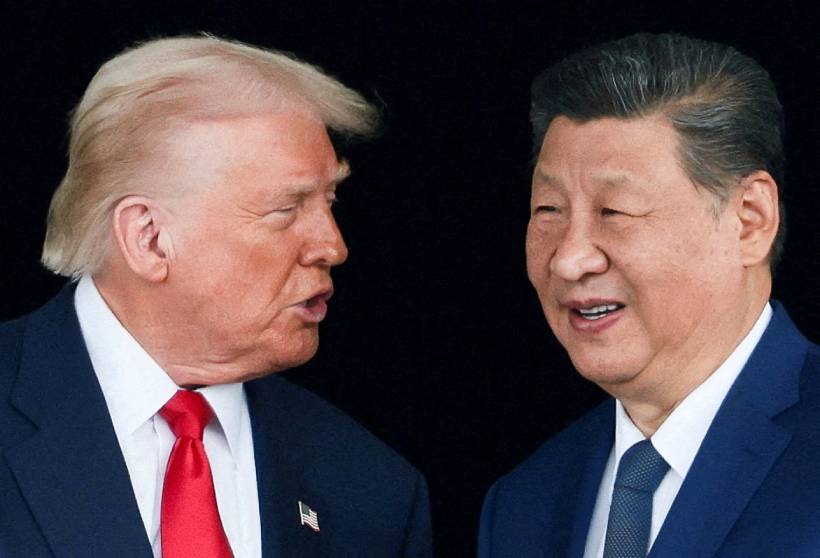
In May 2026, at his own state banquet for Donald Trump in Beijing, Xi Jinping did something unusual for a leader who rarely improvises on camera: he invoked Thucydides amid Cold War 2.0. The Athenian historian’s warning that the fear a rising power instills in an established one makes war “inevitable” was not academic flourish; it was strategic signaling, delivered with the calm of a man who no longer needs to raise his voice to be heard. As Xi prepares to walk into the White House on September 24, in the backdrop of Trump’s ‘Operation Economic Outcast’ impacting China and BRICS, the real story is not whether China is rising. It is whether a distracted, politically bruised America even notices what is rising around it.
I have argued since 2022, in what I called an “Art of Smart Dictatorship with Chinese Characteristics,” that Xi governs through a system pairing absolute personal control at home with patient, calibrated expansion abroad—all wrapped in diplomatic theater designed to keep rivals guessing. Four years, a full US presidential transition and a second Trump-Xi summit season later, that framework has only sharpened. Banquets and handshakes on the surface; purges and Antelope Reef Island underneath.
Summit Theatre: What Trump-Xi 2.0 Really Signals
The Beijing summit produced choreography, not resolution. Trump left declaring “fantastic” trade outcomes, but no joint statement and no verifiable breakthroughs followed him home. What it did produce was Trump’s invitation for Xi to visit Washington on September 24—timed around the UN General Assembly session, giving Xi a dual-purpose trip: multilateral theater in New York and bilateral leverage inside the White House itself. As I argued in “Trump, Xi, and Cold War 2.0: Managing Rivalry in a Fragmented World,” this is a rivalry unfolding under “adversarial coexistence” between powers that remain “deeply intertwined economically, technologically, and financially even as they posture against each other militarily, diplomatically, and strategically.” That paradox will define the September visit as much as it defined Beijing.
Stay ahead of the geopolitical week.
MD Briefing delivers expert analysis across five global fronts — the Indo-Pacific, energy, geoeconomics, European security, and the Middle East — every Monday morning. Free.
What should we expect? Limited, transactional deliverables dressed up as strategic stabilization. Artificial intelligence is reportedly on Trump’s agenda, and Beijing will likely offer symbolic gestures—a soybean purchase commitment, perhaps a rare-earths concession—in exchange for tariff relief and a softer American posture on export controls. What will not move an inch is Taiwan, technology decoupling, or the South China Sea. Xi has never needed a summit to concede ground on core interests; he uses summits to buy time while facts on the ground harden steadily in his favor. Expect warm rhetoric about “stable and healthy” relations, a handful of announcable deals for domestic audiences on both sides, and a quiet continuation of the structural contest underneath—precisely the pattern I described as an era where “the US-China rivalry is here to stay,” regardless of how the theater is staged.
The Thucydides Trap, Invoked by the Dictator Himself
That Xi personally raised the Thucydides Trap with Trump in Beijing was arguably the most revealing moment of the summit season. It was not a slip; it was strategic signaling of the highest order. By reframing China’s ascent as historical inevitability rather than deliberate expansion, Xi exported smart dictatorship into the very language of diplomacy—an attempt to make Washington internalize that confrontation is mutually costly, while Beijing reserves for itself the right to keep rising unchecked. Serious historians increasingly dismiss the Thucydides Trap as deterministic pseudo-history, and that caveat matters. But it matters less than the political effect Xi intended: planting in Trump’s mind the idea that restraint, not resistance, is the wiser course.
The Island Washington Barely Noticed.
While the summit dominated headlines, China was quietly finishing the first phase of a man-made island on Antelope Reef in the Paracels—roughly 1,500 acres of reclaimed land, with satellite imagery in August showing barges and dredgers withdrawing after completion of that phase, comparable in scale and intent to Mischief Reef in the Spratlys a decade earlier. Beijing calls it civilian infrastructure. The emerging outline, including what analysts read as preparation for a military-grade runway, tells a different story. This is smart dictatorship playing out geographically: build faster than rivals can react, dispute the narrative rather than the underlying facts, and let sheer scale outpace any meaningful international legal response—the same pattern flagged by me back in 2022, when Beijing “junked the ruling of the Permanent Court of Arbitration and violated UNCLOS” without paying any real price for it. Four years on, the price remains theoretical. The island is now very concrete.
The Purge: Xi’s Real Consolidation Story
The most under-covered story of Xi’s third-plus term is not diplomatic; it is internal. Since 2022, over a hundred senior PLA officers have been dismissed, investigated, or simply vanished from public life. In January, General Zhang Youxia—Vice Chairman of the Central Military Commission, a childhood friend of Xi’s, and one of the PLA’s last genuinely combat-experienced senior officers—was placed under investigation alongside Joint Staff Chief General Liu Zhenli. The Central Military Commission, normally seven members strong, is now reportedly down to two: Xi himself and his loyal discipline chief. This is not routine anti-corruption housekeeping. Analysts link the timing to unease over the political reliability of a military Xi did not personally build and to internal disagreements over combat readiness ahead of a possible Taiwan contingency window later this decade. It is the smart dictator’s oldest instinct—what I described in 2022 as a “complete overhaul of the top hierarchy”—now taken to its logical extreme: absolute personal control over the gun, even at the cost of institutional continuity and short-term readiness.
America, Distracted
None of this—the island and the quiet planning around Taiwan—is unfolding in a vacuum. It is unfolding while Washington’s bandwidth is consumed by the war in Iran, disputes over Greenland and Venezuela, and a domestic climate in which Trump’s approval has slid to some of the lowest levels of his presidency. As I observed after the May summit, “an over-engaged US with depleted reserves works towards Chinese strategic advantage.” An America relitigating tariffs, fighting fires across the Middle East, and bracing for a difficult midterm cycle is, almost by design, an America that cannot simultaneously give the Indo-Pacific the sustained attention a rising China demands. Every hour spent managing Tehran or Caracas is an hour not spent countering Antelope Reef or reassuring Taiwan, Manila, Hanoi, and Tokyo.
Rising China, Declining America? A Reality Check
It would be too simplistic to declare a clean verdict of rising China against declining America. China’s vulnerabilities are real: a purged and unsettled military leadership, a slowing economy, adverse demographics, and a Thucydides Trap thesis that serious scholars dismiss as fatalistic pseudo-history. Xi has concentrated more personal power than any Chinese leader since Mao, but concentrated power also concentrates risk. A hollowed-out Central Military Commission is a fragile instrument of command, not necessarily a stronger one; however, it can be soon restructured.
Yet the comparative trajectory is hard to ignore. Where Xi projects strategic patience—building islands, restructuring his military on his own unhurried timeline, and using summit diplomacy to buy space rather than concede ground—Trump’s America projects transactional impatience: a costly, unpopular war in Iran; an approval rating in freefall; and steadily eroding narrative ground on trade, alliances, and sovereignty, from Greenland to Panama to the South China Sea itself. An increasingly unreliable America for allies and partners is resulting in their bee-lining towards Beijing. China is playing a decades-long game with a leader who answers to no electorate. Washington is playing a quarter-to-quarter game with a leader whose domestic mandate is visibly eroding and who is friendless at this moment.
That asymmetry of time horizon, more than any single summit, island, or purge, will likely decide the next phase of this rivalry. Smart dictatorship does not need to defeat American power outright to succeed. It only needs to outlast American attention. From the runway rising on Antelope Reef, to ‘Operation Outcast’ and its responses, leading to the carefully choreographed September calendar in Washington, Xi is confident that he will have his say. Watching a distracted superpower manage crisis after crisis of its own making, that confidence does not look unreasonable.