


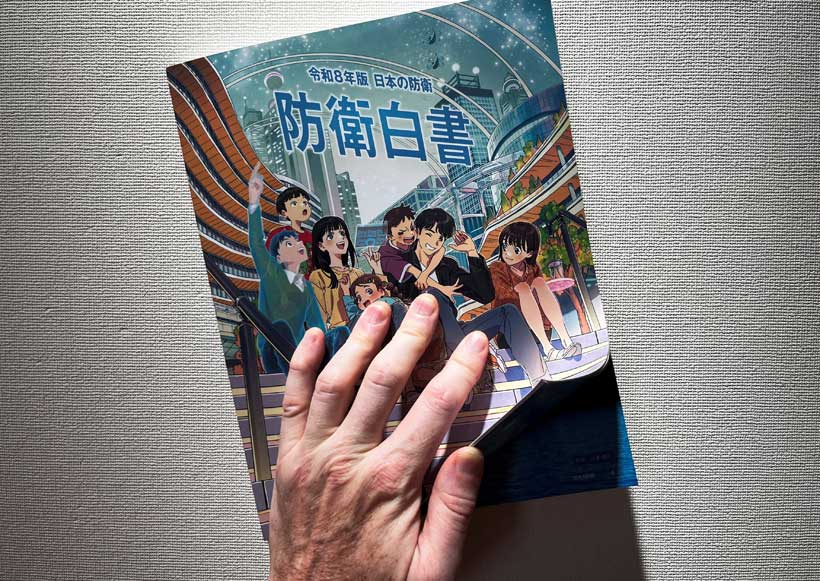
Japan has remained at the forefront of global attention for several reasons in recent times — from concerns over an economic bubble and a slowing economy to a weakening yen. On the leadership front, Prime Minister Sanae Takaichi, Japan’s first female prime minister of the postwar era, has continued in the tradition of the late Prime Minister Shinzo Abe, advancing the Free and Open Indo-Pacific vision toward greater resilience and shared prosperity in economic growth, infrastructure, connectivity, and regional and global security — an agenda increasingly tied to rule-making in the age of AI and data. Japan has also been updating its national security and defence documents while working to raise its defence budget. Against this backdrop, Japan’s Defence White Paper 2026 was released in early August, built around the theme of “new ways of warfare,” as described by Defence Minister Shinjiro Koizumi.
Re-identifying Old and New Security Concerns
The 2026 white paper reemphasises the many dangers surrounding Japan’s security environment, highlighting areas of concern in red on an accompanying map under the heading “the international community and the greatest trial of the postwar era.” The document describes the postwar order as facing conditions it calls “as severe and complex as it has ever been,” citing countries that repeatedly attempt to unilaterally change the status quo, pursue global dominance, reshape the existing international order, and develop new warfare tactics, cyberspace-related capabilities, and gray-zone strategies. These have been recurring concerns in Japan’s defence white papers in recent years.
One key development highlighted in the document is the emergence of science and technology as a gamechanger in security. Countries are racing to develop innovative technologies, and the fact that Japan itself is positioning as a leader in innovation speaks to how security dynamics have shifted worldwide — tech-driven tactics are increasingly preferred over direct, face-to-face conflict. Alongside its concerns over China’s posture on Taiwan, North Korea’s missile and nuclear developments, and deepening Russia-China cooperation, the white paper identifies these “new ways of warfare” as a defining trend of the current threat landscape.
Stay ahead of the geopolitical week.
MD Briefing delivers expert analysis across five global fronts — the Indo-Pacific, energy, geoeconomics, European security, and the Middle East — every Monday morning. Free.
New Ways of Warfare and Challenges
In the age of AI and data, warfare itself is transforming. A growing volume of inexpensive, unmanned assets is being used to strike expensive equipment, disable infrastructure, and complement conventional shells and missiles — a pattern the white paper draws directly from the war in Ukraine, where low-cost drones combined with conventional missiles have repeatedly overwhelmed costlier defences (see the USNI News digest of the white paper). This shift is forcing states to rethink the value of expensive legacy armoury against cheaper, more numerous alternatives. At the same time, AI and integrated networks spanning space, cyber, electromagnetic, and information warfare are becoming more sophisticated, enabling faster tactical decision-making. Countries are advancing applications of AI, quantum computing, and semiconductors to address security challenges across energy, space, and unmanned systems, while also pushing to localise defence production — a shift reshaping technological bases and strengthening bilateral relationships in the process. Japan’s own budget reflects this urgency: its FY2026 defence budget surpassed 9 trillion yen for the first time, part of an accelerated push toward spending 2% of GDP on defence.
What Is the Need of the Hour?
Having identified these new ways of warfare, Japan now needs to deepen cooperation with like-minded countries on joint defence production and the manufacturing of advanced weapons systems — an effort the white paper itself gestures toward through its revision of the Three Principles on Transfer of Defense Equipment and Technology. Minilateral coalitions built around joint production, playing to each country’s individual strengths, and shared market access could be a useful vehicle for this. Equally important is the creation of joint training facilities among like-minded countries to build a skilled pool of experts in space, cyber, electromagnetic, and information warfare. Since science and technology will define future warfare, advanced countries should also help emerging partners in Southeast Asia and Sub-Saharan Africa build their own war-ready technical expertise, widening the global pool of talent. Japan, the United States, India, and Singapore are well placed to lead this effort, given their existing technological capacity and shared strategic interest in a stable, rules-based order.
