For almost six decades, the United Arab Emirates had been a member of OPEC, but all of that came to an end on May 1, 2026, when Abu Dhabi announced its exit from OPEC as well as the OPEC+, which was first formed in 1967. After three months of this incident, it becomes imperative to determine if the doomsday scenarios about OPEC+ after the exit of UAE were true or if OPEC+ has somehow managed to move past this.
Cohesion, test but not broken yet
The decision by the UAE to exit was not an emotional one; rather, it marked the end of an ongoing issue involving quotas. The emirate of Abu Dhabi had spent about $150 billion to raise its capacity to 5 million barrels per day, while its OPEC+ quota stood at 3.5 million b/d. This problem has been a bone of contention for UAE since at least 2021. Since Saudi Arabia refused to change its stance, the UAE decided to leave. According to the U.S. Energy Information Administration, without the UAE, OPEC’s share of world crude would be roughly 31%, and OPEC+’s share of global production slips might slip from 46% to closer to 42%.
The immediate worry was contagion. That worry is Iraq as in June, Baghdad, OPEC’s second-largest producer and one of the group’s five founding members, began publicly warning that it might follow the UAE out the door unless its quota was raised to reflect both its production capacity and its postwar reconstruction needs. However, Iraq’s oil ministry has since walked the threat back rhetorically, insisting it has “no intention” of leaving and prefers to work within OPEC’s mechanisms, but stressed that quotas still need review. Analysts have noted that an Iraqi exit would be a considerably more serious blow than the UAE’s, given Iraq’s status as a founding member and its far larger share of output.
Stay ahead of the geopolitical week.
MD Briefing delivers expert analysis across five global fronts — the Indo-Pacific, energy, geoeconomics, European security, and the Middle East — every Monday morning. Free.
So has cohesion held? Technically yes, as the seven remaining core producers (Saudi Arabia, Russia, Iraq, Kuwait, Kazakhstan, Algeria and Oman) have kept meeting on schedule and kept agreeing unanimously, including Iraq itself, on every monthly adjustment since the UAE’s departure. But the Iraqi episode shows the UAE’s exit set a precedent that unhappy members can now point to.
The Production Decisions Themselves
On the substance, OPEC+ has actually been more, not less, active since May. The group’s April and May increases, agreed before the UAE’s exit took effect on May 1, were 206,000 b/d each month. The most recent meeting, held virtually on August 2 concluded that the seven countries agreed to a further 188,000 b/d increase, to take effect in September. This marks the sixth consecutive monthly increase and completes the unwinding of the 1.65 million b/d tranche of voluntary cuts the group first adopted in 2023, back when the UAE was still a member. The most recent confirmed country-level breakdown comes from the August allocation is Saudi Arabia and Russia each added 62,000 b/d, taking their targets to roughly 10.4 million and 9.9 million b/d respectively; Iraq added 26,000 b/d to reach about 4.4 million b/d; Kuwait added 16,000 b/d, Kazakhstan added 10,000 b/d, Algeria added 6,000 b/d and Oman added 5,000 b/d. Reporting on the September decision notes the per-country increments announced for August 2 mirror the same distribution used in the prior months’ statements, though OPEC’s own release for September does not itemize the breakdown beyond the 188,000 b/d group total.
Notably, several of these “increases” exist mostly on paper. UBS analyst Giovanni Staunovo has pointed out that many OPEC+ members cannot produce up to their new targets because of eroded capacity, while the closure of the Strait of Hormuz during the recent Middle East conflict physically capped how much crude Gulf producers could get to tankers.
Market reaction: relief, not panic
Markets have not treated the UAE’s exit, or the string of production hikes that followed it, as a crisis. Brent touched above $126 a barrel during the Iran war, but by early July but as Strait of Hormuz shipping began normalizing and OPEC+ kept adding barrels, Brent had settled back toward the low $70s. July then delivered the largest monthly gain since March, with Brent surging roughly 24% and WTI climbing about 21%, driven largely by residual war risk near the Strait rather than by OPEC+ stability concerns. The September decision itself was “widely expected” and barely moved markets on its own, with Brent trading around $84–90 a barrel in early August amid Hormuz tanker incidents rather than reactions to the OPEC+ meeting. However, Jorge Leon from Rystad Energy has said that the real market impact will come when normal export flows resume.
What this means for Producer Coordination going forward
The information up until now indicates that the organization appears to have been more resilient than the initial reactions after its exit implied, yet an organization working in a tighter space. OPEC+ has managed to live up to its monthly commitments, held Iraq within the fold despite its flirtations with leaving and achieved a technical reversal of cuts from 2023 without any friction in its official pronouncements.
However, the underlying issue that caused the UAE to exit, which involved members having the capacity to produce more than their quotas allowed, has not gone anywhere; it has merely moved to Iraq. The Middle East Institute has floated that OPEC+ might eventually need new capacity, through membership growth (Kuwait and a post-Maduro Venezuela have both been mentioned) or through reallocating quotas among existing members.
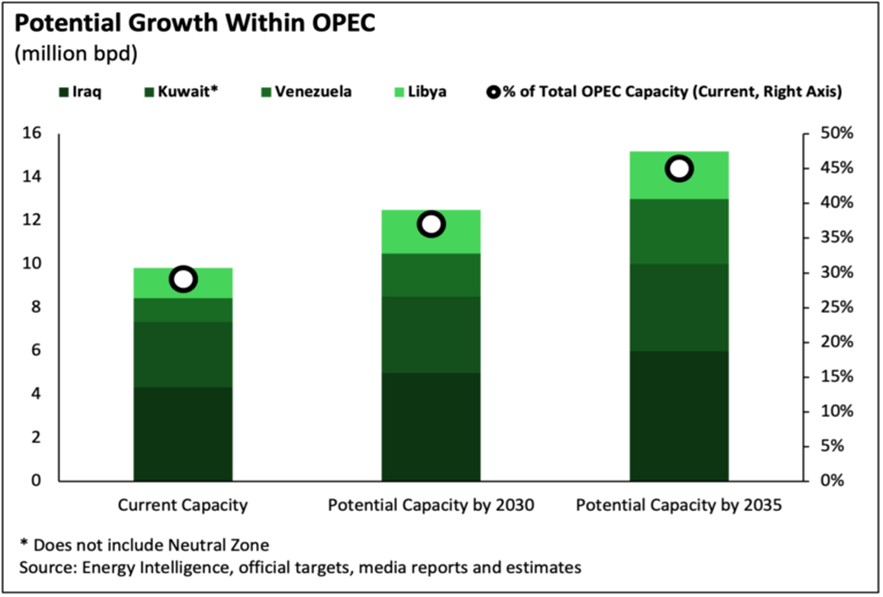
Source: Middle East Institute
Neither path is straightforward, and 2027’s renegotiation now looms as the moment those tensions get resolved or not. The UAE’s exit was not the beginning of OPEC+’s unraveling as September’s decision suggests the alliance can survive one departure. Whether it can survive a second is the real test still to come.