


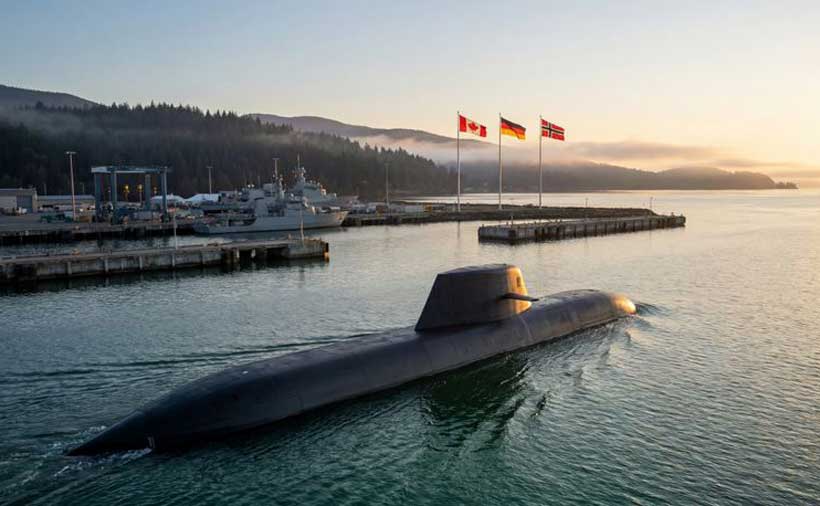
During the July 2026 North Atlantic Treaty Organization (NATO) summit in Ankara, Prime Minister Carney announced Germany’s ThyssenKrupp Marine Systems (TKMS) as Canada’s primary supplier for 12 diesel-electric Type 212CD submarines over the Republic of Korea (ROK)’s Hanwha Ocean to replace its Victoria-class submarine fleet. Carney believes this will strengthen interoperability with NATO allies and increase Canada’s maritime presence in the Atlantic Ocean.
However, despite Carney’s reassurance of Canadian commitment to the Indo-Pacific, this signals a quiet, significant geopolitical retreat. By choosing Germany over the ROK, Canada fundamentally shifts its ambitions of becoming a major player in the Pacific toward a more traditional role as a Eurocentric actor.
Getting Down To Brass Tacks
Beyond intentions to strengthen NATO operations, the type of submarines Canada wants to procure has little to no relevance to the Pacific Ocean.
Stay ahead of the geopolitical week.
MD Briefing delivers expert analysis across five global fronts — the Indo-Pacific, energy, geoeconomics, European security, and the Middle East — every Monday morning. Free.
Germany’s Type 212CD by TKMS is an electric-powered stealth submarine that uses air-independent propulsion technology to stay submerged for weeks at a time and is designed in partnership with Norway. They are exclusively tailored for the shallow, icy waters of the Atlantic and Arctic oceans and optimized to stand against Russian undersea activity.
The ROK’s KSS-III Batch II by Hanwha Ocean has a similar diesel-electric submarine fleet, yet it provides long-range operation capabilities that Arctic-optimized boats aren’t built for. Its defining attribute is its Vertical Launch System (VLS), allowing long-range cruise missiles, and it is primarily designed for land attacks. Most importantly, the ROK’s main selling point to Canada was Indo-Pacific maritime expansion.
Despite both submarines meeting the military requirements for Canada, the 212CD’s Arctic operation strengths point to Canada’s renewed focus on NATO commitments and operations against Russian forces. While factors like timeline and industrial costs may have contributed to Canada’s decision, they don’t explain the strategic signal here. This decision implies Canada will not plan to send its new submarines to counter China’s navy, especially in places like the South and East China Seas, where sustained submarine presence is necessary to deter Chinese presence. Especially when a procurement of this size occurs, Canada has picked a submarine better oriented for potential European conflicts, not the Pacific theater.
Undoubtedly, tripling the Canadian submarine fleet, strengthening interoperability between NATO allies, and increasing Arctic maritime presence is a huge upgrade for deterring Russian military operations. But the strategic upgrades in the Atlantic Ocean come at a cost in the Pacific Ocean.
Indo-Pacific Implications
The most immediate concern of this decision points to Canada’s Operation HORIZON’s future sea operations, especially with submarines. Operation HORIZON is Canada’s military plan to promote stability within the Indo-Pacific region by participating in pan-domain military activities with Pacific allies. Canada has remained steadfast in maintaining these commitments by running recent tactical deployments like Exercise Valiant Shield and Rim of the Pacific (RIMPAC). However, this submarine deal directly contradicts Operation HORIZON’s broader goals, increasing military interoperability between the Indo-Pacific and supporting its anti-submarine warfare efforts. Especially as China grows its undersea submarine fleet, Canada’s designed submarines from the ROK would have played a significant role in deterring China.
While many say Canada’s newly procured Type 212CD submarines or its existing submarines can simply be sent to the Indo-Pacific and resolve this problem, this is simply not true. As of July 2026, Canada has only 1 operational submarine that simply cannot patrol the Pacific and Arctic coasts, and the new procurement is expected to be delivered in 2034. And while the Type 212CD can theoretically operate in Pacific waters, the ship’s capabilities are centered on NATO’s preexisting infrastructure and cannot execute timely cross-Pacific transits like the ROK’s KSS-III submarines. Forcing the Type 212CD submarines to be used in the Pacific would mean an extremely slow transit and a critical absence of missile payload to deter China, bringing minimal strategic value to the Pacific region.
Furthermore, the working assumption that frameworks like AUKUS or the Quadrilateral Security Dialogue, and shipbuilding partnerships have been that the US and its allies, like Canada, would gradually add more maritime presence against China. But Canada has made it especially clear they will not be a first-order contributor to Pacific deterrence. This submarine procurement from Germany moves Canada closer to Europe and the Atlantic, yet further away from Indo-Pacific matters.
The ROK’s Loss
This was a huge loss for the ROK, both economically and strategically. The ROK’s growing defense export industry has been trying to appeal to its allies with its own sea vessels but has been particularly unsuccessful in submarine affairs. Along with the failed Canada deal, Hanwha Ocean also failed to win the contract to build India’s Project-75I submarines. These contracts are economically crucial to the ROK’s key defense exporters, such as Hanwha Ocean, as seen after Canada’s announcement, when their stock dropped by over 20%.
More importantly, the ROK’s pursuit of submarine contracts in North America and Europe can be seen as ROK efforts to advance broader defense cooperation. The same interoperability that Carney refers to for NATO’s submarine forces is exactly what the ROK hopes to develop within the Indo-Pacific. If Carney did go with the ROK, the allied submarine presence would reinforce a collective deterrence against China rather than Russia.
Looking Ahead
Canada’s Indo-Pacific commitment is sincere, but its procured submarines say otherwise. Arctic-hulled submarines aren’t used to patrol Pacific waters, no matter how committed Canada is. The ROK has just learned that the Western alliance’s defense procurement circle depends on a stronger alliance infrastructure it doesn’t yet have. A distinct level of interoperability and political trust NATO has built across North America and Europe is an element the ROK simply cannot compete with.
If the Indo-Pacific countries truly want to establish a greater network of defense procurement with their European and North American counterparts, they need a procurement architecture like NATO’s that makes an Indo-Pacific partner the easy option. Institutional support, procurement agencies, common logistics protocols, and joint interoperability standards could be the starting points for the ROK and its neighbors.
