


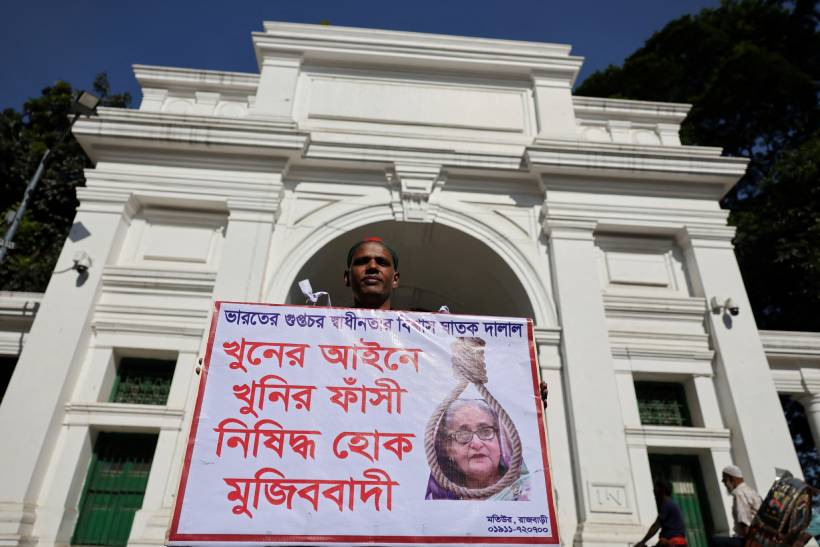
Ousted Bangladeshi Prime Minister Sheikh Hasina said she plans to return from exile in India around December alongside senior members of her banned Awami League party to surrender to authorities, despite facing a death sentence and the possibility of arrest or assassination.
Speaking to Reuters in her first interview since fleeing Bangladesh in 2024, Hasina said she intended to voluntarily return to face the legal proceedings against her, arguing that doing so would expose what she described as politically motivated prosecutions.
“They may arrest me on my return, they may even kill me,” the 78-year-old said during a nearly hour-long telephone interview conducted late Thursday and into Friday.
“Still, I have to go,” she said. “My party leaders and workers are being subjected to tremendous repression. If death comes, I want it to come on my own soil, where my parents are buried and where their blood was shed.”
Stay ahead of the geopolitical week.
MD Briefing delivers expert analysis across five global fronts — the Indo-Pacific, energy, geoeconomics, European security, and the Middle East — every Monday morning. Free.
Hasina sets first timeline for return
Hasina fled Bangladesh after mass protests in 2024 ended her two-decade rule as prime minister across multiple terms.
In November, Bangladesh’s war crimes tribunal sentenced her to death in absentia over the deadly crackdown on a student-led uprising that toppled her government. She has denied the charges and dismissed the proceedings as politically motivated.
Her comments mark the first time she has publicly outlined a timetable for returning, said she intends to surrender voluntarily, or indicated that other senior Awami League leaders in exile plan to do the same.
Among those expected to return is former Home Minister Asaduzzaman Khan Kamal, who also faces a death sentence. Reuters was unable to independently confirm the whereabouts of other Awami League leaders.
“The authorities in Dhaka want to take me back, they are repeatedly sending letters to India seeking to have me sent back,” Hasina said.
“I will go myself.”
She declined to specify an exact date for her return or identify the court where she plans to surrender.
Exile strains Bangladesh-India relations
Hasina’s presence in India has become a major source of tension between Dhaka and New Delhi.
Bangladesh has repeatedly requested her extradition since she sought refuge in India following her removal from office.
India has not publicly indicated whether it will comply. Its foreign ministry said in April it was reviewing Bangladesh’s extradition request while seeking to maintain constructive relations with the country’s new government.
Neither Bangladesh’s government nor India’s foreign ministry immediately responded to requests for comment on Hasina’s latest remarks.
From democracy campaigner to embattled leader
Hasina has been one of Bangladesh’s most influential political figures for decades.
She entered politics after the 1975 assassination of her father, Sheikh Mujibur Rahman, the country’s founding leader, and much of her family during a military coup.
Initially celebrated for campaigning against military rule and later credited with driving strong economic growth, her government increasingly faced accusations from opponents and international rights groups of suppressing dissent, undermining democratic institutions and restricting political freedoms.
Hasina has consistently denied those allegations.
According to a United Nations report, as many as 1,400 people were killed during the crackdown on anti-government protests that ultimately forced her from office.
Awami League seeks political comeback
Hasina said Awami League members have faced widespread arrests, legal cases and attacks since her government fell.
“Cases have been filed against almost all of our leaders and workers, and many of them are in hiding,” she said.
“So I said that this time I am returning home, and one day, all of you should come. All together, we will all surrender in court.”
She insisted she had not held secret discussions with Bangladesh’s authorities about her return.
“Democracy, voting rights, the political rights of the Awami League and justice are not subjects for secret talks,” she said.
Hasina added that imprisonment would not deter her, noting she had previously been jailed several times during Bangladesh’s political upheavals, including under military rule and during a military-backed caretaker government in 2007 before returning to win elections in 2008.
Future outlook
Hasina acknowledged that her conviction could prevent her from contesting future elections but argued that Bangladesh’s voters—not the courts should determine the Awami League’s political future.
“They may have convicted me, and I may not be able to contest elections,” she said.
“But why should they suspend the Awami League? If we have done badly, let the people decide.”
Her planned return could become one of Bangladesh’s most significant political developments since the 2024 uprising, testing both the country’s judicial system and its ability to manage deep political divisions while potentially affecting already strained relations with neighboring India.
With information from Reuters.
