


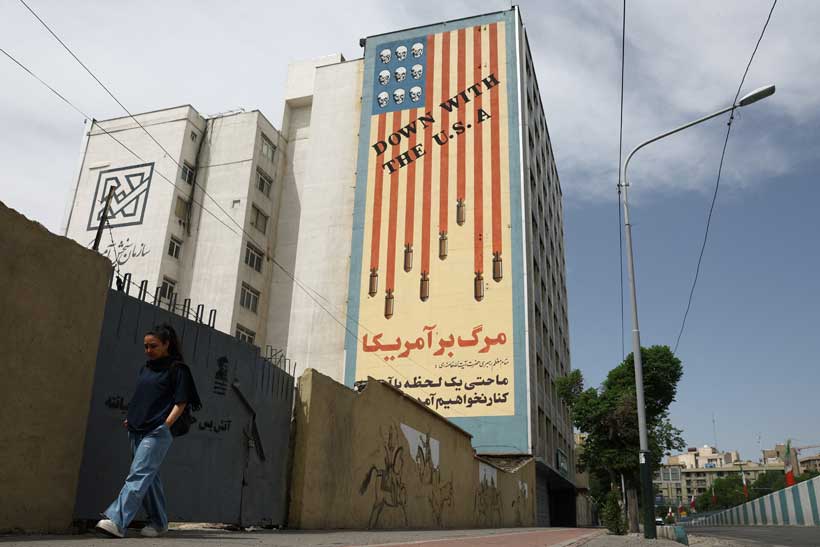
The Iranians have come out on top after the conflict. They have demonstrated themselves as a pure and united nation by not dividing into small factions during the recent militarily confrontation with the United States and Israel. The Americans and Israelis were seemed to be launching a shock and awe strategy against the Iranians to overwhelm them and easily bring down their regime.
However, they were unable to accomplish their task, resulting in social pressure from within the United States, as 61% people were not in favor of launching a war of choice against Iran while the escalation concluded in huge financial setbacks for both the U.S and Israel.
According to John Kiriakou – the former CIA officer, Trump was told by the Israeli Prime Minister that they could easily topple the regime of Iran due to prevailing social unrest at that time. But the Iranians remained intact and united, rallying behind their government. This shattered Americans and Israelis ambitions.
On the day Americans and Israelis launched an unprovoked aggression against Tehran, Iran imposed a closure of the Strait of Hormuz, which made Iran to maintain upper hand throughout the confrontation and sustain its position against the enemy.
Stay ahead of the geopolitical week.
MD Briefing delivers expert analysis across five global fronts — the Indo-Pacific, energy, geoeconomics, European security, and the Middle East — every Monday morning. Free.
Strait of Hormuz was open before 28th February, but during the war it was observed that the United States presented its closure as a cause of war, whereas it was obviously a consequence of the war. In addition to this context, Tehran laid a lot of mines in the waters of the Strait of Hormuz to hinder the flow of maritime trade across the strait.
From the beginning, the Iranians adopted a military strategy called Mosaic Defense, in which they decentralized their defense system, dividing their military into 31 factions which were able to take any decision on spot without asking from the central command of Tehran. This gave their military to take sudden military decisions and hit military targets as per their choice. This strategy significantly helped the Iranians hold the upper hand in the conflict, maintain their position, and stand firm against their enemy.
The Iranians also pursued the strategy of asymmetric warfare, attacking with cheap Shahed-136 drones and using different types of missiles to overwhelm the enemy. They used drones of worth around 20000 to 50000 $ while the Americans and Israelis were using expensive defensive equipment of worth 1 million to 4million dollars.
Iran fought Americans forces using a strategy called horizontal warfare, broadening the conflict across the Middle East by attacking Americans bases in the region and making the region increasingly vulnerable and unstable for the other countries there. This helped Iran consolidate their hard power in the region.
Islamic Revolutionary Guards Corps (IRGC) eliminated the most expensive radars of the US situated in different countries of the region. They blew up AN/FPS-132 and AN/TPY-2 Radar systems of the US in Qatar and Jordan respectively.
Along with that, they decimated American 5th fleet headquarter in Bahrain, which held 75% of the US military power in the region, resulting in heavy losses for Washington. Furthermore, Iran inflicted pain on more than dozen American bases in the Middle East.
It was seemed that Tehran converted this war into a war of attrition by slowly weakening the Americans over time. They were fully prepared for this protracted war but it did not go in favor of the United States, as Washington was unable to afford a protracted war at lot.
Therefore, President Trump was increasingly perceived as pursuing a deal with Tehran over time, emphasizing that a deal was in progress and would be reached soon. As a result, president trump had to sign a memorandum of understanding (MOU) with Tehran on 17th June 27, 2026 to save the world economy from another Great Depression.
The extent which Washington achieved its objectives remain open to debate. These goals included the overthrow of the regime, the de-weaponization of Iran, and the weakening of the country’s strategic potential.
According to the U.S political scientist Robert Pape, Iran has emerged as the fourth center of power, following the US, China, and Russia. It was obvious that Iran had been preparing for possible military misadventure by the U.S and Israel since 1979.
One of the crucial steps that Iran took after the Islamic revolution was the creation of the Islamic Revolutionary Guards Corps (IRGC) parallel to its national army. Consequently, it had huge leverage over the US and Israel during overall confrontation.
Moreover, this military confrontation between the U.S and Iran gave huge advantage to Tehran, making its position stronger in the regional politics and globally. Resultantly, Tehran has achieved what it had been unable to gain over the last 47 years. It successfully gained the removal of sanctions, the release of its $24B frozen assets, dominance over the Strait of Hormuz, and recognition as a regional power. Apart from that, it still retains its regional proxies and ballistic missile program.
While the Americans and Israelis miscalculated the war, assuming that they could win a quick and decisive victory by decapitating the regime. For that they orchestrated a plan to quickly topple the regime through a shock-and-awe campaign and they wanted to place people on the top that were subservient to them. However, the Iranian military emerged as a key deterrent against the adversary and made the pursuit of Washington’s objectives complicated.
