


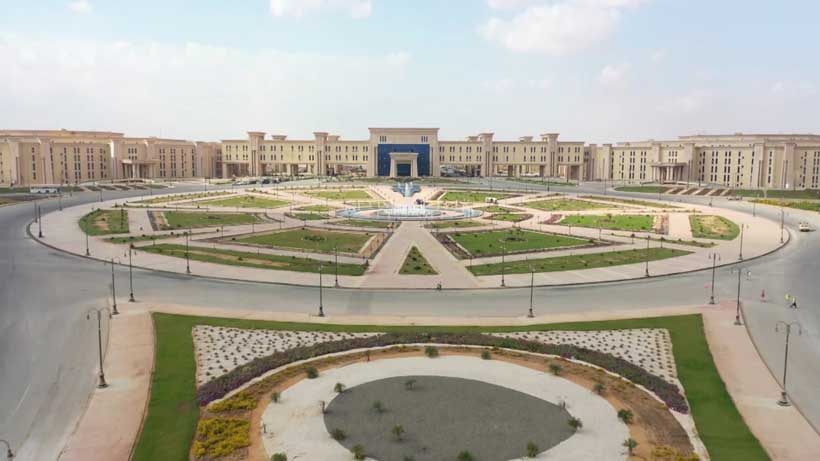
Chinese military circles and websites view the new Egyptian Strategic Command headquarters, “The Octagon,” of the Egyptian Ministry of Defense in the New Administrative Capital near Cairo as an unprecedented engineering and architectural marvel and a significant qualitative addition to command and control capabilities in the Middle East. Military assessments and intelligence analyses accurately confirm this Chinese perspective, as the new Egyptian Ministry of Defense headquarters, “The Octagon,” is not classified as a traditional military facility but rather represents the nerve center for crisis management, the most modern and largest in the Middle East and Africa.
The most prominent analyses and assessments from Chinese military experts and websites focused on the integrated engineering design of the Egyptian “Octagon” headquarters. Chinese observers praised the intelligent fusion of Pharaonic architectural style with modern engineering, considering the headquarters an architectural masterpiece symbolizing Egyptian civilization. From a Chinese military perspective, this makes it one of the largest command centers globally. Chinese military experts have highlighted the project’s scale and vast area, exceeding 92 square kilometers, ranking it among the largest defense ministry facilities worldwide. The Chinese military is also emphasizing the opening of the “Egyptian Octagon” as a national project in which China hopes to officially participate (transitioning to digitalization and artificial intelligence). Chinese military websites are closely following the Octagon’s reliance on the latest secure communication systems and artificial intelligence technologies for data analysis and crisis management, keeping pace with modern developments in cyber warfare and management. A Chinese military perspective views the operations as a fully integrated network.
Chinese military and intelligence think tanks analyzed the significance of the opening of the new Egyptian Ministry of Defense headquarters, known as “the Octagon,” considering it a key Egyptian entity that highlights the Egyptian state’s crisis management strategy. Chinese military reports emphasize that the building represents the “strategic brain of the Egyptian state,” providing advanced infrastructure to connect all Egyptian state institutions and agencies. This enhances the Egyptian Armed Forces’ ability to manage situations with high efficiency during times of peace, crisis, and war. Beijing views this Egyptian military complex as a comprehensive strategic step that confirms Egypt’s vision for modernizing its defense infrastructure and aligns with the state’s overall plan to relocate all its headquarters and ministries to the New Administrative Capital, where major Chinese companies are contributing to the development of several projects.
The strategic importance of the “Octagon” as the brain of the Egyptian state, from a Chinese military perspective, lies in its role as a unified central command. The new headquarters of the Egyptian Ministry of Defense, the “Octagon,” connects all vital state institutions, communication networks, and control centers to ensure rapid decision-making and flexibility during crises. The building was designed, based on Chinese military and intelligence analyses, to function as a comprehensive geographic operations room managing emergencies, natural disasters, and security threats in both peacetime and wartime. Furthermore, the new Octagon headquarters employs advanced Egyptian military protection methods to secure data and communications. This includes a high-speed fiber optic network and massive data centers secured against cyberattacks and intrusions. Its deterrent and sustainable capabilities are enhanced by fortified underground facilities that guarantee the continued operation of the General Command of the Armed Forces and Egyptian state institutions under the most intense military conditions, particularly in the current circumstances following the Iran war and the Strait of Hormuz crisis.
Stay ahead of the geopolitical week.
MD Briefing delivers expert analysis across five global fronts — the Indo-Pacific, energy, geoeconomics, European security, and the Middle East — every Monday morning. Free.
Satellite images of the Chinese military command center (“Beijing Military City”) and Egypt’s “Octagon” complex in the New Administrative Capital reveal a striking similarity in their adoption of the approach of massive, fortified complexes equipped with unprecedented digital and security infrastructure, all of which surpass even the U.S. Department of Defense’s Pentagon. Regarding the comparisons between the Chinese and Egyptian military command centers, intelligence analysts point out that China is building a complex known as “Beijing Military City” on the outskirts of Beijing, covering an estimated 1,500 acres, making it the largest command center in the world more than ten times the size of the US Department of Defense (the Pentagon). Furthermore, the Chinese military command headquarters boasts enhanced strategic fortification capabilities. Located away from the open administrative center in central Beijing, China focuses on constructing fortified and partially underground facilities in the western hills to provide maximum protection against nuclear or bunker-buster attacks, in addition to its advanced cyber capabilities. Here, the Chinese system, similar to the Egyptian Ministry of Defense’s Octagon military command headquarters, focuses on integrating artificial intelligence technologies and managing the People’s Liberation Army forces, while imposing strict secrecy procedures in anticipation of any wartime scenario.
As for the detailed comparison between the two main military command centers, the Chinese and Egyptian Octagon and Beijing Military City, in terms of area, size, and scope, China is constructing its military complex, known in intelligence circles as “Beijing Military City,” about 30 kilometers southwest of Beijing. It spans a vast area of approximately 1,500 acres (equivalent to 7.4 square kilometers), exceeding the size of the Pentagon by more than ten times, making it the largest military command center in the world. On the Egyptian side, the Octagon complex (the new headquarters of the Egyptian Ministry of Defense) is distinguished as one of the largest strategic command and control centers at both the regional and global levels, housing a large number of administrative centers designed for multi-service and comprehensive command. In terms of (design and fortification), satellite imagery analysis reveals massive underground structures on the Chinese side, including a complex network of deeply fortified bunkers specifically designed to withstand nuclear attacks and ensure the continuity of the Chinese high command during wartime. On the Egyptian side, the Octagon represents a sophisticated military architectural masterpiece, comprising eight main buildings (representing the departments and branches of the Egyptian Armed Forces). It features extremely robust concrete designs and centers equipped with the latest advanced digital command and control systems to manage all sectors of the state. Regarding secrecy and security, the Chinese authorities maintain strict secrecy surrounding the Beijing military city project, subjecting the site to stringent security measures and severely restricting access for ordinary citizens. Images show its increasing reliance on partially buried structures to ensure maximum concealment. On the Egyptian side, the “Octagon” complex boasts the highest levels of technological and physical security, with integrated monitoring and protection measures implemented around the building using state-of-the-art defense technologies. In terms of strategic functions, on the Chinese side, the Beijing Military City project is a pivotal part of the People’s Liberation Army’s military modernization plan, aimed at enhancing deterrence and centralized command capabilities and linking operations across all domains (land, sea, air, space, and cyber). On the Egyptian side, the “Octagon” represents the strategic and operational brain of the Egyptian Armed Forces, integrating command, control, and crisis management systems, thus facilitating decision-making and highly efficient troop deployment in all strategic directions.
Compared to the capabilities of other major powers, facilities like Beijing Military City, the world’s largest command center, achieve digital integration and are fully prepared to protect the country’s leadership in the most difficult conflicts. This underscores that investing in such fortified strategic cities and headquarters has become an imperative for any nation seeking to preserve its sovereignty and independence while maintaining state continuity. In emergencies or direct attacks, such as complex regional war scenarios and the repercussions of military conflicts, the headquarters of Beijing Military City, or the Egyptian Octagon, ensures the continuous management of all state facilities, ministries, and governorates through real-time coordination. This is due to the advanced protection it provides through early warning and simulation. The Chinese and Egyptian military command centers include an information network connected to the most powerful early warning and forecasting systems and utilize simulation systems to predict and accurately address external threat scenarios. For example, the Egyptian Octagon allows for the unification of all operations rooms and sovereign and security institutions in a single, secure complex, completely eliminating any gaps resulting from geographical disparities and expediting critical decision-making. Both the Chinese military headquarters and the Egyptian Octagon are managed by closed communication networks and control systems isolated from the public internet, making them completely immune to cyberattacks and Western and American espionage programs. They are also equipped with jamming systems to counter missiles launched from abroad.
Accordingly, the Egyptian Octagon (the country’s strategic command center) represents the brain and robust cyber shield protecting Egyptian national security. It ensures the continuity of decision-making and the management of state institutions under the most challenging circumstances and modern threats, including fourth- and fifth-generation warfare. This facility relies on a sophisticated technological infrastructure, making it a strategic pillar of deterrence in the region. Therefore, advanced command and control centers like the Egyptian Octagon and the Chinese military city near Beijing are vitally important in protecting the country’s national security from foreign interference amidst current regional tensions and conflicts.
