


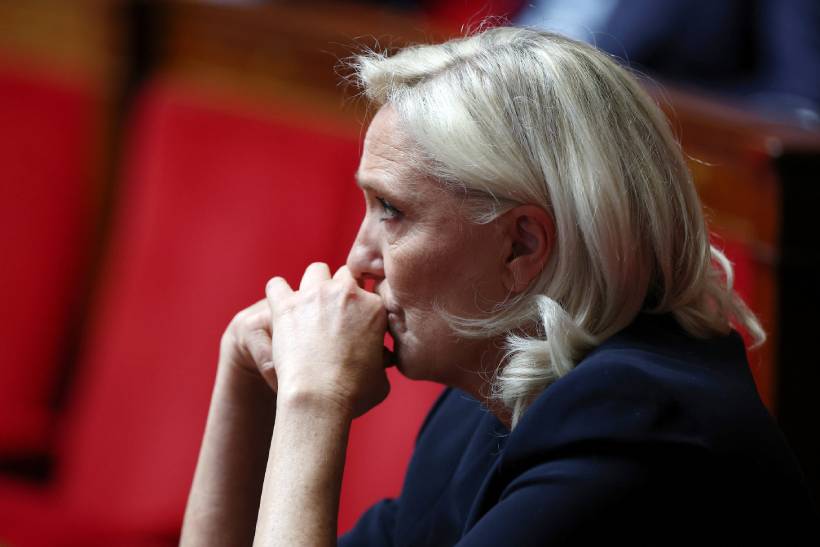
French far-right leader Marine Le Pen faces one of the most consequential legal moments of her political career, with an appeal court in Paris set to rule next week on whether she can remain eligible to contest France’s 2027 presidential election.
Le Pen is appealing a conviction for misusing European Parliament funds that resulted in a five-year ban from holding public office. The ruling could either revive her presidential ambitions or effectively end them, opening the door for National Rally president Jordan Bardella to become the party’s candidate.
Background: What is the EU funds case?
The case centers on allegations that Le Pen and her party improperly used European Parliament funds intended to pay parliamentary assistants.
French investigative outlet Mediapart first reported in 2013 that two senior members of Le Pen’s party, then known as the National Front (FN), were employed as parliamentary assistants while allegedly working primarily for the party instead of the European Parliament.
Stay ahead of the geopolitical week.
MD Briefing delivers expert analysis across five global fronts — the Indo-Pacific, energy, geoeconomics, European security, and the Middle East — every Monday morning. Free.
Investigators later concluded that the practice extended beyond those appointments and formed part of a broader system of so-called “fake jobs.”
Under European Parliament rules, lawmakers receive funding to hire parliamentary assistants for legislative work, but those funds cannot legally finance political party activities.
Following a seven-year investigation, Le Pen and more than two dozen others were ordered to stand trial in 2023 over the alleged misuse of EU funds. She and the National Rally denied any wrongdoing.
What did the court decide?
In March 2025, a Paris court found Le Pen guilty of playing a central role in a scheme that misappropriated more than 4 million euros ($4.56 million) in European Parliament funds.
The court imposed:
- A five-year ban from holding elected office, effective immediately.
- A four-year prison sentence, with two years suspended and the remaining two to be served under home detention.
- A 100,000-euro fine.
The National Rally was also fined 2 million euros, half of which was suspended.
Eight former Members of the European Parliament and 12 parliamentary assistants were also convicted.
The ruling dealt a major blow to Le Pen, who had emerged as one of the leading contenders for France’s 2027 presidential election.
How has Le Pen defended herself?
Le Pen has consistently denied wrongdoing, describing the prosecution as politically motivated.
During the original trial, she argued that parliamentary assistants often perform political work connected to their elected representatives and that prosecutors had adopted an excessively narrow interpretation of their duties.
The trial court rejected those arguments, with Presiding Judge Bénédicte de Perthuis noting that the defendants’ lack of acknowledgement or remorse contributed to the decision to impose an immediate ban from public office.
During the appeal proceedings, Le Pen adopted a more measured tone.
She told the court that if any offence had occurred, neither she nor her colleagues believed they were acting unlawfully, while continuing to reject accusations that an organised scheme existed.
Prosecutors have maintained their request for a five-year ban from public office and a four-year prison sentence, with one year to be served under home detention and the remainder suspended.
What happens next?
The Paris appeal court is expected to issue its ruling on July 7.
Several outcomes are possible:
Conviction overturned
If the court overturns Le Pen’s conviction, she would be free to run in the 2027 presidential election.
Legal experts, however, view this as the least likely outcome given the detailed findings in the original judgment.
Conviction upheld
If the court upholds both the conviction and the five-year ban, Le Pen would remain ineligible to contest the 2027 election.
That scenario would likely make National Rally president Jordan Bardella the party’s presidential candidate.
Reduced sentence
The court could uphold the conviction while reducing or removing the ban from public office.
A ban shortened to two years or less could allow Le Pen to return in time for the 2027 presidential race because the original disqualification began in March 2025.
Further appeal
If the conviction is confirmed, Le Pen could still appeal to France’s highest court, the Cour de Cassation.
However, she has previously indicated she would not pursue another presidential campaign if a final legal decision comes too late to prepare for the election.
Future outlook
The appeal ruling is likely to shape not only Marine Le Pen’s political future but also the direction of France’s far-right movement ahead of the 2027 presidential election.
If she remains barred from office, Jordan Bardella would become the National Rally’s leading candidate, marking the first time in decades that the party contests a presidential race without Le Pen at the top of the ticket. A reduced sentence or acquittal, however, would keep alive her long-held ambition of winning France’s highest office after three previous presidential bids.
Analysis: Why the ruling matters beyond Marine Le Pen
The appeal court’s decision could reshape not only Marine Le Pen’s political future but also the trajectory of France’s far right ahead of the 2027 presidential election.
For years, Le Pen has transformed the National Rally from a fringe movement into one of France’s dominant political forces. By softening the party’s image and broadening its appeal, she brought it closer to power than at any point under her father, Jean-Marie Le Pen. Polls before her conviction consistently placed her among the leading contenders for the presidency.
If the court upholds the five-year ban, the party is expected to pivot fully toward Jordan Bardella, its 30-year-old president. Bardella has become one of France’s most popular politicians among right-wing voters and could attract younger supporters, but he lacks Le Pen’s decades of campaign experience and has never led a national presidential campaign. The transition would therefore carry both opportunities and risks for the National Rally.
The case also highlights the growing influence of the judiciary on European politics. Across Europe, courts have increasingly played a decisive role in determining the political futures of high-profile leaders through corruption, ethics and misuse-of-public-funds cases. Le Pen’s supporters argue the judiciary is interfering in the democratic process, while her opponents contend that elected officials should be held to the same legal standards as everyone else.
A ruling that bars Le Pen from office could also reshape France’s broader political landscape. President Emmanuel Macron cannot seek another term, leaving the 2027 race unusually open. If Le Pen is excluded, both the far right and mainstream parties would need to recalibrate their strategies, while rival conservative and centrist candidates could seek to attract voters who had expected to back her.
Conversely, if the court reduces or overturns the ban, Le Pen would likely re-enter the race as one of the strongest contenders. Such a decision would reinforce her long-standing narrative that she has been unfairly targeted by political opponents, potentially energizing her base.
Ultimately, the ruling is about more than one politician’s legal fate. It will influence leadership within France’s largest opposition party, shape campaign dynamics for the 2027 presidential election, and test public confidence in the balance between judicial accountability and democratic choice.
With information from Reuters.
