


The recent maritime cooperation renewal between Vietnam and Russia (2026-2030) is deliberately pushing Vietnam to become Southeast Asia’s dominant sea power, propelled by South China Sea pressure, multi-vector defence diversification and a state-mandated blue economy strategy.
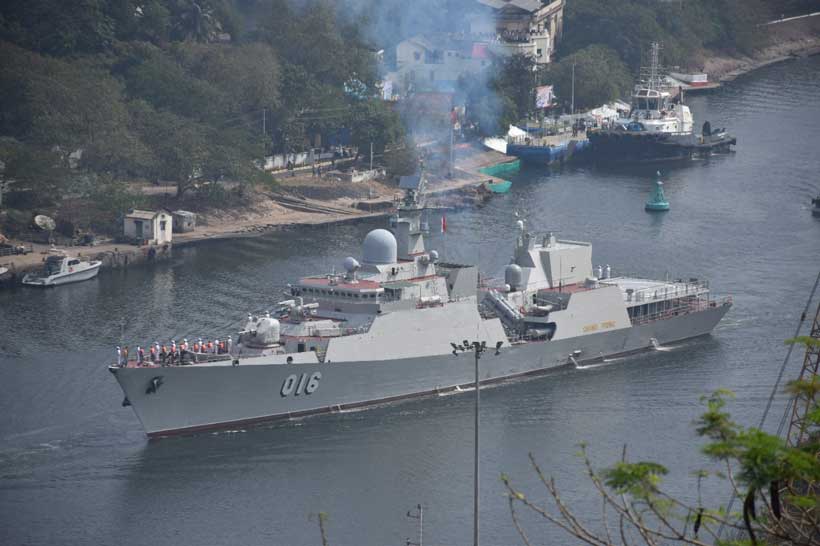
In August 2025, Vietnam had already created roughly 70% as much artificial island in the Spratlys as China, beginning construction on eight previously untouched features in 2025 and expanding to all 21 of its occupied features, which ensures Hanoi will match or surpass Chinese reclamation. At sea, the Vietnam People’s Navy operates Southeast Asia’s largest submarine fleet– six Russian Project 636 Kilo-class boats armed with 3M-14E Klub cruise missiles, delivered between 2014-2017, alongside four Gepard-class frigates. This move highlights a asymmetric response designed to ensure Beijing does not perceive Vietnam as easy prey.
Vietnam moves to legitimize its lawfare to support military hardware. In July 2024, Vietnam filed its third extended continental shelf submission with the UN Commission on the Limits of the Continental Shelf, explicitly invoking Article 76 of UNCLOS. Inside ASEAN-China Code of Conduct negotiations, Hanoi has pushed for rules outlawing artificial islands and Air Defence Identification Zones. Vietnam’s coast guard is also expanding, three former US Hamilton-class cutters have been transferred under the Excess Defense Articles programme, while Japan’s JICA ODA loan is delivering six Aso-class patrol vessels, making Vietnam the largest regional operator of Japanese-built large cutters. A legalized maritime militia, expanded under the 2019 Law on Militia and Self-Defence Forces, completes the grey-zone picture.
The Russia deal is one example of Vietnam’s deliberate diversification. Vietnam now holds Comprehensive Strategic Partnerships with all five UN Security Council permanent members plus Japan, South Korea, Australia, India, Indonesia and others, 14 at the latest of November 2025. Russia supplied roughly 80% of Vietnamese arms import over 1995-2021. Hanoi knows its dependence on Russia is now a liability.
Stay ahead of the geopolitical week.
MD Briefing delivers expert analysis across five global fronts — the Indo-Pacific, energy, geoeconomics, European security, and the Middle East — every Monday morning. Free.
Moreover, Hanoi is advancing the talks with India on a Brahmos supersonic anti-ship missile deal valued at roughly $700 million, building on the gifted INS Kirpan corvette in 2023. The United States, after the September 2023 Comprehensive Strategic Partnership signed, has transferred three Hamilton-class cutters and is in reported talks over F-16s and US-built helicopters. Japan and South Korea are supplying patrol vessels and artillery systems respectively. However, Russia retains value as a source of submarine sustainment, Bastion-P coastal missiles and Su-30MK2 maritime strike aircraft, which is precisely why the 2026-2030 maritime plan keeps Moscow in the loop.
This strategy gives asymmetric concerns. The long-term costs of keeping everyone close could outweigh the benefits, and that Comprehensive Strategic Partnerships without substantive security assistance amount to symbolic insurance. Vietnam’s concurrent participation in a first-ever joint military exercise with China in late 2025, even as it signed military deals in Washington and New Delhi, emphasizes how acrobatic the balancing act has shift.
On blue economy sector, Resolution 36-NQ/TW (2018) commits Vietnam to becoming a “strong maritime nation”, with pure marine sectors contributing 10% of GDP and coastal provinces 65-70% by 2030. Vietnam’s revised Power Development Plan VIII targets 6 GW of offshore wind by 2030 and up to 91.5 GW by 2050, against a technical offshore-wind potential the World Bank estimates at around 599 GW, one of the largest in Southeast Asia. Moreover, Vietnam is investing USD 5 billion on transforming Phu Quoc for APEC 2027.
Fisheries employ roughly 4.5 million people. Vietnam’s shipbuilding industry operates 88 enterprises with a 3.5 million tonne annual capacity, ranked seventh globally in 2024. Each of these sectors is contested or vulnerable in the South China Sea. Chinese coast guard pressure on Vietnamese-licensed oil blocks and systematic harassment of fishing vessels, with Beijing simultaneously seeking to coerce Hanoi into joint-development arrangements on Chinese terms. This is why Hanoi treat naval and coast guard expansion as economic policy as much as security policy. The Russian marine scientific cooperation framework, including the Vietnam-Russia Tropical Centre’s joint research on marine ecosystems and island environments.
Vietnam’s sea power push deserves to be taken seriously. Hanoi’s navy is dwarfed by China’s South Sea Fleet, naval modernization has slowed materially sine the last Kilo delivery in 2017, and the state-owned shipbuilding conglomerate SBIC has entered bankruptcy proceedings, a sobering gap between rhetorical ambition and industrial reality. Secondary sanctions risks on Russian arms procurement add financial complexity that the Moscow plan cannot paper over.
Hanoi is seeking to ensure that the South China Sea cannot be turned into a Chinese lake at Vietnam’s expense, not seeking to challenge China’s overall maritime dominance. Hanoi also tries to position itself as the clear second naval power in Southeast Asia, outstripping Indonesia, Malaysia, the Philippines and Singapore in submarine reach, coastal missile coverage and occupied Spratly islands. The recent May 2026 Moscow meeting, the India BrahMos negotiations and the US Hamilton-class transfers are chapters in pushing Vietnam to realize its sea power goal.
