


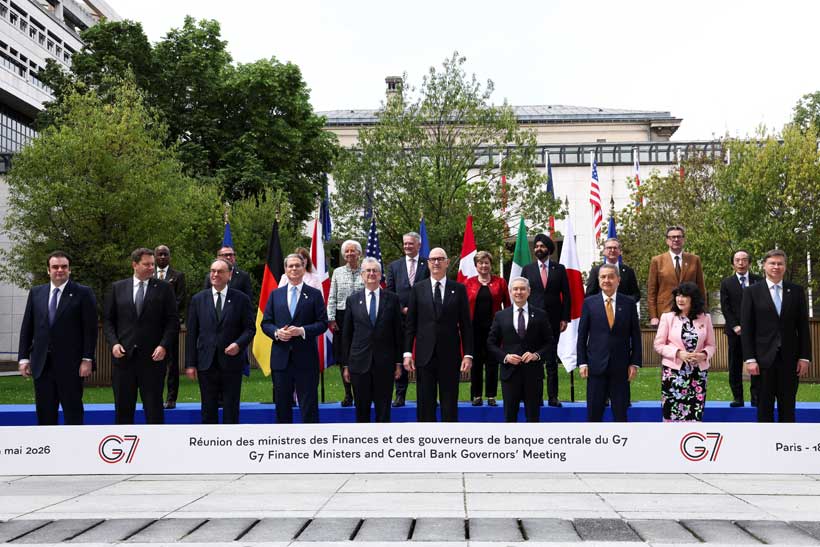
Finance ministers and central bank governors from the Group of Seven gathered in Paris to address growing economic risks linked to the conflict involving Iran, instability in global bond markets, and wider concerns about the future of international trade and supply chains.
The meeting, hosted by French Finance Minister Roland Lescure, brought together not only G7 members but also representatives from Gulf countries, Brazil, India, Kenya, South Korea, Syria, and Ukraine.
The expanded participation reflected increasing concern among major economies that geopolitical conflicts and economic fragmentation are creating long term risks for global stability.
Concerns Grow Over Economic Fallout From Iran Conflict
One of the central issues discussed was the economic impact of the ongoing tensions involving Iran and the broader Middle East.
Stay ahead of the geopolitical week.
MD Briefing delivers expert analysis across five global fronts — the Indo-Pacific, energy, geoeconomics, European security, and the Middle East — every Monday morning. Free.
Although United States President Donald Trump recently announced that he had paused a planned military strike against Iran to allow further negotiations, fears remain over the possibility of renewed escalation.
Several governments reportedly expressed frustration that military actions involving the United States and Israel had proceeded without sufficient consideration of the potential consequences for global markets, energy supplies, and inflation.
Particular concern surrounds the possibility of disruptions in the Strait of Hormuz, one of the world’s most strategically important shipping routes for oil and energy exports.
Officials warned that any prolonged interruption could sharply increase energy prices, fuel inflation, and worsen economic conditions globally.
International Institutions Asked to Increase Support
France urged the International Monetary Fund and the World Bank to increase assistance for countries most vulnerable to the economic fallout from the Middle East crisis.
French officials highlighted concerns over rising fertiliser shortages and food security pressures that could disproportionately affect developing economies.
The discussions reflected broader fears that geopolitical instability could deepen inequality between advanced economies and lower income nations already struggling with debt, inflation, and fragile growth.
By involving countries from the Gulf, Africa, Asia, and Latin America, the G7 also appeared eager to strengthen international partnerships at a time when traditional alliances face increasing strain.
G7 Focuses on Supply Chains and Critical Minerals
Beyond the Iran conflict, finance ministers discussed growing concerns about fragmented global trade systems and dependence on China for critical minerals and rare earth supplies.
Countries within the G7 are increasingly seeking to coordinate efforts to diversify supply chains for materials essential to industries such as renewable energy, electric vehicles, advanced technology, and defence manufacturing.
German Finance Minister Lars Klingbeil argued that Europe must become more assertive in protecting its economic interests and strengthening local industrial capacity.
Meanwhile, European Economic Commissioner Valdis Dombrovskis acknowledged that reducing reliance on Chinese supply chains would require significant time, investment, and long term planning.
Debate Continues Over Russia Sanctions
The meeting also addressed policy differences regarding sanctions on Russia linked to the war in Ukraine.
European officials stressed the need to maintain economic pressure on Moscow despite the United States granting another temporary extension allowing certain purchases of Russian seaborne oil to support energy vulnerable countries.
European leaders signalled concern that easing restrictions too quickly could weaken international leverage against Russia while the conflict in Ukraine continues.
Analysis
The Paris meeting illustrates how global economic policy is becoming increasingly shaped by geopolitical instability rather than purely financial considerations.
The Iran conflict has highlighted the vulnerability of the international economy to disruptions in energy markets and strategic shipping routes. Even the possibility of military escalation has already contributed to volatility in oil prices, inflation expectations, and bond markets.
For the G7, the challenge is not only managing immediate economic risks but also adapting to a rapidly changing global order marked by fragmented trade systems, geopolitical rivalry, and declining confidence in traditional globalisation models.
The growing focus on critical minerals and supply chain resilience reflects broader strategic competition with China. Advanced economies increasingly view economic dependence on geopolitical rivals as a national security concern rather than simply a trade issue.
At the same time, disagreements within the G7 reveal underlying tensions about how to balance economic stability with geopolitical objectives. European frustration over unilateral military decisions by the United States and concerns about sanctions policy demonstrate that Western unity is becoming more complex and conditional.
The meeting also underscores the expanding role of middle powers and developing economies in global economic diplomacy. By involving countries from multiple regions, the G7 appears to recognise that solving issues related to energy security, trade, debt, and conflict increasingly requires broader international cooperation.
Ultimately, the discussions in Paris reflect a world economy entering a period of heightened uncertainty where conflicts, strategic competition, and supply chain politics are becoming central drivers of economic policy and financial stability.
With information from Reuters.
