


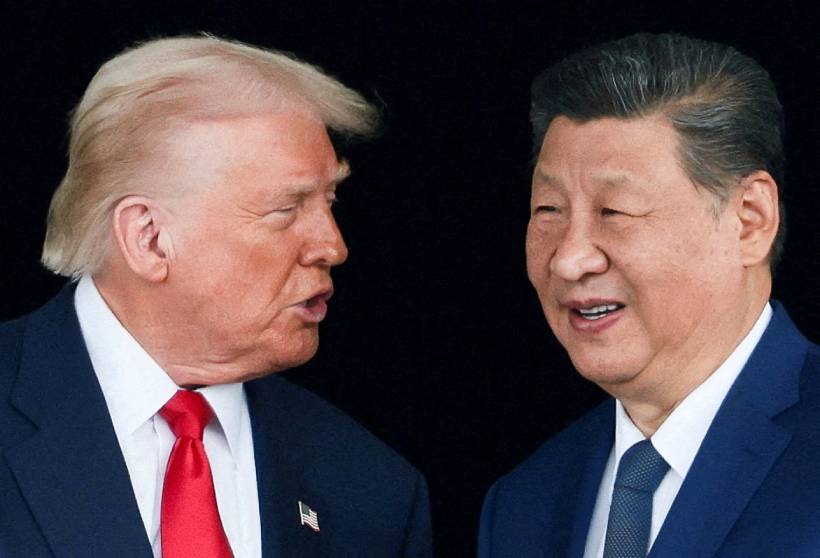
U.S. President Donald Trump departed for China on Wednesday ahead of a high stakes summit with Chinese President Xi Jinping, while downplaying the need for Beijing’s involvement in efforts to resolve the ongoing Iran conflict.
The visit comes at a critical moment as the war in Iran continues to disrupt global energy flows, particularly through the Strait of Hormuz, one of the world’s most important oil transit routes.
Trump Downplays China’s Role in Iran War
Before leaving Washington, Trump stated that he did not believe U.S. efforts to manage the Iran conflict required assistance from China.
He emphasized that the United States would achieve its objectives with or without external help, while reaffirming his central priority of preventing Iran from obtaining nuclear weapons.
Stay ahead of the geopolitical week.
MD Briefing delivers expert analysis across five global fronts — the Indo-Pacific, energy, geoeconomics, European security, and the Middle East — every Monday morning. Free.
Trump’s remarks suggest that Iran will remain a unilateral focus in U.S. policy discussions, even as the broader geopolitical implications affect relations with China.
Strait of Hormuz Becomes Central Flashpoint
The conflict has intensified tensions around the Strait of Hormuz, a strategic waterway responsible for transporting a significant share of global oil supplies.
Iran has reportedly strengthened its control over the passage through new regional arrangements and expanded operational influence, raising concerns about long term stability in global energy markets.
Efforts by other countries to establish alternative shipping agreements highlight growing uncertainty over maritime security in the region.
Rising Energy Costs and Global Economic Pressure
The ongoing conflict has had a major impact on global oil markets, with supply disruptions contributing to tighter energy conditions worldwide.
According to the International Energy Agency, global oil supply is expected to decline significantly due to war related disruptions, further straining already volatile markets.
Brent crude prices remain elevated, reflecting continued fears of supply shortages and geopolitical instability.
Economic Impact in the United States
Rising inflation in the United States has added domestic pressure on the Trump administration as cost of living concerns remain a key political issue.
Recent data shows inflation increasing at its fastest pace in several years, driven by higher food, housing, and transport costs.
Despite this, Trump has insisted that economic concerns are not influencing his decision making on Iran policy, focusing instead on security objectives related to nuclear non proliferation.
Military and Strategic Developments
The conflict has also escalated militarily, with U.S. forces maintaining a presence in the region to secure maritime routes.
Operations in and around the Arabian Sea have included monitoring and redirecting commercial vessels, highlighting the scale of disruption to global shipping networks.
The financial cost of the conflict for the United States has also risen significantly, adding further strain to defense and operational budgets.
Iran Maintains Defiant Position
Iranian officials have continued to reject U.S. demands and reinforced their control over key strategic areas, including expanded definitions of the Strait of Hormuz operational zone.
Military drills conducted by Iranian forces signal continued readiness for escalation, despite ongoing international pressure.
Tehran maintains that its actions are defensive and tied to sovereignty over its territorial waters and regional security interests.
Analysis
The timing of Trump’s visit to China underscores how deeply the Iran conflict is now intertwined with broader global power dynamics.
While the summit is formally focused on U.S. China relations, energy security and the Strait of Hormuz have effectively turned the Iran war into a global economic issue.
Trump’s dismissal of China’s role suggests a more unilateral U.S. approach to the conflict, even as Beijing remains a key economic partner of Iran and a major buyer of its energy exports.
At the same time, the continued disruption of global oil flows highlights the fragility of energy dependent economies and the central role of maritime chokepoints in modern geopolitics.
The combination of rising inflation, sustained high oil prices, and military escalation increases the risk that the conflict will have prolonged global economic consequences.
Ultimately, the situation reflects a widening gap between diplomatic negotiations and ground realities, where strategic objectives, energy security, and domestic political pressures are increasingly pulling major powers in different directions.
With information from Reuters.
