


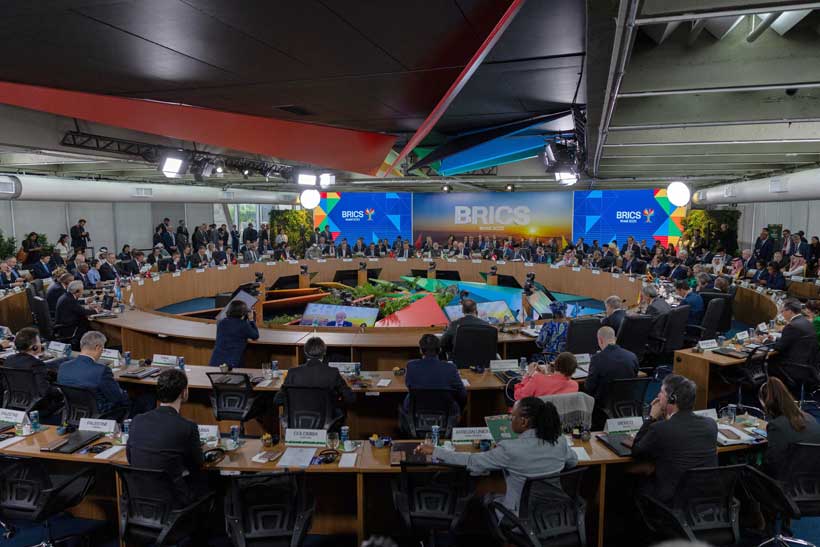
The ongoing Iran conflict is expected to dominate discussions at the BRICS foreign ministers meeting in New Delhi, placing pressure on the expanded bloc to find common ground on one of the world’s most divisive geopolitical crises.
The two day meeting brings together foreign ministers and representatives from BRICS member states, including Brazil, Russia, India, China, South Africa, Iran, Egypt, Ethiopia, Indonesia, and the United Arab Emirates.
India, which holds the BRICS chairmanship for 2026, faces the difficult task of balancing competing interests within the group while attempting to secure a joint statement.
Iran Pushes for Stronger BRICS Position
Iran has urged BRICS members to condemn the actions of the United States and Israel in the Gulf conflict through a unified statement.
Stay ahead of the geopolitical week.
MD Briefing delivers expert analysis across five global fronts — the Indo-Pacific, energy, geoeconomics, European security, and the Middle East — every Monday morning. Free.
Iranian Foreign Minister Abbas Araqchi is expected to participate in the meeting as Tehran seeks diplomatic support from emerging economies and Global South nations.
The conflict has become a major test of BRICS cohesion because member states hold differing positions on the war and regional security issues.
Divisions Emerge Within the Bloc
The sharpest disagreements are reportedly between Iran and the United Arab Emirates, which are aligned on opposing sides of the regional conflict.
Tensions have increased following reports of military strikes involving Gulf states and Iran, complicating efforts to draft a consensus statement acceptable to all members.
Indian officials previously acknowledged the difficulty of forging unity within BRICS because some member states are directly involved in the conflict.
Despite the divisions, India remains hopeful that ministers can still agree on a joint declaration after negotiations during the meeting.
Russia and China Maintain Key Roles
Russian Foreign Minister Sergey Lavrov is expected to attend the gathering, reinforcing Moscow’s active role within BRICS diplomacy.
China, however, will not send Foreign Minister Wang Yi because of scheduling conflicts linked to U.S. President Donald Trump visiting Beijing this week.
Instead, China will be represented by Ambassador Xu Feihong.
Beijing has largely maintained a neutral public position on the Iran conflict while preserving close ties with both Iran and Gulf Arab states.
Energy Prices Add Economic Pressure
The war’s impact on global energy markets has become a major concern for BRICS economies, many of which are heavily dependent on imported oil and vulnerable to rising inflation.
Several BRICS nations, including India, have introduced emergency economic measures to shield consumers and industries from soaring fuel costs caused by the conflict.
The economic fallout is likely to strengthen calls within BRICS for diplomatic solutions and greater coordination among emerging economies.
India Attempts Diplomatic Balancing
India is seeking to use the BRICS platform to strengthen its leadership role among developing nations while avoiding direct alignment with any side in the conflict.
Analysts say New Delhi’s challenge lies in preserving BRICS unity despite deep geopolitical differences among member states.
Former Indian diplomat Manjeev Singh Puri described the participation of nearly all BRICS foreign ministers as a positive sign for dialogue and coalition building among emerging economies.
Analysis
The BRICS meeting in New Delhi highlights the growing difficulty of maintaining unity within an expanded bloc that now includes countries with competing regional interests and conflicting geopolitical priorities.
The Iran conflict has exposed the limits of BRICS as a coordinated political platform. While the group shares common interests in promoting a multipolar world order and strengthening the Global South, its members remain divided on security issues and regional conflicts.
India’s role as chair becomes especially sensitive because it must balance relations with Iran, Gulf Arab states, Russia, China, and Western powers simultaneously.
The absence of a strong unified Chinese diplomatic presence may also reduce the likelihood of a major breakthrough or coordinated BRICS response.
At the same time, the meeting demonstrates that BRICS is evolving beyond an economic grouping into a broader geopolitical forum where emerging powers increasingly debate global security and diplomatic issues.
Whether the bloc can produce a joint statement on the Iran war may become an important indicator of its future credibility and effectiveness as an alternative voice in global governance.
With information from Reuters.
