


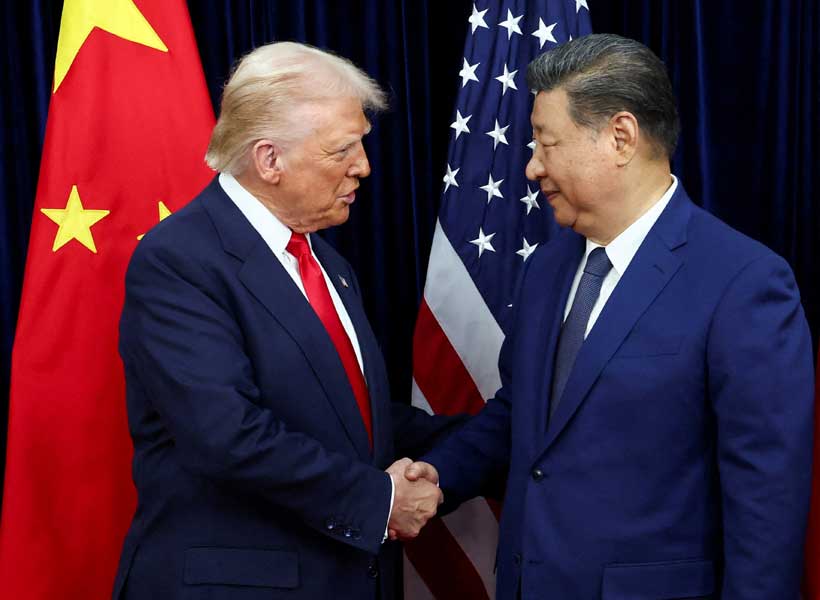
United States President Donald Trump has announced that discussions with Chinese President Xi Jinping in Beijing will include two highly sensitive issues in US China relations: American arms sales to Taiwan and the imprisonment of Hong Kong media tycoon Jimmy Lai.
The planned discussions come at a time of rising geopolitical competition between Washington and Beijing, particularly over Taiwan, regional security, and human rights concerns in Hong Kong and mainland China. Trump’s decision to publicly confirm these topics before the summit signals that strategic rivalry continues to shape bilateral relations despite ongoing diplomatic engagement.
Taiwan Remains the Central Strategic Flashpoint
Taiwan continues to represent the most dangerous and politically sensitive issue in US China relations. China considers Taiwan part of its territory and has repeatedly warned against foreign military support for the island. Taiwan, however, rejects Beijing’s sovereignty claims and maintains its democratic political system with strong support from the United States.
Washington officially follows the One China policy while simultaneously maintaining unofficial ties with Taiwan and supporting its defense capabilities. The United States is legally obligated under the Taiwan Relations Act to assist Taiwan in maintaining self defense capabilities.
Stay ahead of the geopolitical week.
MD Briefing delivers expert analysis across five global fronts — the Indo-Pacific, energy, geoeconomics, European security, and the Middle East — every Monday morning. Free.
Trump’s decision to raise the issue of arms sales directly with Xi reflects growing American concern over military pressure in the Taiwan Strait. The recently announced 11 billion dollar US weapons package for Taiwan further intensified tensions with Beijing and reinforced Washington’s strategic commitment to the island.
At the same time, Trump’s remarks suggest an attempt to balance deterrence with diplomacy. By emphasizing his personal relationship with Xi and expressing confidence that conflict will not occur during his presidency, Trump appears to be signaling a preference for strategic stability while preserving American regional influence.
Growing Pressure on Taiwan to Expand Defense Spending
Recent statements from Trump administration officials urging Taiwan to increase its defense spending reflect a broader shift in American strategic expectations toward allies and partners. Washington increasingly expects regional partners to assume greater responsibility for their own security amid intensifying competition with China.
For Taiwan, this pressure highlights both the benefits and vulnerabilities of reliance on US military support. While American arms packages strengthen Taiwan’s deterrence capabilities, they also deepen cross Strait tensions and increase Beijing’s perception of foreign interference.
China views US military cooperation with Taiwan as a direct challenge to its sovereignty and national reunification goals. As a result, every major arms package contributes to a cycle of strategic escalation between Beijing and Washington.
Human Rights Concerns Add Another Layer of Tension
Trump’s decision to raise the case of Jimmy Lai introduces the issue of political freedoms and human rights into the summit agenda. Lai became one of the most internationally recognized critics of Beijing’s security policies in Hong Kong and his imprisonment has drawn criticism from Western governments and international rights organizations.
The case symbolizes broader international concerns regarding the implementation of Hong Kong’s national security law and the shrinking space for political opposition, independent media, and civil liberties in the territory.
Trump also indicated he would discuss the arrest of Pastor Jin Mingri, founder of Zion Church, highlighting growing US concerns regarding religious restrictions in China. Beijing’s tighter regulation of religious activity and online preaching reflects the Chinese leadership’s emphasis on political control and resistance to what it perceives as foreign influence.
By raising these cases publicly, the Trump administration appears to be integrating ideological and human rights concerns into its broader strategic competition with China.
Implications for US China Relations
The upcoming Trump Xi meeting demonstrates the increasingly complex nature of US China relations, where economic competition, military rivalry, ideological differences, and diplomatic engagement coexist simultaneously.
Taiwan remains the most immediate security risk because any military escalation in the Taiwan Strait could rapidly draw in the United States and destabilize the wider Indo Pacific region. Meanwhile, issues related to Hong Kong and religious freedoms continue to fuel international criticism of China’s domestic governance policies.
Despite these tensions, both leaders also appear interested in maintaining direct communication channels to prevent strategic competition from escalating into open confrontation. Trump’s emphasis on his personal relationship with Xi suggests that leader level diplomacy remains an important mechanism for crisis management between the two powers.
Analysis
Trump’s decision to publicly frame Taiwan arms sales and human rights issues as central topics in his meeting with Xi reflects a broader evolution in American China policy. The relationship is no longer defined primarily by economic interdependence but increasingly by strategic rivalry and ideological competition.
Taiwan has become the clearest symbol of this rivalry. For the United States, supporting Taiwan strengthens regional deterrence and demonstrates commitment to allies in the Indo Pacific. For China, however, external military support for Taiwan directly challenges core national interests and territorial claims.
This strategic imbalance creates persistent instability. Washington seeks to strengthen deterrence without provoking war, while Beijing seeks reunification without appearing weak domestically. Both sides therefore operate within a fragile balance where military signaling and diplomatic communication occur simultaneously.
The inclusion of Jimmy Lai and religious freedom issues also indicates that human rights remain an instrument of geopolitical pressure in US China relations. While Washington presents these concerns as defense of democratic values and civil liberties, Beijing views them as interference in domestic affairs and attempts to undermine Chinese political authority.
Ultimately, the Trump Xi summit highlights how competition between the United States and China now extends across security, ideology, governance, and global influence. Even as both powers attempt to avoid direct conflict, their strategic objectives continue to collide across multiple fronts.
With information from Reuters
