


For the first time in its history, the Africa-EU Parliamentary Assembly is holding its inaugural plenary session — not in Brussels, not in Strasbourg, but in Eswatini, a small landlocked kingdom in southern Africa that most international news cycles rarely mention. That choice of location is itself a signal worth reading. The gathering brings together legislators from 79 OACPS member states and 27 European Union member states, forming a 106-country inter-regional platform collectively representing more than 1.5 billion people, making it the largest inter-regional partnership of its kind in the world.
The three-day session runs from May 12 to 14 at the Ezulwini Palazzo International Convention and Conference Centre, opened by Eswatini’s Prime Minister Russell Mmiso Dlamini and co-chaired by MEP Hilde Vautmans from Belgium and David Houinsa MP from Benin. The agenda covers five areas: peace and security, the future of multilateralism, youth mobility, women in agriculture, and the global race for critical raw materials. Parliamentarians will close the session by adopting a set of recommendations to send directly to the Africa-EU Council of Ministers.
Why the Inaugural Session Marks a New Chapter in Africa-EU Relations
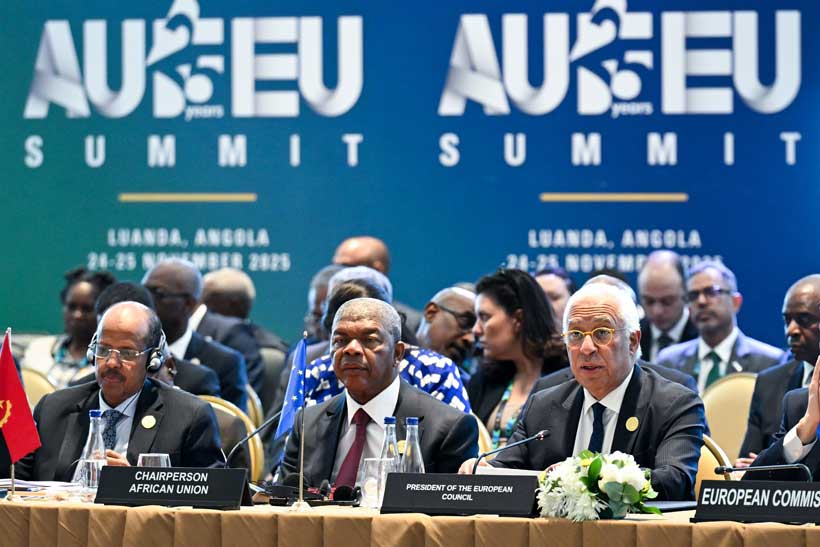
The Africa-EU Parliamentary Assembly was born out of the Samoa Agreement, signed on November 15, 2023, which replaced the Cotonou Agreement adopted in 2000 and the Lomé Convention of 1975. Following its signing, three new parliamentary assemblies were created to complement the broader OACPS-EU Joint Parliamentary Assembly, one for Africa, one for the Caribbean, and one for the Pacific. The constitutive meeting for the Africa-EU assembly was held in Luanda, Angola in February 2024.
What is new this week is the first actual plenary session; the moment the institution moves from constitutive declarations to substantive parliamentary work. The shift from the Cotonou framework to the Samoa Agreement was not merely a name change. It represented a deliberate rebalancing of the relationship, moving away from a donor-recipient model toward a partnership framework built on shared interests, joint governance, and mutual accountability. The Eswatini session is the first test of whether that rebalancing produces something more than language.
Stay ahead of the geopolitical week.
MD Briefing delivers expert analysis across five global fronts — the Indo-Pacific, energy, geoeconomics, European security, and the Middle East — every Monday morning. Free.
Security, Youth and Critical Raw Materials: Three Issues That Define the Agenda
The five agenda items are not equally weighted in terms of current urgency, and it is worth being direct about which ones carry the most geopolitical significance right now.
Critical raw materials are the most immediately consequential. Africa holds a disproportionate share of the minerals the global energy transition requires: cobalt, lithium, coltan, manganese, and rare earth elements whose strategic importance has been thrown into sharp relief by the Iran war’s energy shock and the global scramble to reduce fossil fuel dependency. Europe has been scrambling to secure supply chains for these materials as part of its broader energy security strategy, and both the UAE’s OPEC exit and the Hormuz crisis have accelerated that urgency considerably. The Africa-EU parliamentary discussion on critical raw materials this week is happening against a backdrop of active Chinese and American competition for access to the same resources and African legislators are increasingly aware that the continent’s leverage in that competition has never been higher.
Peace and security is the second genuinely live agenda item. The African continent is managing multiple active conflicts simultaneously eastern DRC, Sudan, the Sahel, Somalia and the role of regional organisations like the African Union and ECOWAS in managing those conflicts has become a central question for European security policy as well, given migration flows, terrorism risks, and the withdrawal of French military presence from the Sahel. The parliamentary assembly gives legislators from both continents a formal channel to address those dynamics outside the more constrained executive-level diplomacy.
Youth mobility is the third item with real political weight. Migration from Africa to Europe remains one of the most politically sensitive issues in European domestic politics, and framing it as “youth mobility in the context of the partnership” rather than as a border management problem signals a deliberate attempt to reframe what has often been a contentious bilateral conversation around shared economic and demographic opportunity rather than security threat.
Eswatini as Host: More Than a Venue
The choice to hold the inaugural session in Eswatini deserves a moment of attention. Eswatini’s Permanent Representative to the EU, Sibusisiwe Mngomezulu, noted that the assembly’s convening in Eswatini reflects not only the Kingdom’s growing diplomatic profile but also its role in supporting dialogue that connects institutions, regions and peoples across this partnership. For a country that rarely features in international diplomatic conversations, hosting the inaugural session of the world’s largest inter-regional parliamentary partnership is a significant statement about the broadening of African diplomatic geography beyond the continent’s traditional power centers.
Our Take: Parliamentary Diplomacy at a Critical Moment
The Africa-EU Parliamentary Assembly launches this week at a moment when the relationship between the two continents is being reshaped by forces neither side fully controls. China’s infrastructure investment across Africa, the critical minerals competition accelerated by the energy transition, the withdrawal of Western military presence from the Sahel, and the migration pressures driven by conflict and climate change are all producing a relationship that the old Cotonou donor-recipient framework was never designed to manage.
The Samoa Agreement’s attempt to build a genuine partnership framework rather than a development assistance relationship is the right instinct for the current moment. Whether the parliamentary assembly produces recommendations with real influence over the Council of Ministers, or becomes another layer of institutional dialogue that runs alongside policy without shaping it, depends on whether both sides treat it as a mechanism for accountability rather than a venue for declarations.
The critical raw materials discussion this week is the clearest test. Africa has leverage it has not always been able to convert into partnership terms that match its actual strategic weight. Europe needs what Africa has. The question the Eswatini session raises, without yet answering, is whether parliamentary diplomacy can help close the gap between those two realities more effectively than executive-level negotiations have managed so far.
