


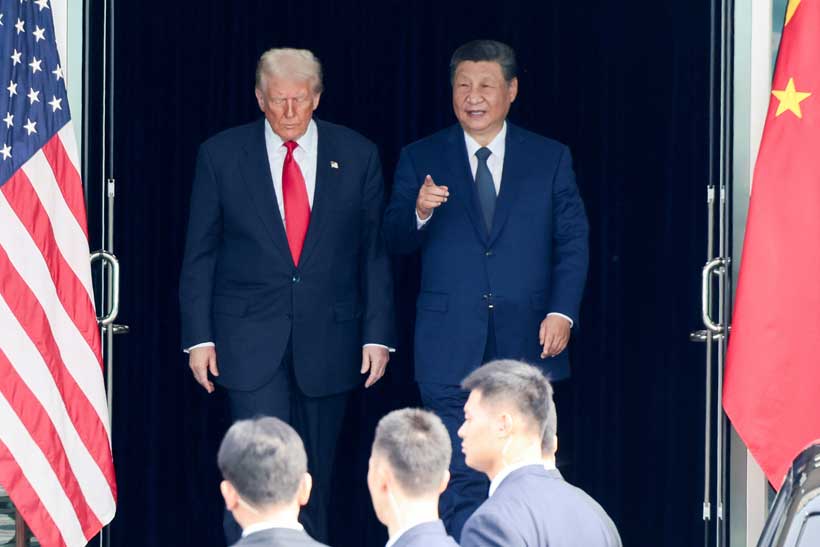
Trump arrives in Beijing on May 14. The summit was originally scheduled for March, then postponed because the US got embroiled in a war in the Middle East that nobody fully planned for and nobody has yet fully ended. That delay, accidental as it was, turned out to be one of the most consequential diplomatic gifts Beijing has received in years. Six extra weeks of watching Washington manage a crisis, deplete its Pacific munitions, alienate its allies, and then fly the Vice President to Islamabad to negotiate with Iran, all while China positioned itself as the responsible, stabilizing presence that everyone needed but nobody wanted to admit.
Xi did not ask for the Iran war, he did not engineer it. What he did was watch it unfold with the patience of someone who understood that Washington’s distraction was Beijing’s opportunity, and spent those six weeks making sure China was in exactly the right position when Trump finally landed.
That positioning work is now visible. Wang Yi hosted Iranian Foreign Minister Abbas Araghchi in Beijing on Wednesday — the first such visit since the war began on February 28, calling for a comprehensive ceasefire and the prompt reopening of the Strait of Hormuz. The meeting was initiated by Beijing, not Tehran. Chinese state media publicized it aggressively. The timing, eight days before Trump arrives, was not accidental. China was sending a message to Washington: we have influence with Iran that you need, and we are prepared to use it, on our terms, for a price to be negotiated in Beijing next week.
How China Became Iran’s Most Important Phone Call
Understanding China’s current leverage requires understanding what it has been doing since February 28 that most Western coverage has underweighted.
Stay ahead of the geopolitical week.
MD Briefing delivers expert analysis across five global fronts — the Indo-Pacific, energy, geoeconomics, European security, and the Middle East — every Monday morning. Free.
Beijing has been Iran’s largest oil buyer throughout the war, absorbing the crude that Western sanctions and the conflict itself have made difficult to sell anywhere else. That economic relationship gives China influence that no amount of diplomatic pressure from Washington replicates: Tehran needs Chinese purchases to keep its economy functioning, and Beijing knows it. Wang Yi and Araghchi have held at least three phone calls since the war began. China has voted against or abstained from every UN Security Council resolution that would have imposed additional pressure on Iran. And when Washington announced sanctions on Chinese refiners buying Iranian crude, Beijing responded with an unprecedented countermove; invoking a “blocking rule” for the first time, directing Chinese companies not to comply with US sanctions. The countervailing orders placed American companies in the position of choosing between US and Chinese regulatory compliance, which is exactly the kind of structural leverage Beijing has been quietly building for years and rarely deploys this visibly.
At the same time, China has been telling Iran what it needs to hear in private and what it needs Beijing to say in public. The Wednesday meeting produced Wang Yi calling for the Strait of Hormuz to reopen “as quickly as possible”, language that aligns precisely with what Washington has been demanding of Beijing for weeks. China is not mediating between the US and Iran in any formal sense. It is managing both relationships simultaneously, extracting from each the concessions and the credit that its position makes available.
Amir Handjani of the Quincy Institute put it plainly: Tehran and Beijing are aligning their interests before the Trump-Xi summit, and the timing is deliberate. For Tehran, the Araghchi visit is a way to show Washington that Iran is not isolated and has options. For Beijing, it is a way to demonstrate to Trump that China’s cooperation on Iran is genuine, visible, and worth compensating.
What China Wants From Trump in Beijing
The summit agenda, as it has been described by every major think tank that has analyzed it in the past two weeks, is not going to produce a grand bargain. The Wall Street Journal’s chief China correspondent, Lingling Wei, who has covered more presidential visits to Beijing than almost anyone, put it the most cleanly: do not expect a grand bargain, especially on tariffs. What to expect instead are surface-level deliverables, Chinese purchases of American agricultural goods, Boeing aircraft, possibly energy imports that allow both sides to claim a stabilizing visit while the harder bargaining is left for working-level channels afterward.
The Brookings Institution’s analysts noted that the summit’s bureaucratic preparations have been described as meager, which limits the prospects for progress regardless of how the atmospherics are managed. The reported agenda items; a bilateral Board of Trade to identify non-sensitive sectors for purchase commitments, limited tariff adjustments, possibly announcements of major Chinese investments into the United States, are significant enough to generate headlines without resolving the structural tensions that define the relationship.
What China actually wants from the summit, according to analysts who follow Beijing closely, is something called “institutionalized friction”, an end to the unpredictable lurches and dramatic escalations that characterized the first year of Trump’s second term, replaced by a more stable pattern in which each side can continue adding small regulatory constraints on the other without triggering a crisis. China wants to know what the rules of managed competition are, not to end the competition. That is a more modest goal than a grand bargain, but it is also a more achievable and more durable one if it can be established.
The Taiwan question sits underneath all of this. Beijing considers it the priority item on the agenda, and has been pressing Washington to adjust its stance ahead of the summit. China may retaliate against US interests in countries where it holds an upper hand if the summit does not produce what it considers adequate movement on Taiwan, though the specific mechanisms for such retaliation remain deliberately unspecified.
The Iran Card and How Beijing Plans to Play It
This is where the three threads of the analysis converge, and where the summit’s most consequential dynamics are likely to play out.
Trump has made no secret of what he wants from Xi on Iran: Chinese pressure on Tehran to reopen the Strait of Hormuz, stop threatening Gulf infrastructure and commercial shipping, and move toward a durable settlement that ends the war. He said publicly that “Xi would like to see the Iran war ended.” Secretary of State Rubio explicitly called on Beijing to use the Araghchi visit to push Iran on the Strait. The US has been treating Chinese cooperation on Iran as a deliverable it expects from the summit.
Beijing’s position is considerably more nuanced. Wang Yi’s Wednesday statement called for Hormuz to reopen, which is the message Washington wanted. But the Iranian foreign ministry’s own readout of the same meeting did not include that point, a discrepancy that reveals how carefully China is managing what it says to each audience. Beijing is not going to simply deliver Iran to Washington’s preferred outcome. It is going to use its Iranian leverage as a bargaining chip in the bilateral conversation about tariffs, technology controls, and Taiwan, extracting concessions from Trump in exchange for the cooperation Trump is publicly demanding.
A director at a Beijing-affiliated think tank told CNBC before the summit that China lacked both the capability and inclination to pressure either side into negotiations. That assessment is probably too modest. China has the capability — its economic relationship with Iran gives it real leverage, and the inclination is present when the price is right. The question going into May 14 is what Washington is prepared to pay for Beijing’s cooperation on the Strait, and whether Trump’s desire to claim a diplomatic win on Iran is large enough to generate concessions on the economic competition questions that China cares about more.
The delay of the summit from March to May has given Beijing an additional advantage that analysts have noted but not fully emphasized. China has had six extra weeks to shape the agenda, explore leverage points, and watch how Washington behaves under pressure. The Iran war showed Beijing that the US depleted its Pacific munitions, alienated its Asian allies, and needed China’s help with Iran before it was willing to board Air Force One for Beijing. That is not a weak negotiating position for Xi to be entering a summit from.
The Pattern Behind China’s Broader Diplomatic Ambition
The Iran war mediation sits inside a larger pattern of Chinese diplomatic activism that has been accelerating since 2023, when Beijing brokered the Saudi-Iran normalization deal that established it as a capable diplomatic actor in the Middle East. Since then, Beijing has been active in the Cambodia-Thailand conflict, hosting multiple ceasefire meetings and attending talks in Malaysia alongside the US. Wang Yi visited North Korea in April, his first trip to Pyongyang in six years, signaling that Beijing is managing the Korean Peninsula actively rather than passively ahead of any renewed US-North Korea engagement. China has hosted the Ukrainian foreign minister while maintaining its “no-limits” friendship with Russia, issued peace proposals for Ukraine, and now positioned itself as an indispensable player in the Iran endgame.
The pattern is not purely altruistic and Beijing is not pretending otherwise. Muhammad Zulfikar Rakhmat, a researcher at Indonesia’s Center of Economic and Law Studies, described China’s approach as “opportunistic and low-risk, often occurring when conditions are already conducive to agreement.” When Beijing chose to broker the Saudi-Iran deal in 2023, both parties already had incentives to re-engage diplomatically. China accelerated an outcome that was already moving in the right direction and claimed the credit. The Iran war mediation follows the same logic: China is not going to push Tehran into an agreement it fundamentally opposes, but it is willing to push Iran toward agreements it was already moving toward, in exchange for the diplomatic credit and the bilateral concessions the push generates.
George Chen of The Asia Group said China’s role in the Iran situation is irreplaceable. As Tehran’s biggest oil buyer, its advice carries weight in ways that no other actor can replicate. China is also one of the few countries that has consistently shown sympathy for Iran at the United Nations, which means its private pressure carries credibility that Washington carries threats. When China tells Iran to move toward reopening the Strait, Tehran listens in a way it does not when the same message comes from Rubio.
What the Summit Will and Will Not Produce
Fifty years of US-China summitry, analyzed systematically, show that these meetings rarely transform the relationship. What they can do, when handled well, is make a potentially dangerous rivalry less volatile. That matters more than usual right now, with an ongoing energy shock reshaping global markets and an Iran war that neither power has fully resolved, adding fresh instability to an already fracturing international order.
The most likely outcome of May 14 and 15 is a set of announcements significant enough to generate positive headlines without resolving the structural competition. Chinese agricultural and energy purchases. Possibly a joint Board of Trade framework. Some signaling on Iran cooperation that Trump can present as a win. Some movement on Taiwan signaling that Beijing can present as progress. The harder questions — semiconductor export controls, the status of the Busan trade truce expiring in November, Taiwan’s long-term status, the Iran settlement’s terms, will be left for working-level channels and a second summit later in the year when Xi visits the United States.
What will not happen is a grand bargain. The relationship is not in that place, the preparations have not been made for it, and both sides have more to gain from a calibrated stabilization than from a comprehensive deal that requires each to make concessions their domestic politics cannot absorb.
What China has already gained, before Trump has even landed, is the more important story. Six weeks of diplomatic positioning: the Araghchi visit, the North Korea trip, the blocking rule on sanctions, the repeated public calls for Hormuz to reopen, have established Beijing as the indispensable intermediary in a crisis that Washington started and has not been able to finish. Xi is not walking into next week’s summit as a supplicant asking for tariff relief. He is walking in as the leader of a country that has something Trump badly needs, at a moment when that need is most acute.
That is the position China spent six weeks building. Whether Trump gives Beijing adequate compensation for it is the question next week will answer.
