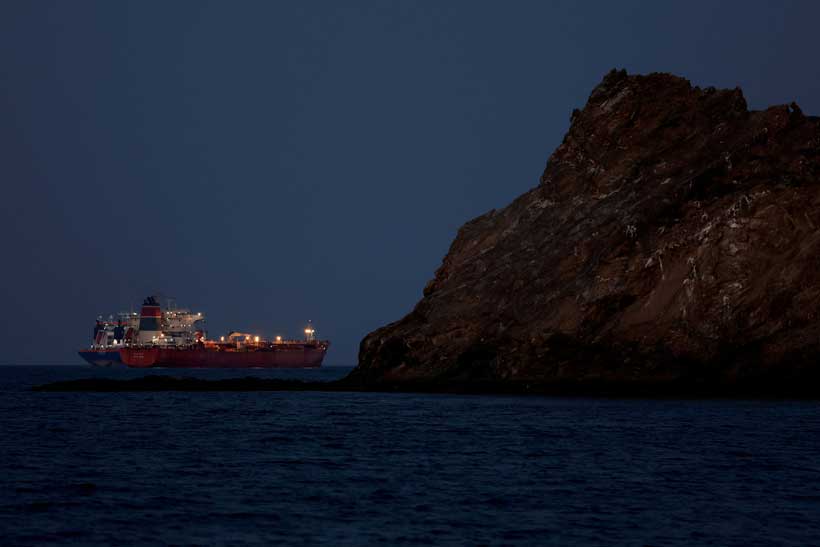
The U. S. has a blockade on Iranian ports, while Iran has lifted and then reimposed its blockade on marine traffic in the Strait of Hormuz, a crucial passage that carries about one-fifth of the world’s oil supply. Since the beginning of the U. S.-Israeli war with Iran on February 28, various non-Iranian oil tankers have crossed the Strait, heading to multiple destinations.
A Panama-flagged tanker, Idemitsu Maru, loaded with 2 million barrels of Saudi Arabian oil, passed through the strait on April 28 destined for Nagoya, Japan. This marks the first Japan-linked crude tanker to navigate the strait since the war began. Another Panama-flagged vessel, Crave, carrying liquefied petroleum gas from the UAE, is en route to Indonesia. The tanker Akti A, which is carrying diesel from Bahrain, is headed for Mozambique.
In South Korea, the Liberian-flagged Navig8 Macallister is transporting approximately 500,000 barrels of naphtha from the UAE to Ulsan, to be delivered at a local refinery. The Malta-flagged Odessa also crossed the strait on April 13, although details of its oil loading are unspecified.
A large crude carrier from Liberia, Fpmc C Lord, is on its way to Mailiao port in Taiwan, loaded with about 2 million barrels of Saudi crude. An Indian-flagged tanker, Desh Garima, is heading toward Sri Lanka with around 780,000 barrels of crude from the UAE. Meanwhile, a vessel called Ruby is transporting Qatari fertilizer to the UAE.
In Italy, a bulk carrier named Merry M is taking petroleum coke from Saudi Arabia to Ravenna. Another tanker, Athina, loaded with naphtha from Bahrain, crossed the strait on April 18, destined for Thailand. A Thai oil tanker has recently passed through the strait, thanks to diplomatic efforts with Iran, which allowed it to avoid payment for passage. Additionally, the Suezmax tanker Pola discharged 1 million barrels of Khafji crude between Thailand and Singapore.
LPG carrier Raine is bound for China after passing the strait on April 18. Two Chinese flagged VLCCs, Cospearl Lake and He Rong Hai, exited the strait on April 11, with Cospearl Lake carrying Iraqi oil expected at Zhoushan port in China, and He Rong Hai heading to Myanmar with Saudi crude.
Several tankers from India have also navigated the strait recently, like LPG carrier Artman, which crossed on April 18. Notably, VLCC Habrut brought Abu Dhabi crude to Paradip on April 15, while VLCC Marathi discharged Saudi crude at Sikka port on March 28. Additional LPG tankers have also successfully transited the strait, making deliveries at Indian ports.
A Malta-flagged VLCC, Agios Fanourios I, entered the Gulf on April 15, aiming to load Basra crude in Iraq for Vietnam. The Liberia-flagged VLCC Serifos recently navigated through an anchorage that bypasses Iran’s Larak Island and is expected in Malaysia’s Malacca port soon. Ocean Thunder, another tanker, has also transited the strait, expected to deliver its Iraqi crude cargo in Pengerang, Malaysia.
Lastly, on April 12, two Pakistan-flagged tankers entered the Gulf, with one headed to the UAE and another to Kuwait for refined products, while an Aframax tanker, P. Aliki, discharged Saudi crude at Karachi on March 31.
With information from Reuters