


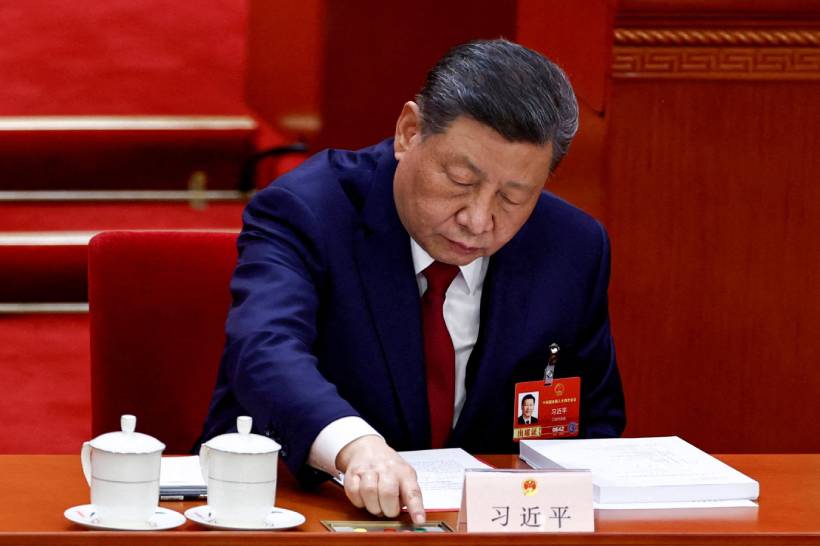
Chinese President Xi Jinping has issued one of his clearest warnings yet on Taiwan, stating Beijing will “absolutely not tolerate” any move toward independence. The remarks came during a high level meeting in Beijing with Cheng Li-wun, a senior figure from Taiwan’s main opposition party, the Kuomintang.
Cheng’s visit, which she described as a peace mission, comes at a time of heightened military pressure from China and growing unease across the Taiwan Strait. The meeting at Beijing’s Great Hall of the People signals both an attempt at dialogue and a display of political messaging from Beijing.
One China and the Reunification Imperative
At the center of Xi’s remarks was the reaffirmation of the “One China” principle. Beijing considers Taiwan a breakaway province and has consistently framed reunification as both inevitable and necessary for national rejuvenation.
Xi’s language emphasized shared identity, describing people on both sides of the strait as belonging to “one family.” This framing is strategic, presenting reunification as a natural and peaceful outcome rather than coercion.
Stay ahead of the geopolitical week.
MD Briefing delivers expert analysis across five global fronts — the Indo-Pacific, energy, geoeconomics, European security, and the Middle East — every Monday morning. Free.
However, Taiwan’s current government, led by Lai Ching-te, rejects these claims. Taipei maintains that Taiwan is already a sovereign entity with its own democratic system, and that its future must be decided by its people.
Historical Roots of the Divide
The tensions trace back to the end of the Chinese Civil War, when the Kuomintang government retreated to Taiwan after being defeated by Mao Zedong and the Communist Party.
Since then, the People’s Republic of China has never exercised control over Taiwan, yet continues to claim it as part of its territory. No formal peace treaty or resolution has ever been reached, leaving the conflict technically unresolved for decades.
Opposition Diplomacy and Domestic Friction
Cheng’s visit highlights Taiwan’s internal political divide. The Kuomintang has traditionally supported engagement with Beijing, advocating dialogue and economic ties as a means of maintaining stability.
In contrast, the ruling Democratic Progressive Party takes a more cautious and sovereignty focused approach. Officials from the DPP have criticized the visit, suggesting it risks sending mixed signals at a time when Taiwan is under increasing pressure.
This internal split is not merely ideological. It shapes defence policy, diplomatic positioning, and public messaging, all of which influence how Taiwan navigates its relationship with China.
Escalating Military and Strategic Pressure
China has significantly increased military activity around Taiwan in recent years, including air incursions and naval exercises. These actions serve both as deterrence and as a signal of Beijing’s capability and willingness to act.
At the same time, Beijing has refused to engage directly with Lai’s administration, labeling him a separatist. This breakdown in official communication channels increases the risk of miscalculation, particularly in a region already marked by military posturing.
The United States and the Strategic Triangle
The role of the United States adds another layer of complexity. While Washington does not formally recognize Taiwan as a sovereign state, it remains its most important security partner and arms supplier.
US support for Taiwan’s defence capabilities is seen by Beijing as interference, while for Taipei it is a crucial element of deterrence. This dynamic transforms the Taiwan Strait into a focal point of great power competition.
The involvement of external actors reinforces Cheng’s warning against the region becoming a “chessboard,” reflecting broader concerns about geopolitical rivalry shaping the conflict.
Implications
Xi’s remarks underscore the rigidity of Beijing’s position and its increasing willingness to assert it publicly.
They also highlight Taiwan’s internal divisions, which Beijing may seek to exploit through engagement with opposition figures.
At a broader level, the situation reflects a shift toward identity driven geopolitics, where issues of sovereignty, legitimacy, and national narrative carry as much weight as military capability.
Analysis
Xi Jinping’s messaging operates on two levels simultaneously. On the surface, it promotes peace, cooperation, and shared identity. Beneath that, it reinforces a non negotiable stance on sovereignty, backed by the implicit threat of force.
Engaging with figures like Cheng Li-wun allows Beijing to project openness to dialogue while sidestepping Taiwan’s elected leadership. This approach suggests a long term strategy aimed at influencing Taiwan’s internal political landscape rather than relying solely on external pressure.
At the same time, the combination of hardline rhetoric and military signalling reflects a calibrated strategy of deterrence. By framing independence as the primary threat to peace, Beijing shifts responsibility for escalation onto Taiwan, while maintaining its own posture as reactive rather than aggressive.
The broader risk lies in the narrowing space for compromise. As positions harden and communication channels weaken, the Taiwan issue becomes increasingly framed in absolute terms, where political flexibility is constrained and the potential for miscalculation grows.
With information from Reuters.
