


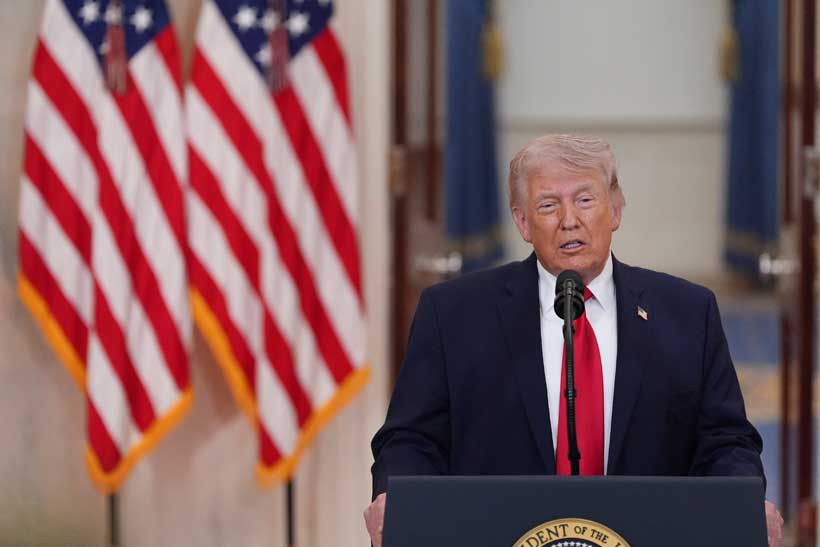
In the midst of escalating tensions with Iran, former US President Donald Trump issued a stark warning: comply, or “a whole civilisation will die tonight.” The remark, widely interpreted as a threat of overwhelming military force, drew immediate backlash not only for its severity but for its language.
The phrase did more than signal aggression. It invoked a centuries-old concept loaded with power, hierarchy, and exclusion. To threaten the destruction of a “civilisation” is not merely to threaten a state. It is to gesture toward the erasure of culture, history, identity, and humanity itself.
What Does “Civilisation” Actually Mean
The term “civilisation” emerged during the Enlightenment in 18th century Europe. It was used by thinkers to describe what they believed was a superior form of social order developing in Western Europe.
At its core, the concept rested on three assumptions
Stay ahead of the geopolitical week.
MD Briefing delivers expert analysis across five global fronts — the Indo-Pacific, energy, geoeconomics, European security, and the Middle East — every Monday morning. Free.
First, that some societies were more advanced than others
Second, that history followed a linear path from barbarism to refinement
Third, that those at the top of this hierarchy had both the right and responsibility to “civilise” others
From the beginning, civilisation was not a neutral description. It was a judgment.
Civilisation and Power
The idea quickly became entangled with empire. European colonial powers used “civilisation” as a justification for conquest, enslavement, and cultural erasure. Entire populations were labeled “barbaric” or “uncivilised” to legitimize domination.
This legacy lingers. The word still carries an implicit division between “us” and “them,” between those who belong and those who do not.
When invoked today, especially in political rhetoric, it often signals more than cultural pride. It signals hierarchy and exclusion.
Why Trump’s Words Struck a Nerve
Trump’s threat resonated so strongly because it echoed this historical baggage.
To say a “civilisation” could be wiped out in one night suggests total annihilation not just of a government or military, but of a people and their identity. It evokes the logic of absolute war, where the enemy is not just defeated but erased.
Even some of his supporters reacted uneasily. The language crossed from strategic posturing into something more extreme, hinting at collective destruction rather than targeted conflict.
The Dangerous Logic Behind the Term
The deeper issue lies in how the concept of civilisation shapes thinking about conflict.
If one side is seen as representing “civilisation,” then the other can be cast as its opposite. Once that line is drawn, violence becomes easier to justify.
History shows how quickly this logic escalates. When opponents are framed as threats to civilisation itself, compromise becomes weakness and destruction becomes acceptable.
Implications for Global Politics
Trump’s rhetoric reflects a broader trend in global politics where identity based language is increasingly used to frame conflicts.
This shift has several consequences
It raises the stakes of conflict, turning disputes into existential struggles
It dehumanises opponents, making extreme actions more thinkable
It deepens divisions, both internationally and domestically
In a nuclear age, such language is not merely symbolic. It carries real risks.
Analysis
At its core, the controversy is not just about one statement but about the enduring power of a word. “Civilisation” is often presented as a marker of progress and achievement. Yet historically, it has also been a tool of exclusion and violence.
Trump’s threat exposes this dual nature. By invoking civilisation in the context of destruction, he unintentionally reveals the concept’s darker side. The same idea that once justified empire can still be mobilised to frame modern conflicts in absolute, dangerous terms.
The real danger lies not only in what was said, but in how easily such language resonates. It reflects a persistent mindset in which humanity is divided into hierarchies, and where the destruction of the “other” can be imagined as necessary or even justified.
Conclusion
The word “civilisation” carries a long and troubled history. It has been used to celebrate human achievement, but also to justify domination and violence.
When political leaders invoke it in moments of crisis, they tap into that history whether intentionally or not.
Trump’s statement serves as a reminder that language is never neutral. In the wrong context, even a word associated with progress can become a vehicle for threat, exclusion, and fear.
With information from Reuters.
