


When Leverage Replaced Loyalty
There is a diplomatic category error that shapes almost all Western analysis of the Global South, and it goes something like this: if a country is not clearly with us, it must be drifting toward them. India buying Russian oil is read as a tilt toward Moscow. Brazil chairing BRICS is read as an embrace of Chinese-led multipolarity. Indonesia joining BRICS while deepening US security ties is read as confusion, or incoherence, or proof that these countries cannot quite be trusted as partners.
The reading is wrong. What is actually happening is considerably more interesting, and considerably more deliberate. A significant portion of the world’s population, organized across the Global South’s most consequential states, has concluded that the era of obligatory alignment is over and that the current moment of great power competition creates not a problem to be managed but an opportunity to be exploited. The logic is straightforward. When two powers desperately want your cooperation, you can extract from both. When neither can afford to lose you, you need not fully commit to either.
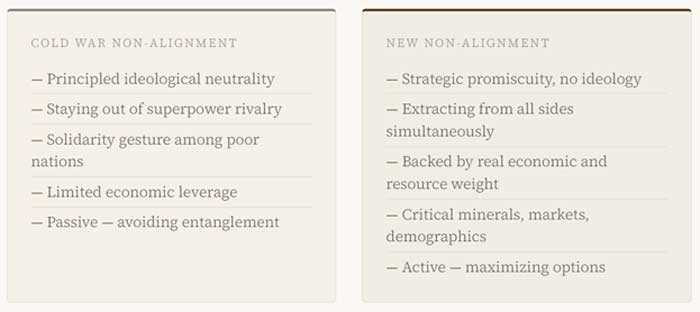
This is not Cold War non-alignment, which was built on the idea of principled neutrality — staying out of superpower competition on ideological grounds. The new version has no particular ideology. India’s External Affairs Minister Jaishankar put it plainly at the Munich Security Conference when he said India should be admired for maintaining “multiple options” in its foreign policy. Not neutrality. Options. The distinction is the whole point.
Stay ahead of the geopolitical week.
MD Briefing delivers expert analysis across five global fronts — the Indo-Pacific, energy, geoeconomics, European security, and the Middle East — every Monday morning. Free.
What Changed and Why Now
Three things have fundamentally shifted. First, the Global South is no longer economically marginal. India is the world’s fifth-largest economy. Indonesia is the largest in Southeast Asia. Brazil is simultaneously the world’s largest exporter of several agricultural commodities, a critical minerals giant, and host of COP30. These countries have something great powers want, which gives them leverage the original non-aligned movement never possessed.
Second, the current US-China competition, unlike the Cold War, is as much economic as ideological. Both powers need Global South markets, resources, infrastructure opportunities, and diplomatic votes. Brazil’s economic dependence on China and security cooperation with the United States are both indispensable, making decoupling from either side untenable. That mutual indispensability is not a vulnerability for Brazil. It is the source of its leverage.
Third, Trump’s return to Washington has paradoxically accelerated the trend. When he imposes 50% tariffs on India for buying Russian oil and simultaneously 50% surcharges on Brazilian goods, he does not pull these countries into the Western camp. He pushes them toward each other and toward anyone willing to deal on better terms. During a 2025 visit, Brazilian President Lula and Chilean President Boric explicitly stated their unwillingness to be drawn into having to choose between the United States and China. Not as diplomatic evasion — as a policy position.
India and the Art of Extracting From Everyone
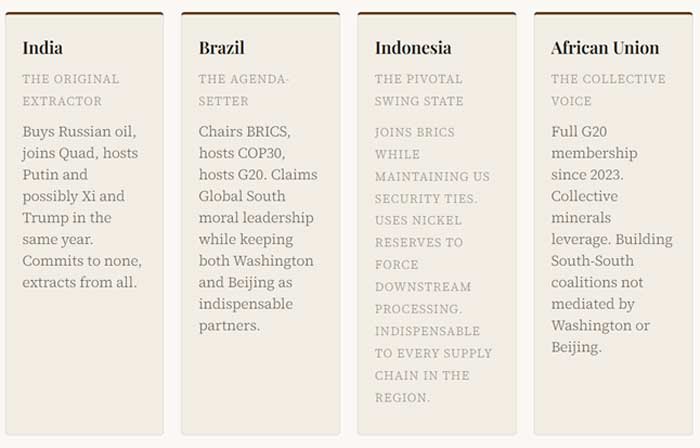
India is the most sophisticated practitioner of the new non-alignment, partly because it has been refining the approach for longer than anyone else, and partly because its situation is uniquely complex. It has a land border dispute with China, a deep historical partnership with Russia, a growing security relationship with the United States, and an independent foreign policy tradition dating to Nehru. Navigating all of this simultaneously requires something considerably more active than neutrality.
India’s traditional passive non-alignment of the 20th century has shifted toward what Indian MP Shashi Tharoor coined “multi-alignment”, a proactive engagement with competing great power centres: the US-led West, a rising China, and its traditional partnership with Russia. The Russia relationship is the most visible pressure point. Russian crude now accounts for 35-40% of India’s total energy requirements, up from just 3% before the Ukraine war. India buys it not out of sympathy for Moscow but because Western sanctions created a discount that a country of 1.4 billion people, importing 87% of its oil, cannot rationally ignore.
Trump imposed 50% tariffs on India over its Russian crude purchases. India’s official position remained consistent: ensuring the energy security of 1.4 billion Indians is the supreme priority; diversifying energy sourcing in line with objective market conditions is at the core of its strategy. A US-India trade agreement was announced in February 2026, with Trump claiming India had agreed to stop importing Russian crude. India has not officially confirmed any such commitment. India says one thing, does another, and neither side can afford to walk away. That is the multi-alignment strategy in its most refined form.
“India says one thing, does another, and neither side can afford to walk away. That is the multi-alignment strategy in its most refined form.”
The China dimension adds another layer. Growing frustration with Trump’s tariffs is pushing India to cautiously improve ties with China while preserving the Russian partnership. Modi visited the SCO Summit in Tianjin for his first visit to China in seven years. Chinese investments are picking up again in India, driven by Indian business pressure. India will host Putin, potentially Xi, and potentially Trump in the same year presenting this simultaneously as its BRICS chairmanship, a bilateral relationship, and a Quad summit. Hosting three great power leaders in one calendar year, none of whom you have fully committed to, is itself a geopolitical statement. The optics are the policy.
The limits are real. Within India’s foreign policy establishment a genuine philosophical schism endures. One camp argues that abandoning Moscow risks strategic isolation and invites encirclement by a Sino-Russian axis stretching from the Himalayas to the Indian Ocean. The pragmatist camp sees a Russia diminished and dependent on Beijing, and argues for a pivot toward American technology and the Quad’s security umbrella. Multi-alignment is not a solved problem for India. It is an ongoing navigation between contradictory pressures, managed imperfectly in real time. The wonder is not that the strategy has cracks. It is that it holds at all.
The Agenda-Setter: Brazil and Active Non-Alignment
Brazil under Lula is running the strategy at a different pitch, less about military hedging and more about claiming the moral and institutional high ground of Global South leadership, while keeping the economic relationships with all major powers intact. The Lula government’s green diplomacy is central to this bid. Hosting COP30 and presiding over BRICS and the G20 within the span of one year was not accidental scheduling. It is a deliberate claim that Brazil is the country that gets to set the agenda for the developing world on climate and development finance, at exactly the moment when the United States is retreating from multilateralism and China’s leadership of the Global South is contested.
When Lula landed in New Delhi in February 2026 with 11 ministers and one of the largest Brazilian delegations ever to travel to Asia, he framed the meeting as an encounter between the world’s pharmacy and the world’s granary, a digital powerhouse and a renewable energy titan. During a period of escalating competition between Washington and Beijing, India and Brazil presented themselves not as subordinate allies but as creators of a more diverse global framework. Brazilian exports to India increased by 52.9% following Trump’s tariffs, and bilateral trade exceeded $15 billion in 2025, targeting $20 billion by 2030. Trade that previously ran through great power intermediaries is starting to run directly between Global South capitals.
Lula’s October 2025 visit to Jakarta produced eight memoranda of understanding worth around $6 billion, covering trade, critical minerals, defense-industrial ties, and agriculture. A visit to Indonesia is not just bilateral. It is a statement that Brazil is building a South-South architecture that does not run through Washington or Beijing. The architecture is nascent, the contracts are not all signed, and the follow-through is uncertain. But its existence changes what Brazil can credibly threaten to do if either great power pushes too hard. Leverage, in the end, is about what you could do, not just what you have done.
The Swing State: Indonesia and the Art of Indispensability
Indonesia is the most underanalyzed piece of the Global South multi-alignment story, which is strange given its weight. The fourth most populous country in the world, the largest economy in Southeast Asia, a democracy with vast critical mineral reserves — Indonesia sits at the center of almost every strategic competition that matters in the Indo-Pacific. President Prabowo has moved quickly to deepen the multi-alignment posture. Indonesia joined BRICS in 2025 while maintaining its security relationships with the United States and its deep trade ties with China. The point is not to choose but to ensure that any architecture being built needs Indonesia inside it.
Jakarta’s approach to nickel is the clearest expression of this. Indonesia holds the world’s largest nickel reserves, a critical input for electric vehicle batteries that both the US and China urgently need. The decision to ban raw nickel exports and force downstream processing domestically was controversial with Western trade partners and ran against WTO rules. Indonesia implemented it anyway. When you have something everyone needs, you set the terms. The policy is now being extended to other critical minerals. This is not non-alignment in the passive sense. It is leverage maximization using geography and geology as the primary tools.
The African Union and the New Multilateralism
The African Union has been running the multi-alignment strategy at the collective level in ways that individual African states could not manage alone. The AU’s incorporation as a full G20 member at the 2023 New Delhi summit, India’s doing, as a Global South institutional claim, gave the continent a seat at the table where global economic rules are negotiated. That seat matters not just symbolically but practically, because it gives the AU standing to shape the rules on development finance, climate adaptation funding, and debt restructuring that directly affect its members.
Trump’s aggressive posture toward Global South governments has, paradoxically, strengthened the AU’s hand. Both Brazil and South Africa faced sharp rhetoric from Washington in 2025, with Trump accusing Brazil of suppressing free speech and South Africa of committing genocide. The confrontations drew the two countries closer and enhanced their leadership claims within the Global South. Lula has visited Angola, Egypt, and Nigeria since returning to office, reopened embassies closed under Bolsonaro, and hosted the Brazil-Africa Forum and the Brazil-Africa Dialogue on Food Security. The South Atlantic is becoming a strategic space in its own right, one that connects Latin American and African multi-alignment projects into something approaching a shared institutional framework.
Is This a Power Center or Just a Better Auction?
The question the multi-alignment strategy cannot yet answer is whether it produces collective power or merely individual advantage. The distinction matters enormously. If individual Global South states have learned to extract better terms from great powers by playing them off against each other, that is tactically significant but structurally limited. The extraction depends on the competition continuing, the great powers remaining interested, and Global South states not overplaying their hands. When the competition cools, or one power achieves decisive advantage, the leverage evaporates.
If what is happening instead is the construction of a genuine third force, new institutions, new trade routes, new financial architecture, new diplomatic coalitions operating independently of the US-China binary , then it is something structurally different and potentially durable. Access to expanding markets, control of essential raw materials, and sovereignty to establish domestic regulations are genuine strengths of the Global South that can be leveraged in global negotiations. The critical minerals position alone, with Africa, Brazil, Indonesia, and India collectively controlling an extraordinary proportion of the resources the energy transition requires , gives the Global South structural leverage that does not depend on great power competition to exist.
The honest assessment is that it is currently more auction than power center, but with genuine momentum toward something more durable. Lula faces an election in 2026. Modi faces ongoing pressure from both the US and China. Indonesia’s nickel strategy requires regulatory consistency over years. What is new and important is not that these states have solved the coordination problem. It is that they have recognized the leverage point and have started building the institutional vocabulary — BRICS, the AU in the G20, South-South trade agreements, critical minerals coalitions — to formalize what has previously been informal.
The countries that spent decades treating the Global South as a passive arena for their competition are now discovering that the arena has developed its own agency. That agency is messy, inconsistent, and frequently opportunistic. It is also real. And the great powers that fail to account for it, that continue to read non-commitment as confusion rather than strategy, will keep being surprised by a world that has quietly decided it does not owe them a choice.
