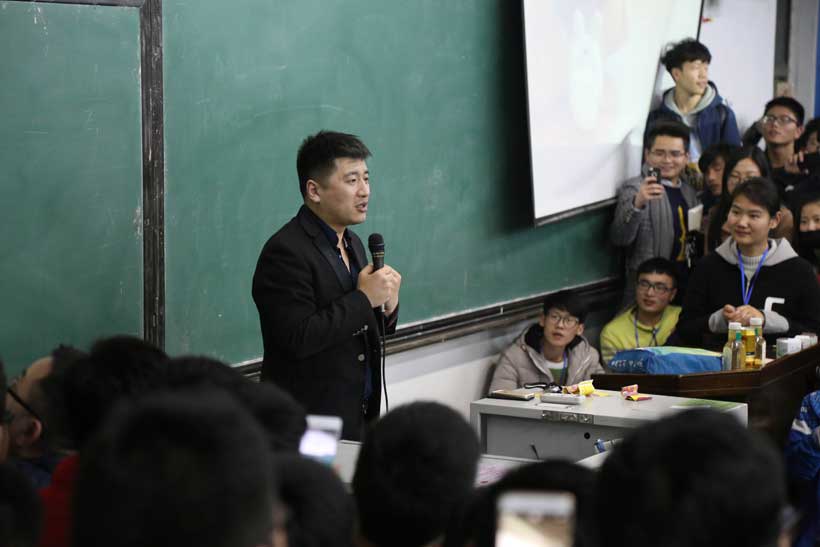
Two years ago, Zhang Xuefeng – China’s most famous social media influencer in the field of education, also called “education-guru,” said: “My life goal is that if I die one day, there will be a trending topic on major platforms called ‘Zhang Xuefeng is dead’.” The news last week of his sudden death due to cardiac arrest generated over 600 million views on the Chinese social media, as Zhang had desired. The line outside the funeral home stretched for several kilometers. Who is Zhang Xuefang?
Who is Zhang Xuefeng?
Almost each and every college-going youth in China – in the past decade, was not only familiar with the name Zhang Xuefeng but had interacted online with the most popular gaokao (college entrance examination) “guide and professor.” “Zhang Xuefeng laoshi” – (teacher Zhang Xuefeng) as he is fondly remembered, had over 40 million followers on Douyin, WeChat and Xiaohongshu – China’s version of TikTok, Facebook and Instagram, respectively. Douyin alone has 26 million followers. Zhang owned three companies – the biggest of them being Suzhou Fengxue Weilai Education Technology Co.
Known as a “northeasterner,” 41-year-old Zhang was born in May 1984 in Fuyu county, Heilongjiang province, and rose to prominence as a tutor for college and postgraduate entrance exams in 2016. This was also the time when the Chinese communist authorities had cracked down on the Chinese and foreign coaching ‘shops’ in the education sector. The only official Chinese English language newspaper, China Daily, mentioned in his introduction “He later became a prominent online influencer and education entrepreneur who was widely recognized for his expertise in college entrance exam application and postgraduate admission counseling.”
Stay ahead of the geopolitical week.
MD Briefing delivers expert analysis across five global fronts — the Indo-Pacific, energy, geoeconomics, European security, and the Middle East — every Monday morning. Free.
Zhang Xuefeng: A Phenomenon
As soon as the news of Zhang’s death broke out, there was a massive surge of messages with grief and cries of sorrow all over the social media and comment sections of the newspapers. “The grief was real, the gratitude (towards Teacher Zhang) was real, and the sense of loss was real,” a blogger commented. It is this unprecedented pouring of genuine grief coming from millions of ordinary and poor rural youths, students, and parents from all across China that the passing away of Zhang Xuefeng is being viewed as a phenomenon.
An editorial comment paying tribute to “Zhang Xuefeng phenomenon” wrote: Zhang Xuefeng is gone, but the reality he reflected remains: the narrow bridge is still there, those on it are still crowded, and those on the side are still falling; the information barrier is still there, and the bewilderment of underprivileged students when faced with college admission brochures is still there.”
On March 24, the day of Zhang’s sudden demise, a late-night message swept the entire internet with lightning speed. As reported, the message was: “Thank you, Teacher Zhang. I got into college because of you. Another child from a poor family has lost a light.” Responding to the accusations of exploiting sentiments of millions of the rural poor and making millions out of it, the commentary referred to above, defending “Zhang Xuefeng phenomenon” observed: “some say he peddled anxiety, some say he turned sacred education into a marketplace, and some say he was merely a mouthpiece for capitalist logic. After his death, the debate not only failed to subside but intensified.”
Zhang Xuefeng: A Paradox
To critics who dismiss the unprecedented popularity and the rags-to-riches style phenomenal rise in the fortunes of the ordinary water-engineering college graduate who grew up in extreme poverty, to call Zhang Xuefeng a phenomenon is nothing but farce. Interestingly, those who describe Zhang Xuefeng “enterprise” as farcical do acknowledge however the admiration he received from the millions of Chinese youths and the help he [Zhang] provided them in cracking one of the world’s toughest college entrance examination systems have been genuine. Herein lies the paradox.
All those who disapprove of him and his so-called mentorship to largely Chinese hailing from rural background and small towns where good education is non-existent, he is a paradox because he inspired the marginalized millions to “pursue equality in an era of inequality; he encouraged them to chase upward mobility in a society in which social stratification is rigid.” He is not a celebrity in the traditional sense, nor a moral exemplar. He is just a postgraduate entrance exam lecturer, an internet celebrity who speaks rapidly in his live broadcast room and uses plain (some say vulgar) language to break down the intricacies of university education.
Zhang Xuefeng is a mirror image of contemporary Chinese people. People who are always feeling insecure, always worried about being surpassed, always anxious, always wanting to climb to a higher position, always afraid that one wrong step will ruin everything… Surrounded with such diverse insecurities and career uncertainties, the college entrance examination and the postgraduate entrance examination are the only remaining channels that may change one’s fate and achieve upward social mobility. In a recent tribute to Zhang Xuefeng, the New York Times wrote: “He rose to fame in 2016 and subsequently founded a consulting firm that helps students choose majors, internships, and career paths based on their exam scores, family background. His live streams have attracted hundreds of thousands of simultaneous viewers, and his courses have even cost tens of thousands of yuan.”
At another level, it is quite interesting and yet significant that despite conflicting positions within China’s leftist intelligentsia, some experts have severely and rather fiercely reprimanded Zhang Xuefeng and similar over 1400 self-proclaimed “education-gurus” and private agencies who exploit the information gap and regional educational institution asymmetries, asymmetries caused especially under the profit-oriented market reform era for decades and adversely impacting the lives and careers of students and youth belonging to poor families. A left-inclined commentator has observed: “Zhang Xuefeng’s rise to prominence stemmed from the anxieties of the working class in the neoliberal era. His solutions were merely short-sighted measures; the real solution lies in societal change.”
In conclusion, For many people, Zhang’s ideas are rude, and his style of delivery looks almost like a villain. However, for many others, Zhang is merely the anti-hero who reveals the unfiltered truth to common people, free from propaganda, fantasy, and lies, for their own benefit.
If one simply looks at the reactions and responses in the comment boxes and on the social media, it’s not difficult to find out while the popular opinion is sympathetic to and supportive of Zhang Xuefeng, and the authorities do not support Zhang. “Zhang speaks out for the common people, pointing the way for the most powerless and vulnerable. Objectively, Zhang’s program caused problems with the government’s enrollment plan, leading to the accelerated exit of some educational institutions, study abroad agencies, and outdated vocational schools. This is also the livelihood of millions of college graduates. However, these people are not ordinary citizens; they are rent-seekers who exploit information asymmetry to rob the lower classes,” a reader posted.
It is important to mention, the above reference to the authorities had been made in the context of a recent controversy that was sparked by Zhang Xuefeng’s blunt live stream remark on Taiwan. Known for stirring-up controversies by at times his uncharitable statements and ridiculing students and parents for their “unwise” career options on the one hand. And on the other hand, at times by making blunt public statements and getting caught in the crossfire with the government policy decisions, Zhang’s various social media blogs and livestream posts were put under strict ban last September. The direct trigger for total censorship on Zhang’s social media was a video he released soon after the military parade in which he claimed to donate 50 million RMB on the day the People’s Liberation Army (PLA) will send troops to Taiwan.
In a strongly-worded commentary indirectly making a dig at the authorities, an op-ed columnist wrote: “Zhang Xuefeng’s sudden death seems like a metaphor for an era. His personal success and controversy, along with the rise and fall of his business model, are not accidental occurrences, but rather the inevitable result of the country’s regression and the comprehensive intrusion of market economy/capitalist logic into the education sector. This phenomenon reflects the struggles of countless families caught in the anxieties of social mobility, the confusion of the younger generation facing an uncertain future, and the cold reality that capital instrumentalizes humanity and profits from social contradictions.”